
Market felt weirdly quiet today. $PIXEL was hovering in that flat, nervous range where nobody wants to make the first move, and the usual flood of gamefi threads on X felt like they were shouting into the void. I was supposed to be checking my portfolio, but instead I tabbed over to Pixels and logged in just to kill time—plant a few crops on my free plot, sell some resources, see what the day’s haul looked like. Nothing serious. Just poking around like I do when the charts get boring.
Out of curiosity I started wandering over to the neighboring owned plots. That’s when I noticed how much smoother everything moved for the guys who actually held the land NFTs. I thought, okay, maybe I’ll look into what those Farm Land NFTs are really doing under the hood. I’ve heard the usual line a hundred times: NFTs build the digital economy by giving players true ownership. You buy land, you control your corner of the world, value flows, everyone wins. Simple story.
But the more I watched my own yields versus what the owned plots were pulling in, the more something uncomfortable clicked. People are looking at this completely wrong. The NFTs aren’t there to hand out equal slices of the economy to every player who shows up. What actually happens is that the limited supply of those land NFTs quietly turns their holders into the landlords of the entire system. They get the exclusive resource nodes, the yield multipliers, the ability to rent plots to the rest of us, and the little tax-like cuts from anyone farming or building on their ground. The free players—the majority—keep the fields busy, keep the resources moving, keep the activity alive. Without that constant flow from below, the owned plots don’t compound nearly as fast.
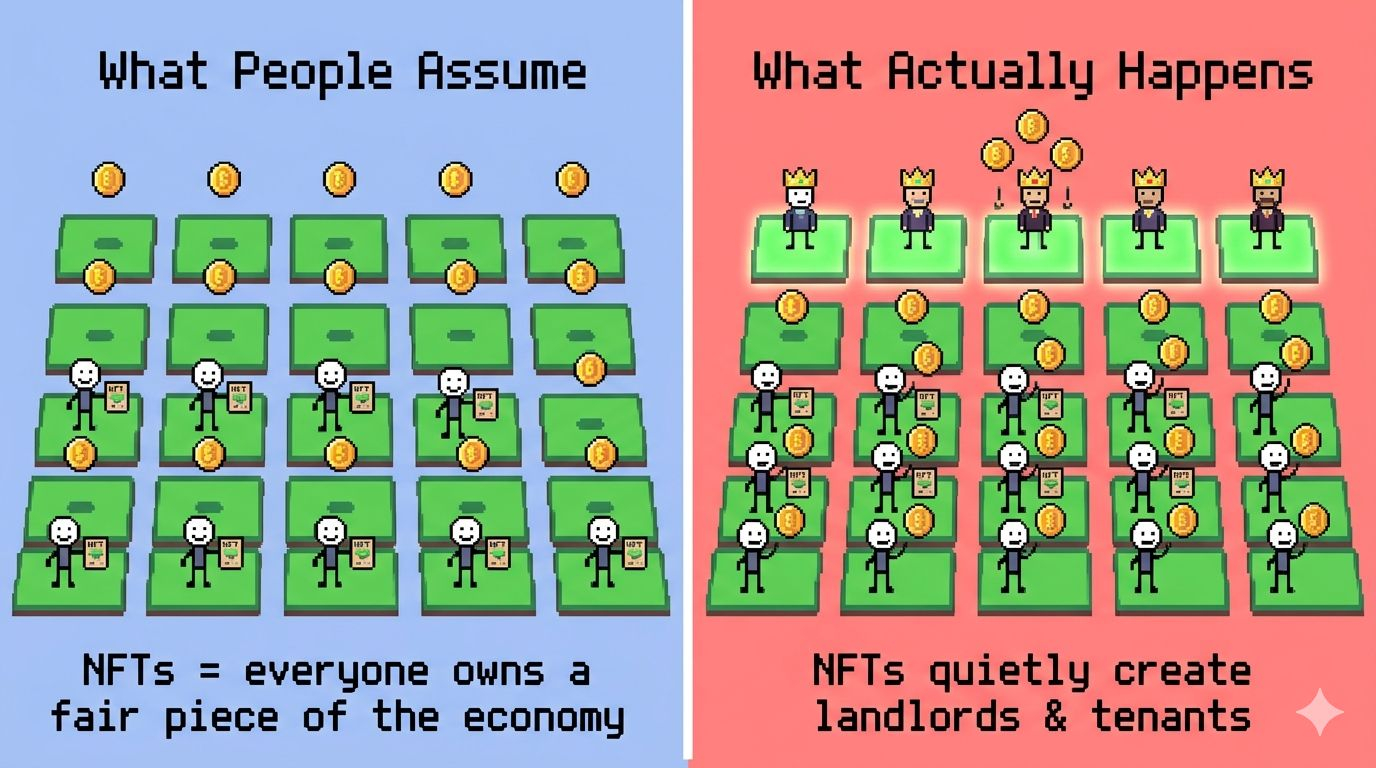
I thought it was supposed to be this beautiful decentralized thing where ownership democratizes everything. I even almost bought a plot last month thinking exactly that. But actually, the mechanism is tighter than it looks: the NFTs create deliberate scarcity at the top so the economic loops have somewhere to anchor. Value doesn’t just appear because pixels exist. It appears because someone owns the dirt everyone else needs to stand on.
Here’s the part that still bothers me, though. If the whole digital economy in Pixels is really built on this landlord-tenant split, how sustainable is it once the early NFT crowd cashes out or gets bored? I’ve seen the floor prices climb enough that new players are already feeling the gate. What happens in the next real dip when the grinders decide the rent—whether in time or BERRY—isn’t worth it anymore? The model works right now because the imbalance forces activity, but that same imbalance could turn brittle fast. I’m not fully convinced it scales without eventually squeezing the very players who keep the machine running.
It matters most to the people who got in early with the land; they’re the ones whose $PIXEL stacks quietly compound while everyone else is still calculating break-even hours. It matters to the casual farmers like me who keep discovering the hidden friction every time we hit a yield wall. And it matters whenever the broader market mood turns quiet like today—because that’s when you see whether the player-driven loops actually carry weight or whether it all still needs fresh money and fresh hype to stay afloat.
I closed the game after one last harvest, switched back to the charts, and just sat there for a minute. The numbers hadn’t moved. But now I’m looking at Pixels differently, wondering how long this particular flavor of ownership can keep the economy feeling alive before the hierarchy starts to show its cracks. I’ll probably just watch how it plays out.
@Pixels #pixel