
I want to talk about the watering mechanic
Not because its the most exciting feature in the game
But because I think it is the most honest signal the design team has sent about what kind of experience they are actually trying to build
Every crop in Pixels moves through four distinct growth stages and dies permanently if the player misses a single watering at any of those stages
In a genre where most games automate resource gathering to keep players feeling productive the conscious decision to build in a failure condition that punishes inattention tells me something specific about the intent behind this product
They want real players not idle accounts
The energy economy reinforces that reading in ways that compound on each other interestingly
The daily cap sits at 1000 units regenerating passively at 033 per minute which works out to roughly 20 units per hour without intervention
A fully passive player accumulates energy overnight but the serious farmer is using active restoration methods to stay ahead of the cap
The Sauna inside Terravilla regenerates 4 energy per minute while the player is online and physically present in that space
The VIP Lounge drops 400 units every 8 hours for subscribers
Crafted food items restore energy at rates that scale with the complexity of the recipe and the skill level required to produce them
The system is designed so that players who understand it and engage with it actively outperform players who treat it passively
That sounds obvious until you realize how rare that design choice is in Web3 gaming where most projects reward wallet activity not player attention
And the Taskboard is where this behavioral design gets genuinely sophisticated in a way I havent seen discussed seriously
Daily tasks reset every 24 hours and reward completion with tokens and Reputation Score increases across categories including farming mining cooking crafting and social interactions
The task categories are not random
They are a daily curriculum that pushes players to engage with multiple skill trees simultaneously rather than grinding a single resource loop into the ground
A player who only farms misses cooking tasks
A player who only crafts misses mining tasks
The Taskboard is quietly teaching players the breadth of the game economy by making broad engagement the most efficient path to daily rewards
Thats curriculum design dressed up as a quest board
The Reputation Score system deserves a full analysis that it almost never receives because most coverage treats it purely as an anti-bot mechanism
It functions as one but the behavioral implications go further than fraud prevention
Trading with other players requires reaching 1200 Reputation points
Accessing the full marketplace requires higher thresholds still
Creating a guild costs 15 tokens on top of meeting Reputation requirements
What this creates is a credentialing layer where economic participation expands progressively as players demonstrate sustained engagement with the game over time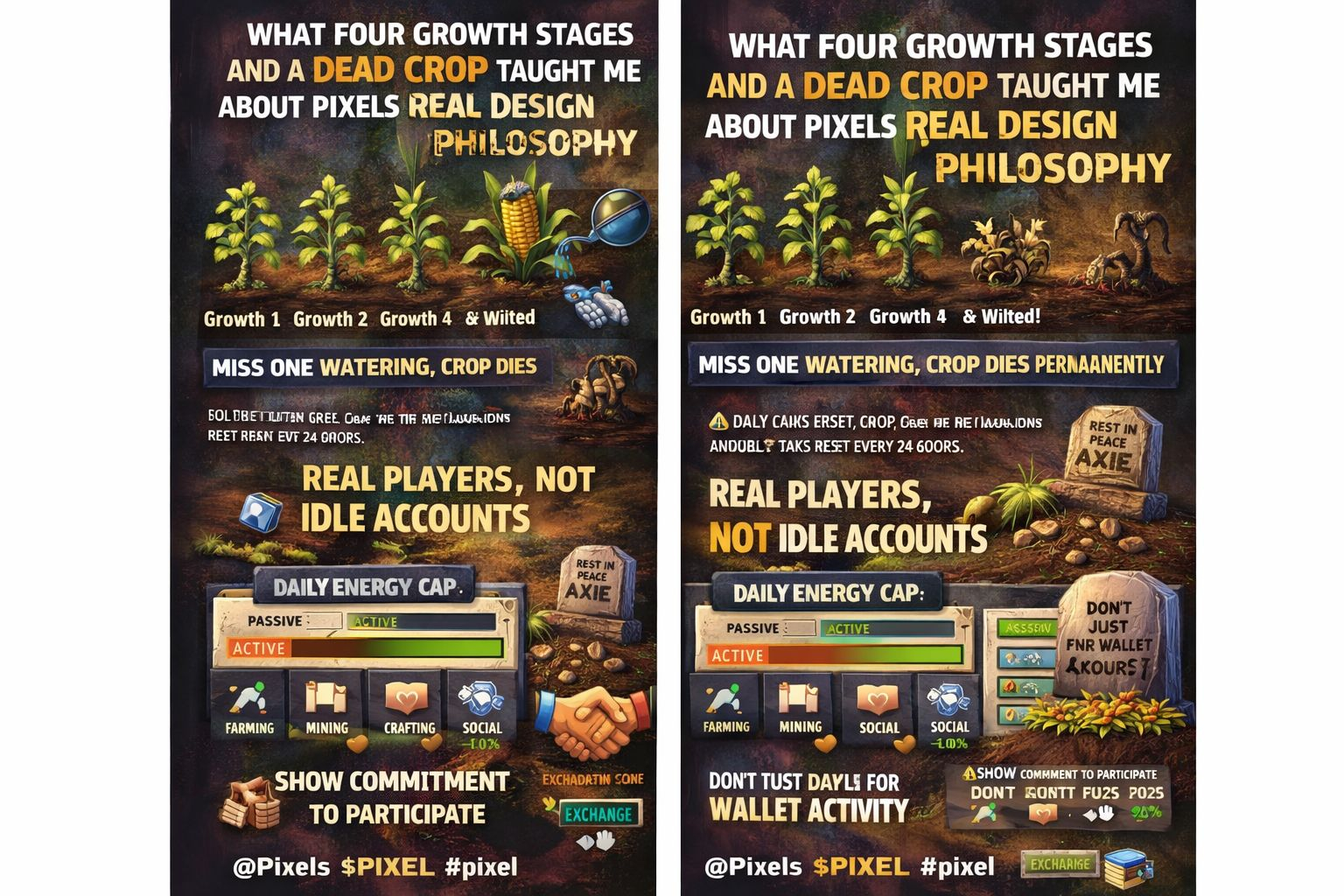
A new wallet cannot immediately extract value from the economy even if it has tokens to spend
Extraction requires demonstrated participation first
That inversion of the typical Web3 onboarding sequence is architecturally significant
Now here is where I want to address the Axie Infinity comparison directly because I think it is being made lazily by analysts who see a farming game on Ronin and assume the story ends the same way
Axie collapsed for three specific interconnected reasons
Token emissions outpaced new player entry creating inflation that destroyed purchasing power for in game assets
The scholarship model concentrated economic power among a small number of managers who extracted value from a large number of scholars with no ownership stake
And the gameplay loop was shallow enough that players had no reason to stay once token rewards fell below the opportunity cost of their time
Pixels has addressed the first problem by rebuilding the economy around off chain Coins with controlled emission
The third problem is being addressed through crafting depth seasonal content and the competitive Union system
The second problem is the one I watch most carefully because the landowner dynamic I described previously rhymes with the scholarship model in ways the community should pressure the team to address explicitly
One rhyme is not a destiny
But it deserves watching
The Union competition system introduced in Chapter 3 called Bountyfall is the most significant social design addition since the original guild mechanics launched
Three factions named Wildgroves Seedwrights and Reapers compete for control of Yieldstone territories with prize pools that scale based on actual player participation volume
This is not a leaderboard competition where the same whale wallets claim top positions every cycle
Territory control requires coordinated group activity which means the competitive layer genuinely rewards organization and social coordination over individual capital size
A well organized group of moderate players can outcompete a poorly coordinated group of wealthy ones if their collective farming output is higher
That dynamic is how you build faction loyalty that survives a bear market
The cross ecosystem integration strategy is the thread I find most strategically interesting in @Pixels 2025 and 2026 roadmap
The Forgotten Runiverse collaboration distributed 25 million tokens to players through a joint event
Sleepagotchi integrated token payments and pulled 8 million tokens into staking in its first week
The Stacked platform that started as an internal retention tool and now licenses to external studios is the most ambitious pivot the team has made because it repositions the entire project from game to infrastructure provider
A studio building on Stacked infrastructure and integrating token staking becomes a distribution channel for the existing player base
Every new game that joins the ecosystem is a reason for existing players to stay connected to the token layer even when the farming loop feels repetitive
The platform bet is bigger than the game bet at this point
But the question I keep returning to in April 2026 is whether the player who reaches level 100 across multiple skill trees has a satisfying answer to what comes next
The crafting chains at the highest tiers require Space environment resources like Voidtonium and Astracactus that only a fraction of the 5000 NFT plots produce
The most complex recipes in the cooking and winemaking systems require ingredients that cross multiple environment types and multiple skill disciplines to source
A master level crafter is genuinely dependent on a network of other players to access their full recipe library
That interdependency is elegant design
It just needs more players to reach mastery before it becomes visible
My read on $PIXEL in April 2026 is that the token is carrying the weight of a platform transition that the market has not yet priced correctly in either direction
The game mechanics are more sophisticated than the price suggests
The vesting pressure is more sustained than the community acknowledges
And the mobile gap for a player base that is 18 percent Filipino and heavily concentrated in Southeast Asia and Latin America remains the single most damaging unforced error this team is sitting on
The watering mechanic kills your crops if you ignore them
The mobile gap is doing the same thing to the teams addressable market
