

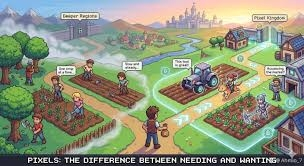
At first, @Pixels doesn’t feel like a system that’s trying to control anything. It feels open. Calm, even. You can log in, move around, farm, craft, and repeat without ever feeling pushed in a specific direction. There’s no urgency, no aggressive monetization pressure, no obvious “best path” being forced on you.
For a while, that illusion holds.
But the longer you stay, the more you start noticing something subtle: not all players are progressing in the same way. It’s not about speed. It’s not about who clicks faster or grinds longer. Some players just seem to land in better situations more consistently - better boards, better chains, better outcomes. And it doesn’t feel random.
That’s where the perspective shifts.
We’re used to thinking about game economies as systems that reward volume. Do more, get more. That model is simple, and it’s also why most play-to-earn systems eventually break. When everything is rewarded equally, players optimize for the easiest loop, repeat it endlessly, and drain the system without adding anything meaningful back.
Pixels doesn’t fully behave like that.
Instead of rewarding everything, it seems to be filtering. Certain behaviors expand over time, while others stay stuck in place. And it doesn’t announce this directly. You don’t get a message telling you what you did right or wrong. You just feel it, in the way some loops start compounding while others quietly flatten out.
That’s where PIXEL becomes more than a simple reward token. It starts to feel like a signal, a way the system reinforces specific patterns of behavior. Not by forcing you, but by making some paths naturally lead further than others.
It’s similar, in a way, to how platforms like TikTok or YouTube operate. They don’t treat all content equally. They amplify what they can scale. Creators adapt without always understanding why something works. Over time, behavior shifts to align with what the system favors.
Pixels feels like a slower, less visible version of that.
But the deeper layer only shows up when you try to move value out.
Inside the game, everything is smooth. Actions never get rejected. Coins flow endlessly. You can stay active forever, and the system keeps accepting your input. It creates the impression that earning is continuous and unrestricted.
Then you try to take that value beyond the loop.
That’s when the friction appears.
Moving value through something like Ronin Network doesn’t feel as seamless. Some rewards translate cleanly. Others don’t. Some sessions convert into something tangible, while others feel like they lose coherence the moment they try to leave the system.
And that’s when it becomes clear: earning inside Pixels and extracting value from it are not the same process.
The Task Board might show you a chain that leads to $PIXEL, but that doesn’t mean that chain was equally supported underneath. Some paths are backed by actual reward pools with enough depth to sustain exits. Others exist, but don’t carry the same weight when it comes to turning activity into ownership.
This is where a hidden layer starts to matter, something like a Trust Score or behavioral filter. Not a hard gate, but a soft one. It doesn’t stop you from earning, but it affects how smoothly that earning translates into something real.
Over time, this changes what you’re actually optimizing for.
You’re not just chasing better tasks or higher rewards anymore. You’re aligning, consciously or not, with the parts of the system that consistently receive support. The loops that keep getting funded. The behaviors that keep getting recognized.
And that’s a very different kind of game.
Because now, you’re not just playing for rewards. You’re playing for permission.
Permission for your activity to carry weight. Permission for your rewards to persist. Permission for what you earn to behave like something you actually own.
That’s also why the system holds together better than older models. It doesn’t allow unlimited extraction. It doesn’t treat every action as equally valuable. It filters, shapes, and slows down the flow of value so that only certain patterns scale cleanly over time.
But that design comes with a trade-off.
It makes the system harder to fully understand from the inside.
You can feel when things are working. You can sense when you’re landing in better positions. But you don’t always know why. And that uncertainty shifts the experience from simple gameplay into something closer to interpretation.
Which leads to a question that doesn’t have a clean answer:
If reaching $PIXEL isn’t the finish line, then when does it actually become yours?