
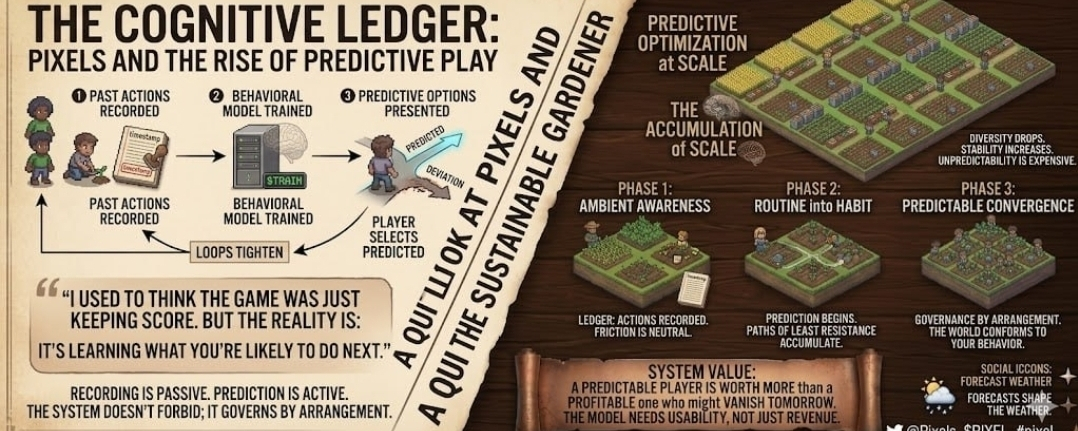
I used to think the game was just keeping score. You plant, you harvest, you craft—each action logged, each reward dispensed. The system felt like a ledger. Clean. Neutral. A record of what happened, nothing more.
But the longer I played, the more that explanation started to fray. Not because anything broke. Because certain things kept happening before I did them. The way a task seemed to surface just as I was about to look for it. The way friction softened on routines I'd repeated enough times. The way the world felt less like it was reacting to me and more like it was waiting for me—already shaped to receive the action I hadn't taken yet.
That's when I realized the system wasn't just recording. It was predicting. And the difference changes everything about what it means to be a player inside it.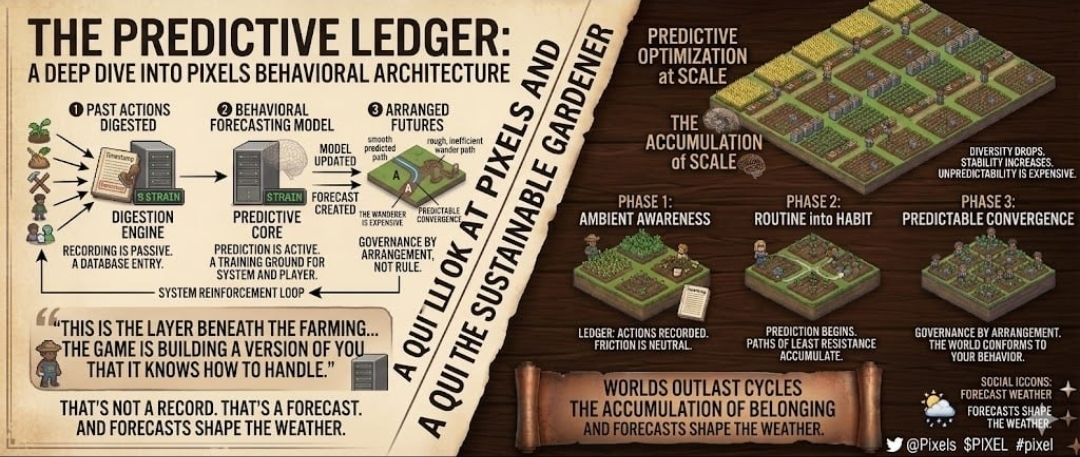
Recording is passive. A database entry. Timestamp. Action type. Reward issued. Prediction is active. It's the system building a model of who you are based on what you've done, then using that model to shape what happens next. Not dramatically. No pop-up says "we've anticipated your next move." But the small optimizations accumulate. The path of least resistance gets smoother. The world begins to conform to the shape of your behavior, and you barely notice because it feels like progress.
This is where the language we use fails us. We call it "personalization." We call it "player experience." We call it "the game feeling good." But what's actually happening is closer to training a model—and being trained by it in return. The system learns your patterns. Then it presents options that align with those patterns. You select from those options, which reinforces the pattern. The loop tightens. The possibilities narrow. Not because anything is blocked, but because the frictionless path becomes so appealing that wandering off it feels like inefficiency.
I've seen this dynamic in other places. Recommendation algorithms. Search predictions. The quiet way a feed reshapes itself around what you've clicked before. Pixels isn't a feed, but the underlying mechanics rhyme. The more you play, the more the game knows what you're likely to do next. And the more it knows, the more it can arrange the world to meet you there.
The uncomfortable question is what happens to the version of you that might have done something else. The player who would have explored a different corner of the map. Who would have tried an inefficient crop rotation just to see what happened. Who would have wandered. That player still exists, technically. Nothing stops them. But the friction of deviating from the predicted path increases silently. The smooth road is right there. The rough one takes effort. Most people take the smooth road. Most people don't even notice they're choosing.
This matters because prediction, at scale, becomes a form of governance. Not governance by rule. Governance by arrangement. The system doesn't need to forbid anything. It just needs to make certain behaviors easier than others. Over time, the player base converges toward the behaviors the model can process most efficiently. Diversity drops. The world becomes more manageable but less surprising. More stable but less alive.
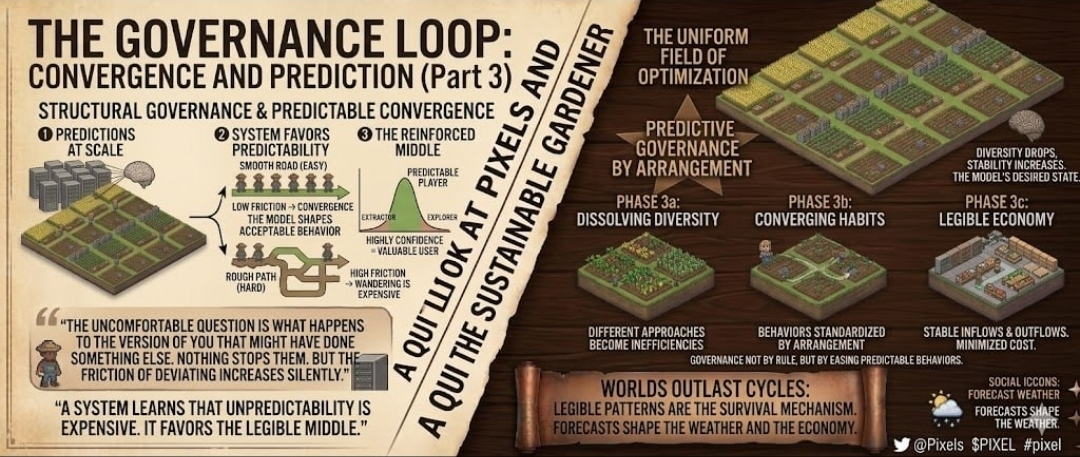
I don't think this is malicious. I think it's structural. A system that survives its first growth cycle learns that unpredictability is expensive. Extractors are unpredictable in one way—they drain and leave. Explorers are unpredictable in another—they don't optimize, they drift. Neither fits neatly into an economy that needs to balance inflows and outflows. So the system learns to favor the predictable middle. The player who logs in regularly. Who completes similar tasks. Whose behavior becomes legible enough that the model can anticipate them with high confidence.
That player is valuable. Not because they spend the most or earn the most. Because they're usable. Their time can be structured. Their patterns can be relied upon. In a system that depends on stability, a predictable player is worth more than a profitable one who might vanish tomorrow.
This is the layer beneath the farming. Beneath the tasks. Beneath the token. The game looks like a world. But it's also a training ground—for the player, yes, but more importantly for the system that's quietly learning what you'll do before you do it. Every session feeds the model. Every routine makes you more legible. Every small alignment between your behavior and the system's expectation tightens the loop a little further.
I'm not saying this is wrong. I'm saying it's happening. And once you see it, you can't unsee it. The game isn't just keeping score. It's building a version of you that it knows how to handle.
That's not a record. That's a forecast. And forecasts shape the weather.