
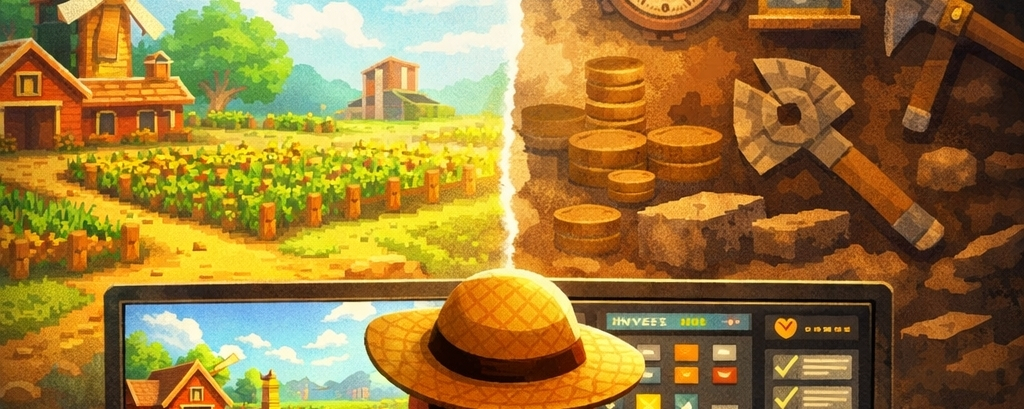
Pixels didn’t hook me because of the world or the token. If I’m honest, it crept in through something quieter… the way it slowly reshaped how I think while playing.
At the start, I treated it like any familiar loop. Farm, craft, earn, repeat. No friction, no real reflection. Just movement. But over time, that rhythm started to feel off. Not because the game changed suddenly, but because rushing stopped being efficient.
Somewhere around Tier 5, things tighten.
Resources don’t feel disposable anymore. Every action starts carrying weight. You notice that using something immediately isn’t always the smartest move. Sometimes holding it, or even breaking it down, creates more value than pushing forward. That’s when the shift happens… not in the mechanics, but in your mindset.
New players still move on impulse. They do everything, collect everything, stay active. It feels natural. But experienced players don’t behave like that. They pause more. Skip actions. Think in terms of trade-offs instead of progress.
And the game never explicitly asks for this. There’s no instruction telling you to optimize. But if you ignore it, you feel it. Progress slows, outcomes feel off. So players adapt on their own. They start tracking decisions, testing different approaches, even making choices that look inefficient just to understand the system better.
At that point, it doesn’t quite feel like “playing” anymore. It feels like managing something.
That’s where it gets complicated.
Because this is also what makes Pixels interesting. It avoids the usual shallow loops. You can’t just grind without thinking. The system quietly pushes back through scarcity, timing, and how resources cycle. It demands a bit more awareness.
But that awareness changes the experience.
The fun becomes less about constant action and more about careful decisions. It’s quieter. More internal. Sometimes the best move is to wait, or to do nothing at all. And that’s a strange feeling in a game environment.
It reminds me of real-life habits. Like when someone starts taking budgeting seriously. At first, spending is casual. Then awareness kicks in, and suddenly every decision feels deliberate. You pause, you think ahead, you weigh outcomes.
Pixels creates a similar shift.
So now it feels like two layers exist at once. One where everything is open and exploratory. Another where everything is calculated and intentional. New players exist in the first. Veterans settle into the second.
Maybe that transition is the real design.
Not just to entertain, but to move players from acting freely… to thinking in systems.
And that leaves me with a question I keep circling back to.
If a game slowly trains you to prioritize value over experience, to think before acting, to sometimes do nothing at all…
are you still playing, or are you learning how to function inside an economy that just happens to look like a game?