
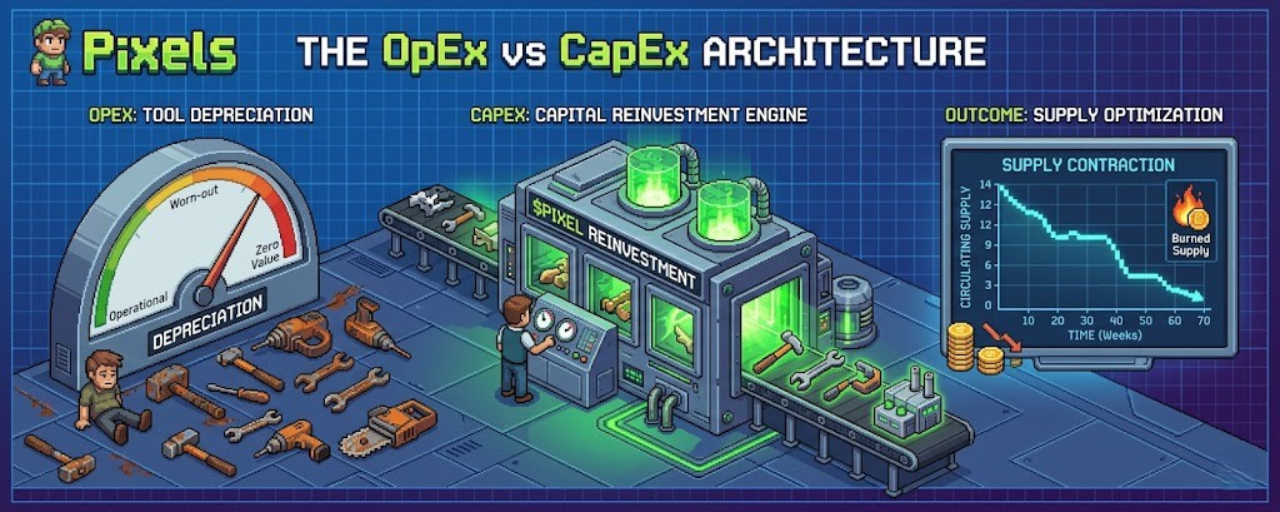
Most Web3 gaming projects failed because they were built on a fundamental economic flaw: infinite supply with static infrastructure. After a technical audit of the Chapter 3 mechanics and the updated Pixels ($PIXEL) Litepaper, it is evident that the development team is implementing an Operating Expenses (OpEx) model - a standard in traditional IT business that has been historically absent from GameFi.
1. The Transition from CapEx to OpEx: Survival Economics
In the "Play-to-Earn 1.0" model, players made a one-time investment (Capital Expenditure - CapEx) by purchasing an NFT tool that generated yield indefinitely. This inevitably led to hyper-inflation.
Pixels is radically shifting the paradigm through Crafting Durability (the degradation of tools and stations).
The Mechanic: Production stations and tools now have a finite lifespan.
The Economic Impact: Players are required to constantly reinvest a portion of their earnings into repairing or replacing infrastructure. This transforms the game from a "printing press" into a functional business simulation where Operating Expenses (OpEx) are mandatory for participation.
2. Progressive Speck Upgrades: The Infinite Liquidity Sponge
One of the most powerful stabilization tools in the $PIXEL ecosystem is the Speck Upgrade system. According to the technical documentation, land plots can expand indefinitely, but they do so with exponential cost scaling.
This creates a "Golden Cage" for large capital holders:
Instead of extracting tokens to the open market, rational actors are incentivized to unlock higher-tier recipes (T3/T4).
Each subsequent upgrade tier absorbs more tokens than the last, creating a natural Contraction of Supply as the player base matures.
3. Treasury Logistics and the 80/20 Split
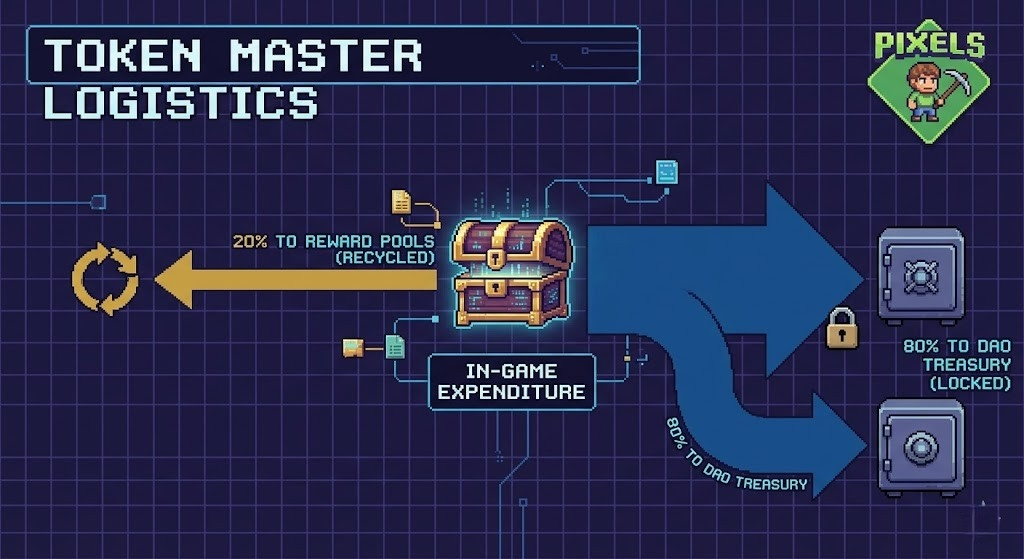
The distribution of $PIXEL ent in-game has been re-engineered to follow a strict 80/20 formula:
80% is directed to the Community Treasury (DAO), effectively removing it from the active circulating supply.
20% is recycled back into Ecosystem Rewards, ensuring the replenishment of pools for future growth.
This split ensures that during periods of high economic activity, the aggregate supply of tokens contracts faster than new emissions are generated. This is the definition of a Supply-Side Sink.
Conclusion: Mathematics over Emotion
Pixels has evolved beyond a social farming game. It is now a Management Protocol for Scarcive Resources. By embedding asset depreciation and progressive expenditure into the core loop, Pixels addresses the "Death Spiral" that plagued previous GameFi models.
In a market saturated with projects selling hope, Pixels is selling engineering resilience.