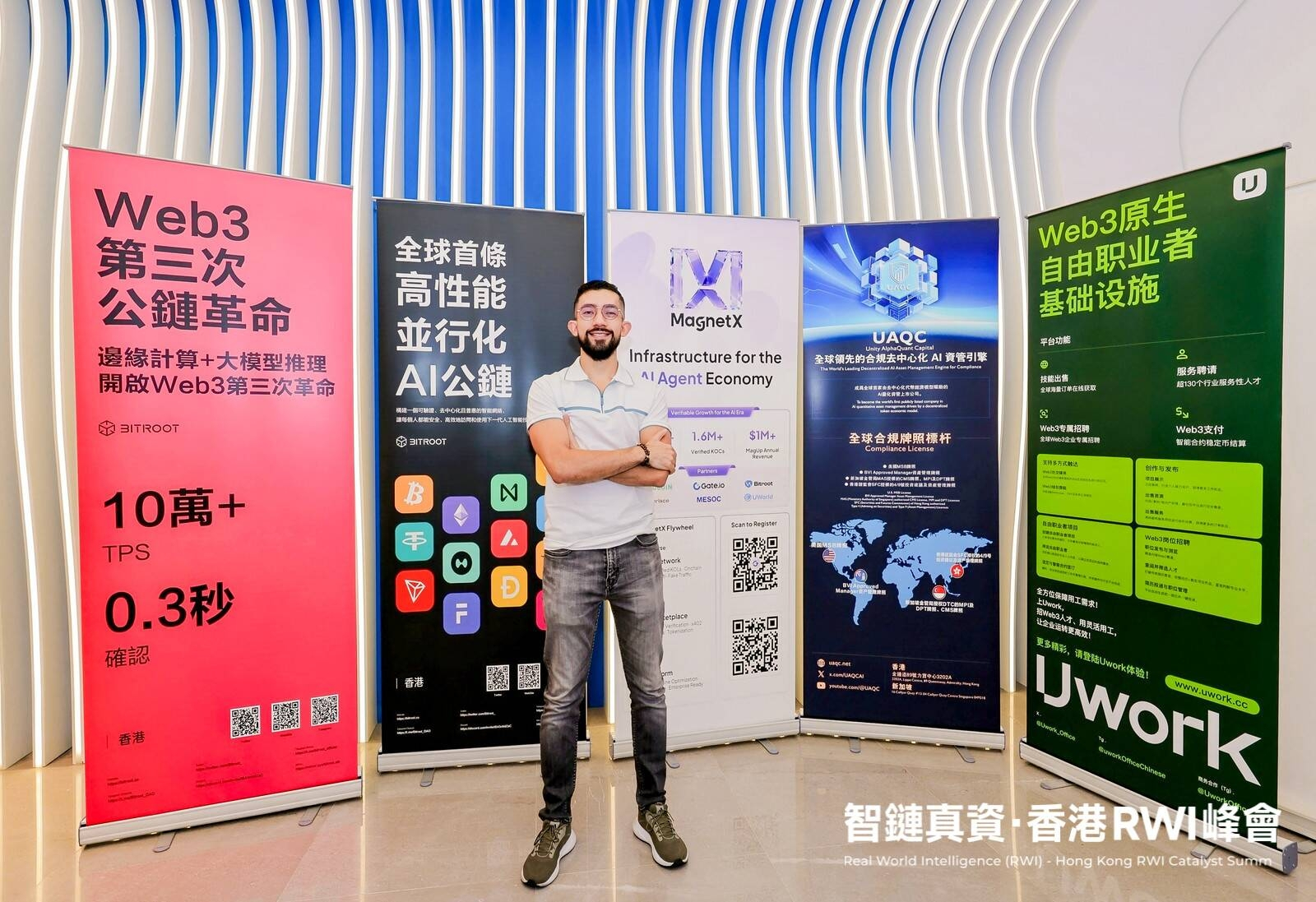
📊 In-depth analysis of Bitroot's post content
This is a post about the Web3+AI (Decentralized AI/DeAI) sector, focusing on the value proposition of the Bitroot blockchain. We will dive deep into four dimensions: surface information, industry pain points, technical logic, and business vision.
1. Surface Information: Core Messaging Breakdown
1. Tag Positioning (Sector Tags)
Directly anchors the project's core sector: AI Infrastructure + Decentralized AI + Web3 development.
The target audience is crystal clear: AI developers, Web3 builders, and DeAI sector professionals.
2. Core Text Translation and Literal Translation
Stop reinventing the wheel, start building based on Bitroot. 🛠️
For a long time, AI developers have been struggling with decentralized computing resources and clunky on-chain smart contracts. Bitroot revolutionizes this situation by embedding core AI components directly into the protocol infrastructure.
Native interface: Provides seamless, out-of-the-box support for mainstream AI models.
Smooth interaction: A native communication layer for AI agents—no more cross-chain friction.
Optimize supply: Automatically match the most cost-effective computing power.
When the infrastructure is so mature, you can put 100% of your energy into what truly matters: innovation.
2. Deep Logic: Precisely hitting the industry's pain points.
Every sentence in the post corresponds precisely to the core dilemmas of current on-chain AI/decentralized AI (DeAI) developers:
1. The current state of 'reinventing the wheel' in the industry.
Current developers in the AI + Web3 track face the biggest problem of fragmented infrastructure:
To create on-chain AI Agents, you need to adapt different public chains' EVMs, solve cross-chain communication, interface with distributed computing power, and encapsulate AI model calling interfaces. 90% of your efforts go into low-level adaptations instead of product innovation.
Bitroot's core assertion: I've built a solid underlying AI infrastructure, you can develop directly on my chain without reinventing the wheel.
2. The core pain point of 'distributed computing resources + clunky smart contracts'.
This is the real dilemma for DeAI developers:
Distributed computing resources: AI inference/training requires a large amount of computing power, but on-chain computing power is scattered across different nodes and public chains, requiring developers to self-connect, schedule, and settle, which is extremely costly.
Smart contracts are clunky: Traditional public chains (like Ethereum) have EVMs designed for financial transactions, do not natively support AI computing, developers need to bypass on-chain performance bottlenecks with complex cross-chain and oracle solutions, leading to poor experience, high costs, and weak security.
Bitroot's solution: AI native architecture (AI-EVM) embeds AI components into the public chain from the ground up, allowing smart contracts to natively support AI calls, fundamentally solving adaptation issues.
3. Technical Selling Points: In-depth breakdown of three core capabilities.
1. Native Interface: Seamless support for mainstream AI models.
Technical essence: Bitroot has made AI native extensions (AI-EVM) at the EVM layer, embedding standard calling interfaces for AI Agents, allowing developers to call mainstream large models like GPT and Claude directly on-chain, achieving 'out-of-the-box'.
Industry value: Solved the problem of 'difficulty in calling on-chain AI models', enabling average Web3 developers to quickly develop on-chain AI applications, thus lowering the development threshold.
2. 'Native Communication Layer: Eliminating cross-chain friction'
Technical essence: Bitroot natively integrates an AI Agent's cross-chain communication protocol, solving the current DeAI's 'chain island problem'—AI Agents on different public chains cannot interconnect, and developers need to create cross-chain bridges and messaging, leading to extremely high friction costs.
Industry Value: Achieved native cross-chain interaction for AI Agents, allowing on-chain AI to collaborate freely in a multi-chain ecosystem, providing the infrastructure for the birth of 'Super AI Applications'.
3. Automatically match optimal computing power: Optimize supply.
Technical essence: Bitroot has built a distributed AI computing power scheduling network that can automatically match the lowest cost and highest efficiency idle computing power globally, providing low-cost and highly available computing resources for AI inference/training.
Industry value: Solved the issues of high AI computing costs and resource waste, allowing developers to obtain computing power at the lowest cost while letting idle power owners earn returns, achieving market-based allocation of computing power.
4. Project Positioning and Business Vision
1. Project Essence
Bitroot is not an AI application but a high-performance Layer 1 public chain that is AI native, positioned as the infrastructure layer in the DeAI era, comparable to Ethereum's role in Web 2.0—Ethereum is the infrastructure for DeFi, while Bitroot aims to be the infrastructure for DeAI.
2. Core Differentiation
Compared to other high-performance public chains (like Solana, Avalanche) and AI public chains (like Fetch.ai, SingularityNET), Bitroot's core differentiation.
Traditional high-performance public chains have high TPS and low Gas but do not natively support AI. The native AI-EVM architecture adapts AI computing from the ground up.
Traditional AI public chains focus on AI models/Agents, have weak public chain performance, parallelized EVM with 0.4s ultra-fast consensus, balancing performance and AI native.
Centralized AI cloud services have concentrated computing power and data, while decentralization, verifiability, and on-chain rights confirmation align with Web3 values.
3. Business Ambition
Short-term: Attract DeAI developers to build applications based on Bitroot, creating a DeAI ecosystem.
Mid-term: Become the 'infrastructure leader' in the DeAI track, catering to global on-chain AI's computing power, models, and application needs.
Long-term: Restructure the underlying architecture of AI, breaking the monopoly of centralized AI giants on computing power and data, achieving large-scale implementation of 'decentralized AI'.
5. Industry Background: Why is this track hot right now?
1. Intersection of Technologies: The wave of AI + Web3 integration.
The bottleneck of AI: centralized AI giants monopolizing computing power and data, developers and users are choked, with prominent issues in privacy, compliance, and value distribution.
The bottleneck of Web3: Traditional public chain performance is insufficient, natively does not support AI, unable to bear AI-level computing demands.
Bitroot's opportunity: Use 'AI native public chains' to bridge both sides, solving the decentralization issue of AI while addressing the AI adaptation issues in Web3.
2. Market demand: The explosion of AI Agents.
2025-2026 is the explosion period for AI Agents, with a surge in demand for on-chain AI Agents (like DeFi advisors, NFT trading, on-chain automation tools), developers urgently need a public chain that natively supports AI, and Bitroot has hit this trend spot on.
6. Open Questions
1. Technical implementation risk: AI-EVM, native cross-chain communication, and computing power scheduling are complex technologies that need to verify actual performance and stability.
2. Ecological competition risk: Public chains like Ethereum and Solana are also laying out native AI upgrades; Bitroot needs to quickly establish ecological barriers.
3. Regulatory risks: Decentralized AI involves computing power, data, and models, which may face uncertainties in global regulations.
💡 Summary
It precisely captures the core pain points of DeAI track developers, using 'AI native infrastructure' positioning to attract developers to abandon reinventing the wheel and instead build applications based on Bitroot.
- Its core value is attempting to reconstruct the underlying infrastructure of AI, transitioning from 'monopoly by centralized giants' to 'decentralized, verifiable, and user-built Web3 era'.