
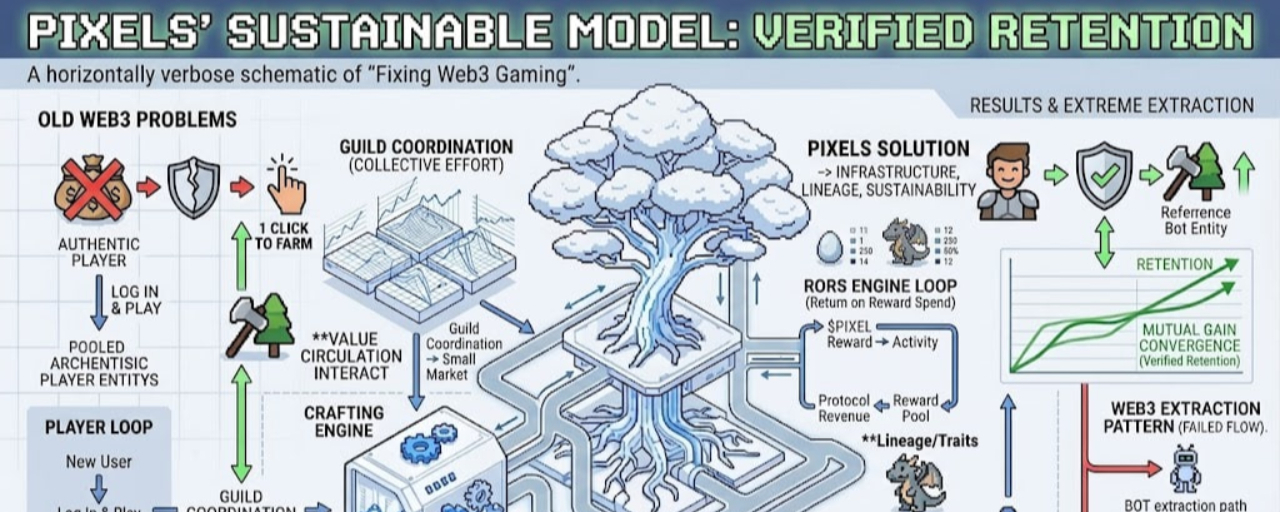
I've been rugged enough times to smell extraction from a mile away.
Early wallet eats. Late wallet bleeds. Bots farm while humans sleep.
The chart pumps on hype, then flatlines into a ghost town Discord.
That's not a bug. That's the whole damn system.
So when I first heard about Pixels, I rolled my eyes. Another Web3 game? Another token? Another promise about ownership? I've been burned by that pitch more times than I can count. Most of these projects aren't economies—they're vending machines with prettier interfaces. You insert attention. You receive a token.
You sell it to someone who arrived later than you. The music stops. We've all seen this movie. We know how it ends.
But then I actually stayed in Pixels. And something felt off—in a good way.
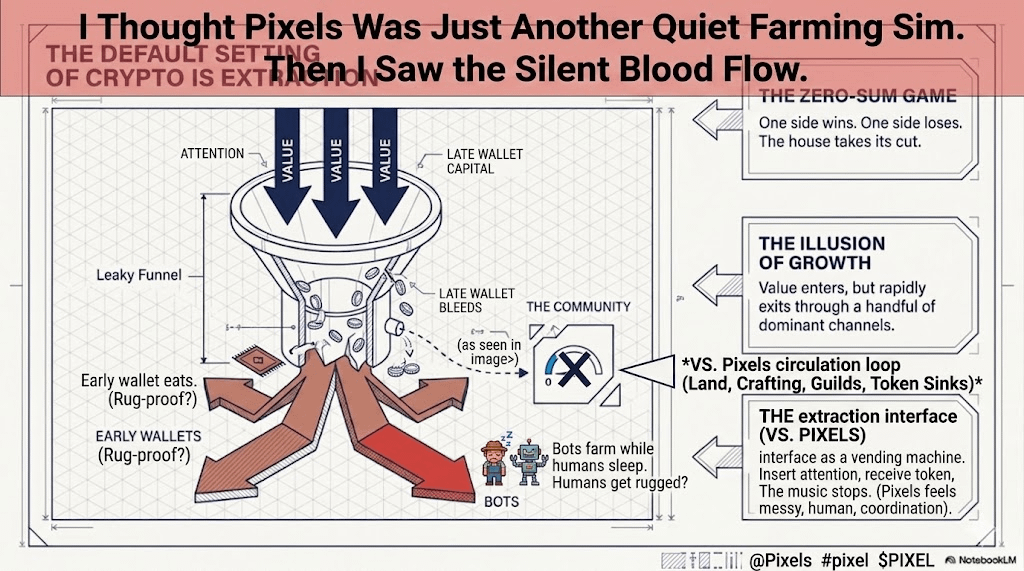
Farming is bait. I realized that fast. The real game isn't planting crops. It's land ownership. Not a cosmetic flex—control. You decide what gets produced, who interacts, how value moves. Early players who grabbed land? They're not just playing. They're permanently ahead. Everyone else rents, reacts, catches up. I've seen this before in other spaces—$SUI had its own land grab moment, but that's a different story. Here, the land isn't speculation. It's infrastructure.
Then there's crafting. That's the engine. Farming just feeds it. Players need what you make—tools, upgrades, resources. Suddenly it's not a game system. It's a small market. Undercutting, hoarding, supply squeezes. Messy. Human. And it works. I've watched solo players grind for days while guilds move past them in hours. That's not unfair. That's just coordination.
But here's what really got me. Most Web3 "economies" are designed to extract. Value flows in one direction: from latecomers to early wallets, from humans to bots, from players to the house. Pixels isn't trying to extract. It's trying to circulate. And in a space where everything else bleeds value until there's nothing left, circulation feels almost radical.
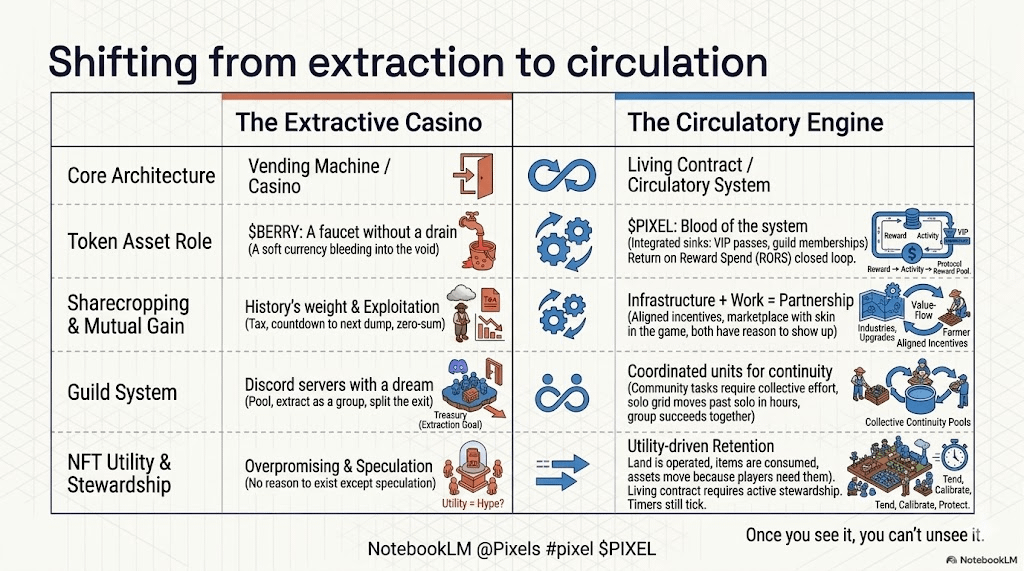
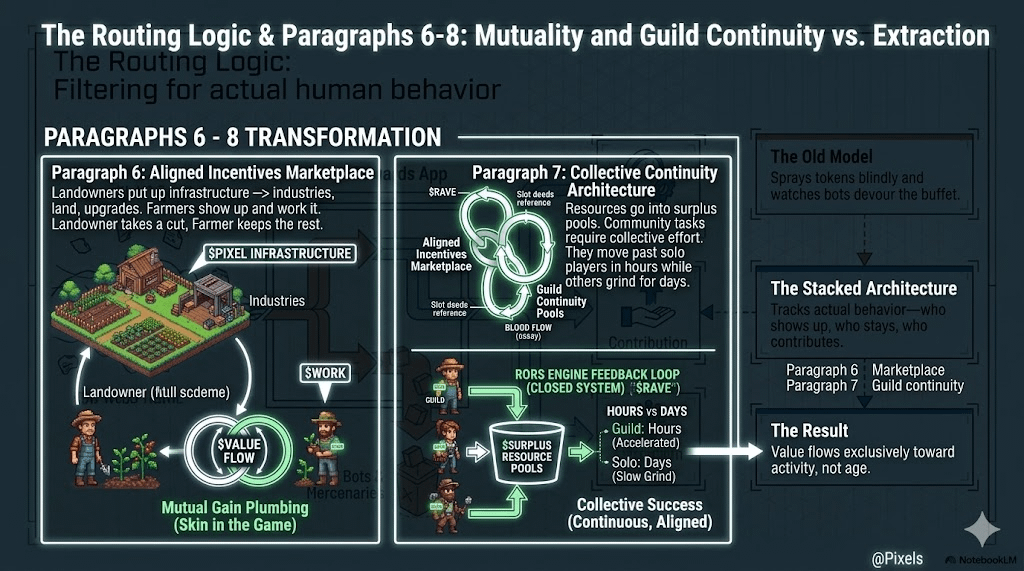
I heard the word "sharecropping" and winced. History's weight. Exploitation dressed up as partnership. But the more I played, the more I saw: landowners put up infrastructure—industries, land, upgrades. Farmers show up and work it. The landowner takes a cut. The farmer keeps the rest. That's not a tax. That's a partnership with aligned incentives. If the farmer wins, the landowner wins. If the landowner neglects the land, the farmer leaves for better soil. Neither side can extract in a vacuum.
I've played games where the "economy" was just a countdown timer to the next dump. This doesn't feel like that. This feels like a marketplace where both parties have skin in the game and a reason to keep showing up.
Guilds? I've been in Web3 guilds before. Most are just Discord servers with a treasury and a dream—extract as a group, then split the exit. People pool resources, sure, but the goal is always the same: get in, get out, leave the bag for someone else. The Pixels guild system feels different. Resources go into surplus pools. Community tasks require collective effort. One player farms, another crafts, another trades.
They move past solo players in hours while others grind for days. The group succeeds together, or the rewards don't materialize. That's not an individual race to the exit. That's a collective race toward continuity. I'm not saying it's perfect. Guilds fracture. Incentives drift. People get greedy. But the architecture itself pushes toward cooperation instead of cannibalization. That's more than most projects can say.
And the NFTs? Most games overpromise. Here, land gets used. Items matter. Utility drives everything—not hype. I've watched too many NFT collections launch with no reason to exist except speculation. Pixels actually ties them into gameplay. Land isn't just owned—it's operated. Items aren't just collected—they're consumed. Assets move because players need them, not because someone said they're "rare." That's a big difference. Utility drives retention. Not hype. Not floor prices.
The token actually does something. I watched $BERRY leak value like a faucet with no drain. A soft currency bleeding into the void. The move to $PIXEL as the primary asset—with real sinks like NFT minting, VIP passes, guild memberships—isn't just tokenomics. It's a statement: we're building for retention, not extraction.
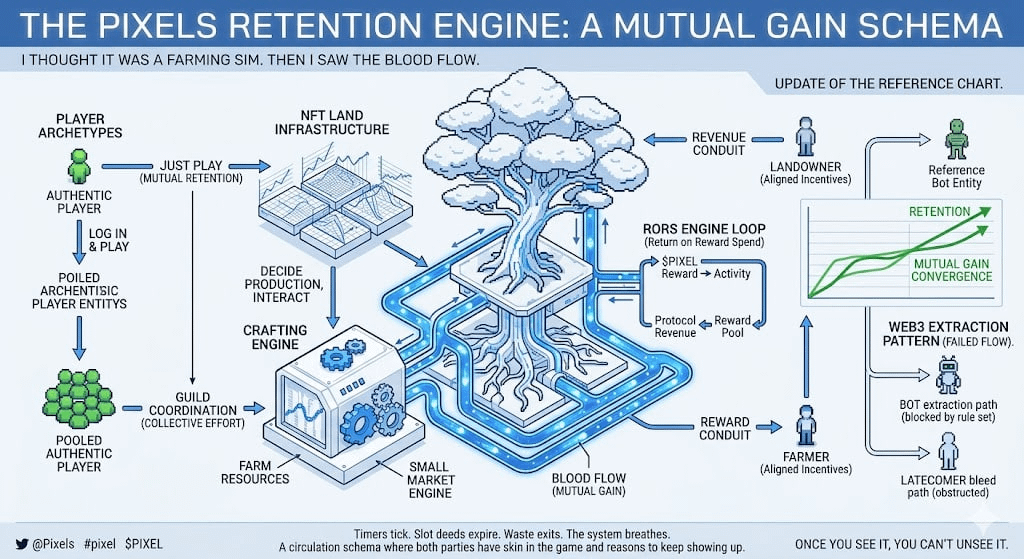
The RORS engine is the part that stuck with me. Return on Reward Spend. The goal is brutally simple: every dollar distributed as a reward should generate at least a dollar in protocol revenue. That's a closed loop. Not a faucet draining into a bucket with a hole. A circulatory system where value moves, transforms, and returns. I've seen AI-driven protocols like $RAVE aim for similar feedback loops, but that's a different beast entirely. Here, it's about keeping players alive, not just validators.
I'm not naive. Mutual gain sounds clean on paper. In practice, it's messy. Landowners set fees too high. Farmers leave for better plots. Guild leaders burn out. The incentives have to be maintained, recalibrated, protected. This isn't a set-and-forget algorithm. It's a living contract that requires active stewardship. But maybe that's the point. A circulatory economy isn't supposed to run itself. It's supposed to be tended. The timers still tick. The slot deeds still expire. The deconstruction loop still asks you to break what you built so something new can grow. That's not a flaw in the design. That's the circulation itself.
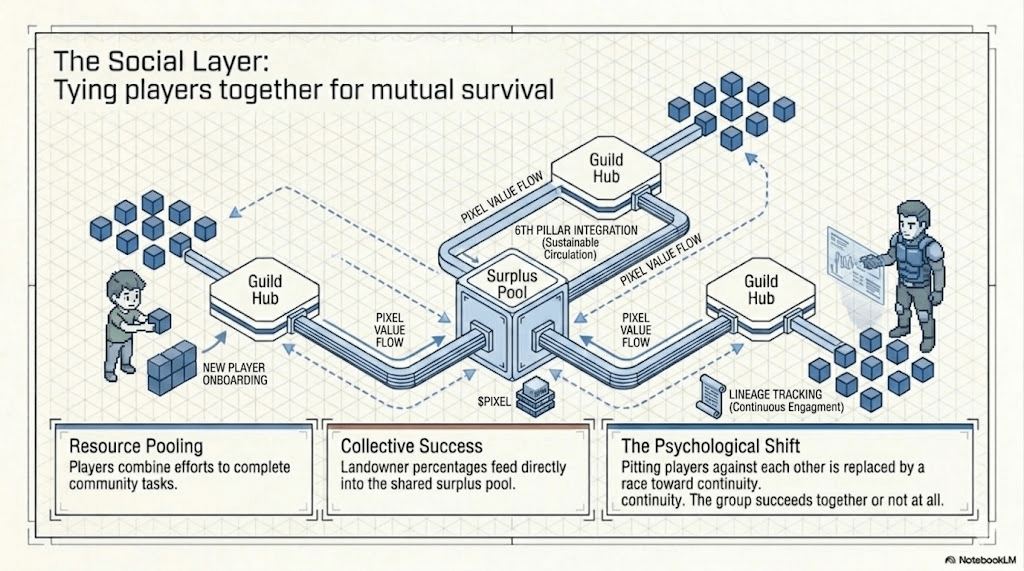
What I'm actually watching for is whether this keeps breathing. Most Web3 projects extract until there's nothing left. Pixels circulates. Blood flows. Waste exits. The system breathes. Landowners win when farmers win. Farmers win when landowners invest. Guilds win when communities form. The token wins when activity persists. That's not a vending machine. That's an economy.
I'm not here to cheerlead. I'm here to observe. And what I'm observing is a project that built mutual gain into the plumbing instead of just putting it on a marketing slide. The timers are still ticking. The blood is still flowing.
Once you see what's underneath? You can't unsee it.