
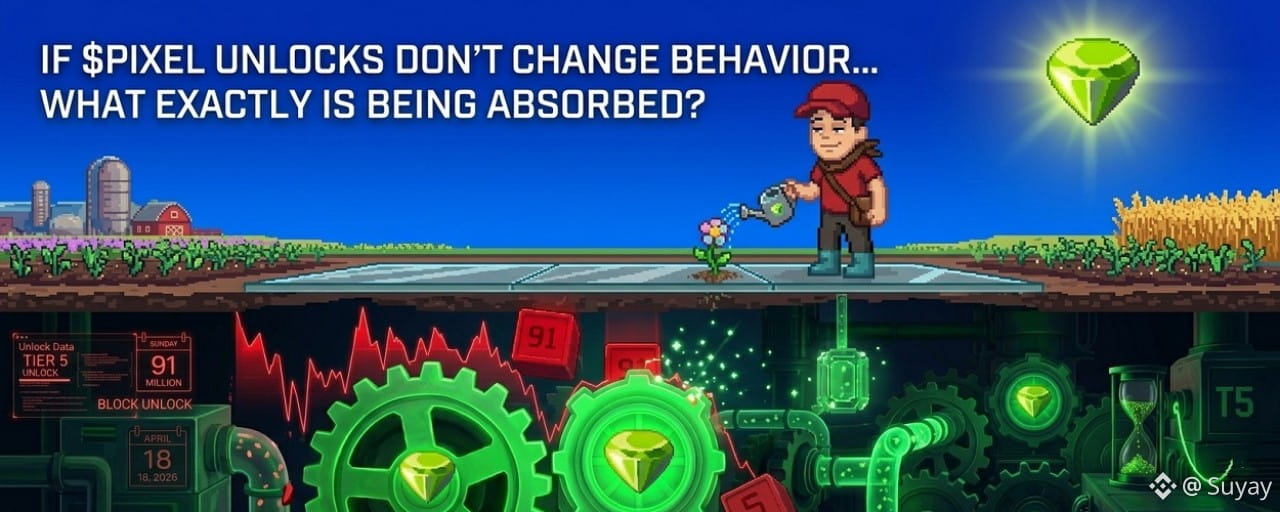

Something feels too stable today. Not in the market, because the numbers are still adjusting after the unlock, price hovering lower, finding what looks like a temporary floor. That part makes sense. What doesn’t fully make sense is how little of that instability seems to translate into how the system feels from the inside.
Usually, after an event like yesterday, especially when new $PIXEL enters circulation at that scale, there’s a period where behavior shifts. Players slow down, rethink what they’re doing, maybe become slightly more cautious without even noticing it. Not dramatically, just enough to feel that something changed. Here, that adjustment is hard to detect. The $PIXEL unlock happened, the price reacted, volume moved, and yet the experience inside Pixels continues almost uninterrupted.
At first, that seems like a good outcome. It suggests resilience, maybe even maturity. A system that doesn’t break under pressure, that can absorb volatility without passing it directly to the player. That was already visible yesterday. But today it feels like something else is happening on top of that.
Because it’s not just that the system absorbed the shock.
It’s that it didn’t create a reason for anyone to adapt after it.
And that’s a different kind of signal.
Stacked keeps adjusting rewards based on behavior, filtering more aggressively what looks like automation, refining how value is distributed in real time. The logic behind it is clear: reinforce patterns that sustain the system, reduce those that don’t. In theory, that should make the environment more efficient, more aligned, less noisy.
But efficiency has a side effect that’s harder to notice.
If the system is constantly correcting itself in the background, if it’s smoothing out the impact of events before they reach the player, then the player stops experiencing the moments where adjustment would normally happen. Not because those moments disappeared, but because they’ve been processed already.
Which means behavior doesn’t need to change.
It just continues.
And that’s where things start to feel slightly off.
Because in most environments, instability forces adaptation. You make a wrong decision, you feel it, you correct. You stay too long, you lose something, you adjust next time. That feedback loop is what shapes how people interact with the system over time.
Here, that loop feels… softer.
Not absent, but less visible. Less immediate. Almost delayed.
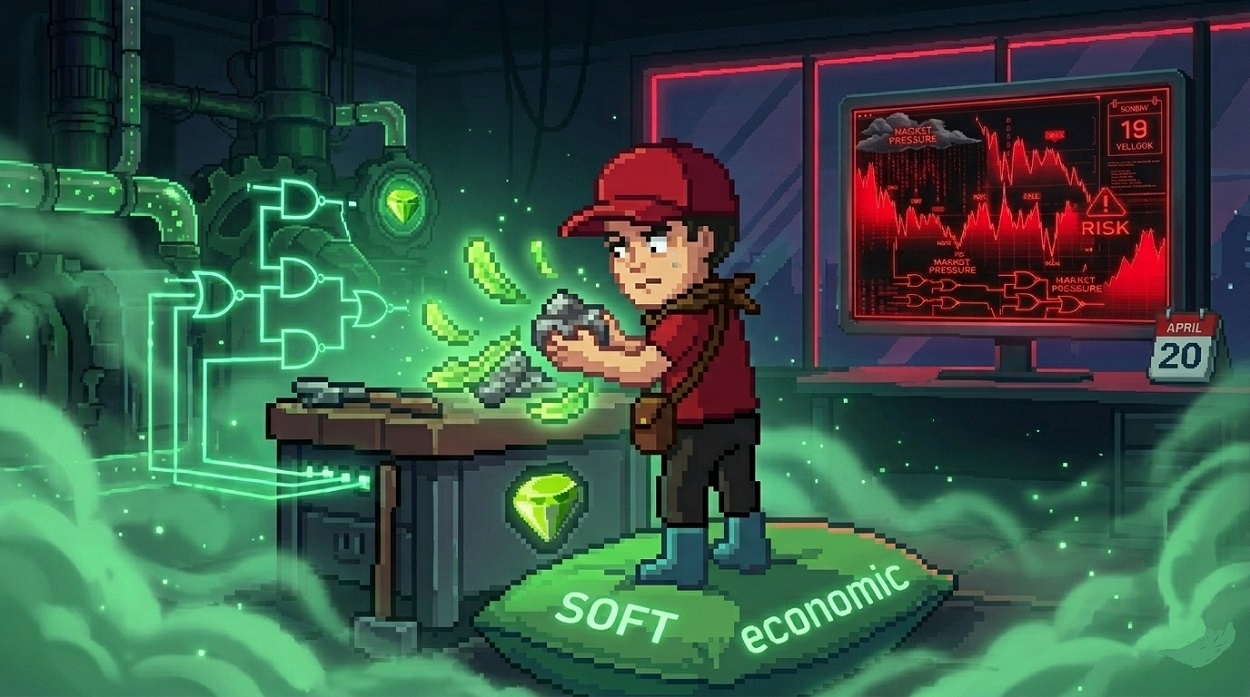
If rewards are already being optimized, if distribution is already being filtered, if volatility is being partially absorbed before it reaches the behavioral layer, then the system is doing part of the adjustment on behalf of the player.
And that changes the role of participation in a subtle way.
You’re still playing. You’re still making decisions. But it’s not entirely clear how much of the outcome is coming from your adaptation… and how much is coming from the system adapting around you.
That distinction didn’t matter before.
Now it might.
Because if the system becomes good enough at maintaining balance internally, at preventing extreme outcomes, at guiding behavior without exposing the full weight of volatility, then players might never fully encounter the edges of the system.
They stay inside a managed range.
Comfortable, consistent, relatively predictable.
And while that sounds like improvement, it introduces a different kind of question.
If nothing really forces you to adjust anymore… are you still learning how the system works?
Or just operating inside a version of it that has already been adjusted for you?
I’m not sure there’s a clear answer yet.
But the more stable everything feels after a moment that should have created tension, the harder it becomes to tell where the system ends… and where the player actually begins to react to it.