
When I was researching Pixels, the more I looked, the more I felt this matter was a bit absurd.
The cryptocurrency circle has carried a sense of mission from the very beginning. Decentralization, permissionless, overthrowing intermediaries, allowing ordinary people to participate in wealth distribution... these words can be found in any project's white paper.
Then I opened Pixels, and in a 16-bit pixel style farm world, I discovered these things:
The landlord sits at home collecting rent, the tenant helps them farm and shares the harvest, VIPs buy more labor time with money, ordinary players spend their days with that 475 points of stamina, and the "money" they earn, if they want to withdraw it, still has to pay a tax of 20% to 50%.
This is not a new economic experiment.
This is an old trick that humanity has played for thousands of years, only this time the visuals are pixelated, the ledger is blockchain, and exploitation has become more transparent. 😂
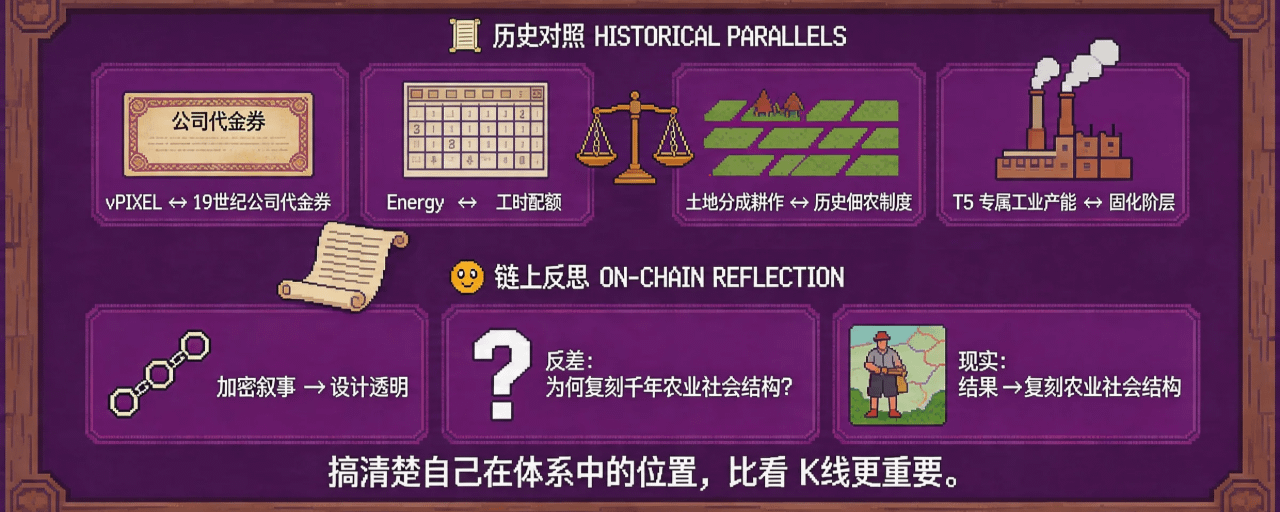
First, let's talk about vPIXEL. This thing has a historical prototype called Company Scrip.
In 19th century America, the mines and lumberyards did not pay workers in cash but rather in a type of 'scrip' that could only be spent in company-owned stores, called Company Scrip.
Workers receive wages and find that this money can only be used to buy food and tools in the boss's store. They cannot save money, cannot spend it elsewhere, and cannot leave this system. A lifetime of labor is trapped in the company's own cycle.
The United States passed the Fair Labor Standards Act in 1938, which clearly stipulated that wages must be paid in legal currency, gradually eliminating Company Scrip.
It is now 2026.

In Pixels, vPIXEL was launched—a tax-free reward token that can only be spent within the game ecology, non-transferable, and cannot be exchanged for any external assets.
Technically more advanced, logically identical to Company Scrip. 👀
Let's talk about Energy; what is this thing?
Each player has 475 natural stamina points each day; once used up, work stops, and it resets the next day.
Before the industrial revolution, there was no limit to workers' labor time; capitalists made you work as long as they wanted. Later, the labor movement fought for an 8-hour workday, which led to the protection of labor time.
Pixels' Energy system, on the surface, is a game mechanism, but in reality, it is a system of enforced labor time quotas. 475 points a day is your labor time limit as a 'digital laborer' in this system; not a bit more.
However—if you are willing to pay, you can buy Energy Drinks, pay for VIP (400 points of instant stamina replenished every 8 hours), or 'rest' in the sauna to recover more stamina.
Wealthy players have effective working hours that are two to three times that of ordinary players.
This is not a bug in game design; it is a perfect replica of economic reality: time can be bought with money, and wealthy people's time is inherently more plentiful than that of the poor. 🤔
Then there is the land system, which is the most straightforward.
There are only 5000 NFT lands in the entire game, and there will never be more. Those who hold land can allow other players to work on their land and proportionally extract output shares—officially termed sharecropping.
The term sharecropping itself carries a heavy historical trauma in American history.
After the Civil War, many freed Black laborers had no land and could only work as tenants for white landlords, exchanging labor for the right to farm the land, with half or even more of the output owed to the landlord. Because of debts that could never be repaid and surplus value that could never be reclaimed, many people found themselves in a more covert economic captivity than slavery.
Pixels has transferred this mechanism unchanged into the game, giving it the same name and not changing a single word.
The Tier 5 update that just went live on April 15 completely limits the highest industrial capacity to NFT land. 5000 landlords have gained production capabilities that no other players can touch. Class differentiation is hardcoded into the code, with no room for negotiation.
I am not saying this design is wrong.
There is a very subtle point that needs to be clarified here.
The designers of Pixels, in a sense, are very honest. They do not pretend this is an equal utopia; they directly wrote the scarcity of land, differences in labor time, and withdrawal tax rates into the rules, visible to everyone.
This is much more transparent than those systems in the real world that hide class differentiation behind complex legal texts and financial products, while verbally shouting 'equal opportunity.' 🙄
Moreover, from the perspective of pure economic sustainability, this design is actually more robust than most GameFi projects. Because it is based on a power structure with intrinsic logic—landlords have the incentive to maintain the game ecology because their asset values are directly linked to ecological activity; ordinary players have the incentive to participate because participating earns more than not participating, even under the revenue-sharing system.
This logic has existed in human history for thousands of years; it can operate because it aligns with the basic structure of human nature.
But there is one thing that made me really stop and think for a long time.
The cryptocurrency space, starting from the Bitcoin white paper, has been claiming it wants to disrupt the old financial order, allowing ordinary people to bypass intermediaries and establish a fairer wealth distribution system.
This narrative is very powerful and is the fundamental reason this circle has attracted hundreds of millions of people worldwide.
Then we spent more than a decade building a pixel farm, which has landlords, tenants, company scrip, labor time limits, and a system for distributing production materials by class.
It is not criticizing Pixels; it is asking a bigger question:
If everyone were given the opportunity to design a new economic system, and the final design looks so much like the agricultural society of thousands of years ago—then is it that humanity cannot escape the gravity of certain economic structures, or have we simply not seriously considered escaping?
Leave the ending blank