
If you have ever worked in data growth in the internet or gaming industry, you surely know how frustrating it is to analyze 'user groups'.
How do traditional game studios operate?
The product manager raised questions, the data team runs queries, cleans the data, builds models, and produces a thick PPT report. Then the operations team bases their activities and rewards on the report.
This cycle can take several weeks.
In this era where attention is extremely scarce, by the time you distribute the rewards, the core players you initially wanted to retain have already uninstalled the game and left.
The biggest pain point of traditional online operations is the huge time gap between 'insight' and 'action'. 🥶
This is why, after I delved into the top-level design of @Pixels the Stacked engine, I immediately concluded that it would become a killer application in the B2B infrastructure.
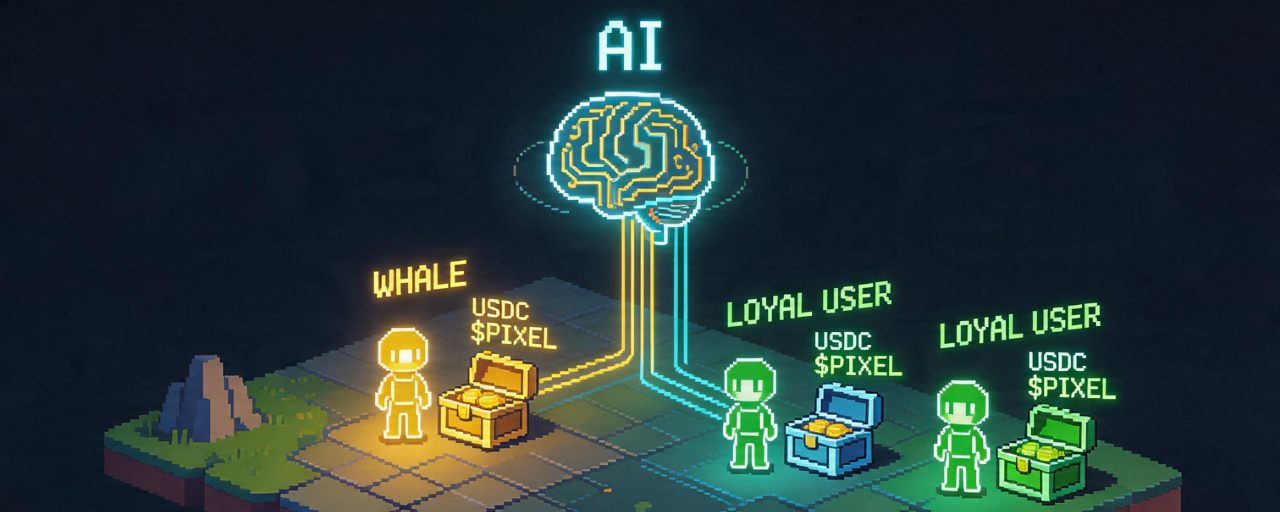
Because #pixel elegantly smooths out this fracture—it introduces a thing called 'AI game economist'!
This is definitely #pixel the most powerful differentiator.
Imagine this brand-new workflow: the operators of the game studio no longer need to wait for long data schedules; they can directly open the backend of Stacked and ask questions to the AI in natural language.
Furthermore, you can ask it extremely tricky business questions:
Why do our whale players always churn between the 3rd and 7th day of logging in?
Go look at those loyal users who have been retained for more than 30 days. What were their behavioral trajectories in the early stages?
Which economic mechanisms in the game have been proven to have the strongest positive correlation with long-term retention rate (LTV)?
Based on the vast behavioral database cultivated by the team over many years of practical experience, this AI game economist will quickly identify the churn patterns hidden beneath the massive data iceberg.
But if it only provides a report, at best it’s just a smarter BI tool.
The biggest advantage of Stacked is: from insight to action, zero waiting.
Once the AI identifies the root cause of player churn, it will immediately suggest to the studio the 'next most worthwhile reward experiment'.
For example: the system detects that a big spender lacks core objectives on the 4th day and suggests issuing a targeted, time-limited high-value task with rewards set as real USDC or high points.
The operator just needs to click confirm, and this reward mechanism will instantly and accurately drip to the specific players' clients.
For the studio, they have gained a growth engine with significant practical value;
For us players, we no longer have to endure those illogical, time-wasting garbage tasks!!
The system utilizes extremely clever AI to allocate the marketing budget originally used for user acquisition in the most comfortable and matching way, rewarding us for the real effort we put into the game.
If you're still struggling with $PIXEL the limitations of being a single-player game token, then your perspective really needs a refresh.
In this cross-game ecosystem powered by AI engines, true value creation has only just begun.