
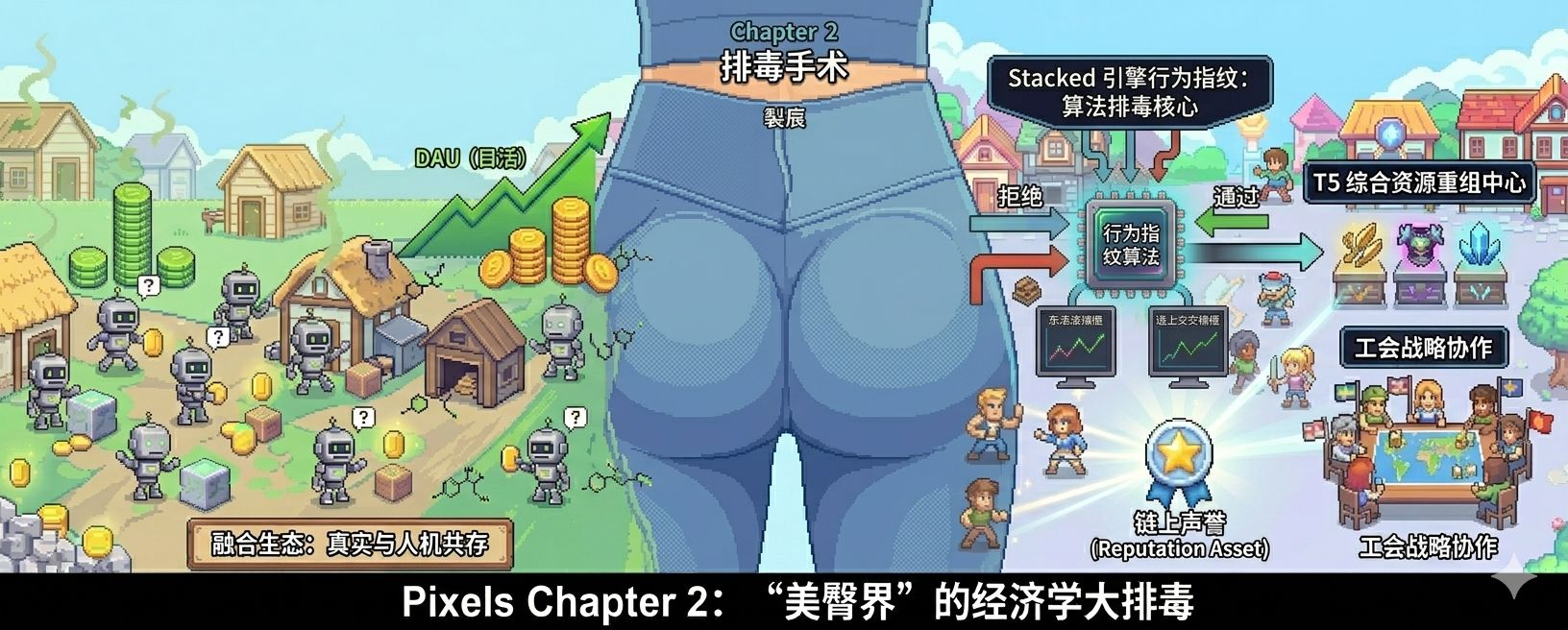
Brothers who love beautiful buttocks and yoga pants, you must have seen the news about Lululemon these days. This yoga pants brand, which is a standard for middle-class women, is actually under investigation by U.S. regulators because its fabric may contain PFAS (permanent chemical substances). PFAS makes yoga pants oil- and water-resistant, extremely smooth, and more sexy, but it is very difficult to degrade and accumulates in the human body and the environment, becoming a permanent toxin.
As a dual enthusiast of chain games and yoga pants, this storm in the world of beautiful buttocks naturally makes me think of Pixels#pixel . The robot script army in Pixels is like the hidden 'economic toxins' similar to PFAS behind the extreme prosperity of the GameFi track. Today, I will analyze it for everyone:
1. Lululemon's fate aligns with early Pixels, causing toxic prosperity.
Female consumers endure the long-term health risks that PFAS may bring for that momentary lift and bare sensation. Similarly, early Pixels had to allow the existence of a large number of scripts (Bots) for the ultimate user data and daily active users (DAU). This script prosperity is Pixels' PFAS, which made the early PIXEL tokens appear to have excellent liquidity and a highly active ecosystem, but it is essentially a source of inflation that harms the long-term foundation of the project. Now regulators are watching Lululemon, while the market is focused on whether Pixels' Chapter 2 can complete this difficult detox operation.
2. Using Stacked Engine behavioral fingerprinting is not just about preventing bans, but also about algorithmic detoxification.
Lululemon needs to reconstruct fabric processes to achieve PFAS-free products. Pixels relies on its core technology—Stacked Engine for detoxification. Now, Pixels is no longer just simply detecting IPs but has applied cutting-edge technology—Heuristic Behavioral Fingerprinting. The Stacked Engine not only identifies basic mechanized behaviors but also collects player clickstream entropy, resource output rates, and on-chain behavior paths of wallet addresses (such as interaction depth with exchanges, guilds, and NFT lands) at the millisecond level. This is not merely blocking but using AI algorithms in dynamic games to calculate whether this is a person's interaction entropy. The accuracy of this behavioral fingerprint technology directly determines whether Chapter 2 can filter out real users and eliminate script toxins.
3. The T5 system and controlled deconstruction mechanism change the economic model to actively detoxify.
Purely technical means cannot eradicate human nature. Pixels' second detox path is the controlled deconstruction (Deconstructor) of the T5 production system. The failure of the P2E (Play-to-Earn) model is because it only has unlimited output ends. The brilliance of the T5 system lies in creating a huge asset consumption and restructuring pool. Players must forcibly deconstruct low-tier assets into high-tier war materials. This is not only an update of game content but also a precise macroeconomic regulation project. It transforms the originally chaotic selling pressure into rigid assets that must be invested in guild battles. It is like Lululemon must recycle all those old styles containing PFAS and turn them into a new generation of environmentally friendly fabrics, which requires huge sunk costs and complex process reorganization.
Lululemon's moat is brand loyalty, while Pixels' technological moat is on-chain reputation (Reputation Asset). Robots can simulate planting, but cannot simulate complex guild collaboration and territory strategy.
If Lululemon can survive the PFAS storm, it will continue to lead the trend of men's appreciation for beautiful buttocks; and if Pixels can thoroughly filter out robot PFAS through Chapter 2's game mechanism, it will complete the evolution of GameFi from a Ponzi scheme to on-chain infrastructure.
