
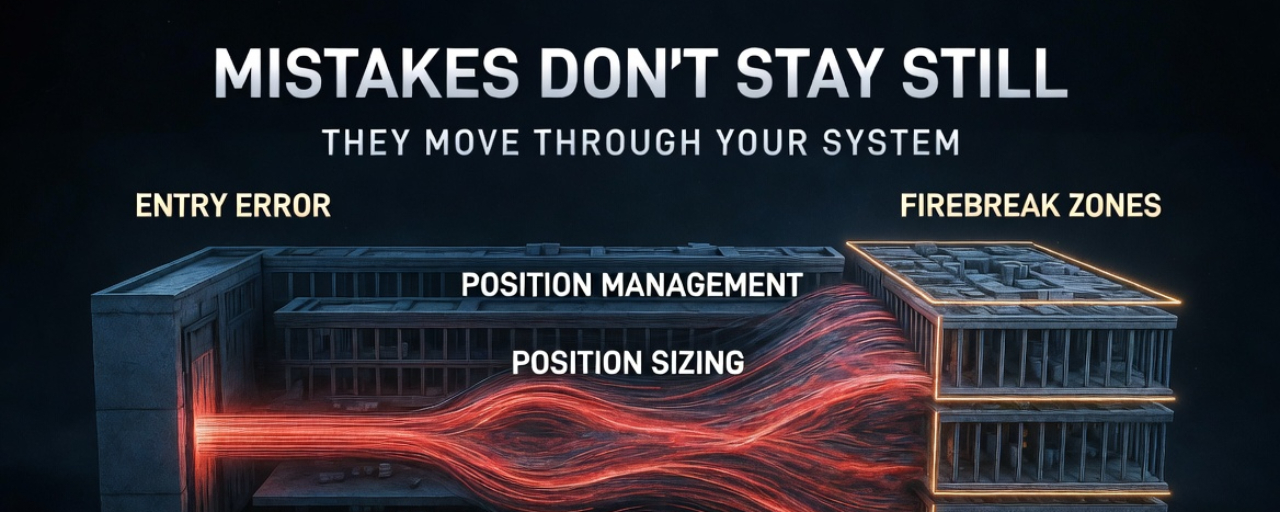
In the crypto world, I have seen many trading systems built on a seemingly reasonable assumption: if a trade goes wrong, just fix that point, and the system will improve. Wrong entry? Fix the entry. Mismanaged? Adjust the management. Poor sizing? Optimize the sizing. Each part seems like an independent, tidy problem that can be solved individually.
This way of thinking makes everything seem much more linear than it actually is.
Because in reality, those steps aren’t independent. They’re a chain link: Signal leads to Entry, Entry shapes Position, Position constrains Management, Management decides Exit. Changing one point in the chain doesn’t just fix it; it changes the input for the next step. And the next step will make decisions based on a state that has shifted slightly, looking fine, but actually skewed.
Mistakes don’t just stand still. They move along the chain.
An imperfect entry doesn’t just create a wrong entry point; it changes how you manage the position afterward. Management gets skewed by sizing. If sizing is off, the entire exit logic starts to get distorted. In hindsight, you often find the endpoint where everything breaks apart, but the real source began several tiers back, from a decision that seemed completely reasonable at the time it was made.
This is why debugging in trading is so difficult. And this is also why I started paying attention to how BinanceAI Pro is designed differently.
BinanceAI Pro doesn’t just intervene at one point in the chain. It operates throughout, from how signals are read, to how entries are suggested, to how positions are managed once the orders are in. It sounds comprehensive, and this is exactly why we need to look closer instead of taking it at face value.
Because when a system intervenes throughout the chain, it doesn’t eliminate mistakes. It reallocates mistakes.
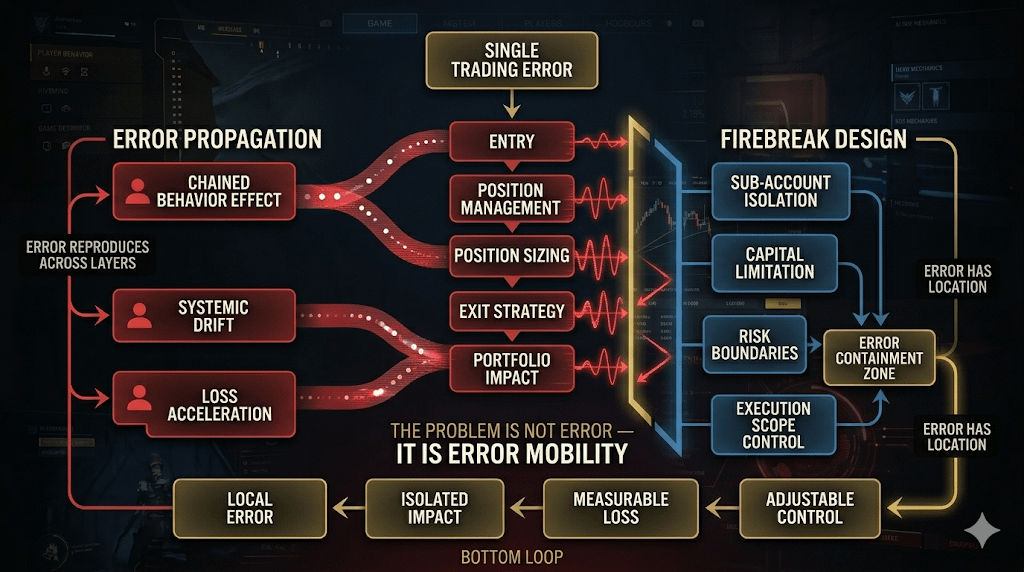
Each step in the chain might look better when viewed in isolation. Cleaner signals. More accurate entries. Management seems more disciplined. Locally, everything makes sense, but this is precisely what hides distortion at the systemic level. When each step is optimized to look reasonable at the moment it occurs, you no longer see the mistakes—not because they’ve disappeared, but because they’ve drifted to another tier in the chain, thinner, less visible, and therefore much harder to debug.
Traditional bots make mistakes in easily recognizable ways; they do exactly what they’re programmed to, even when the underlying conditions have changed. Fixed address mistakes. AI Pro is different. It’s flexible, it adjusts, it makes each step look reasonable, and that very flexibility creates a new type of mistake—one without a fixed address that drifts along the chain until it accumulates enough to break out at an unexpected point.
The real question I’m tracking with BinanceAI Pro isn’t whether it helps with better entries. It’s what happens to the entire chain when the market changes regime, when the initial assumptions are broken. In a linked system, a regime change doesn’t just make one misstep. It skews the entire chain simultaneously, and if each step is optimized to look reasonable locally, that skew will be very hard to spot until you’re at the end of the chain.
There's a detail in the design of BinanceAI Pro that stands out to me more than the AI aspect. Separate accounts, limited capital, and a defined operational scope from the get-go. These aren’t just peripheral features. They’re how the system limits the spread of mistakes. When the decision chain is confined to a defined area, reallocating errors still happens, but it can't spill beyond those borders. It has an address. And what has an address can be monitored and adjusted over time.
What doesn’t have an address cannot be.
BinanceAI Pro doesn’t try to eliminate mistakes; no system can do that. It aims to make mistakes less mobile, less able to shift through the tiers of the decision chain. This is a completely different problem from what most systems are trying to solve. And it’s much harder.
I don’t have enough real-world data to conclude whether it can do this or not. The whitepaper doesn’t answer that question, and neither does the narrative. The only thing that can answer is how the system reacts when the market begins to skew and mistakes start finding their way through the chain. That’s what I’m still tracking.
Trading always carries risk. AI-generated proposals are not financial advice. Past performance does not reflect future results. Please check the availability of products in your area.
#BinanceAIPro $XAU @Binance Vietnam