
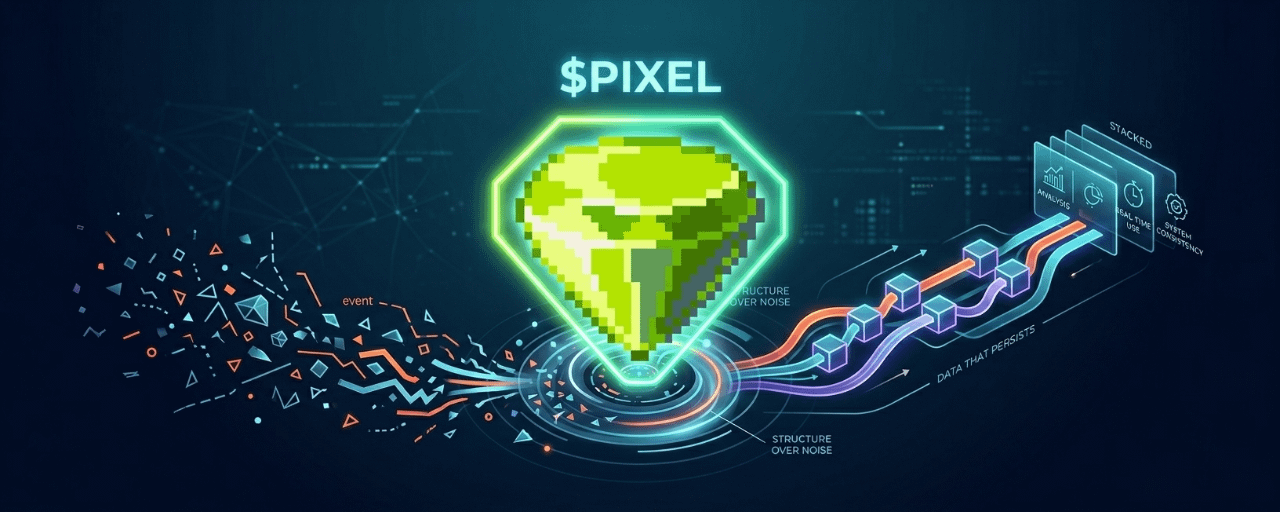
There is a point in most live systems where data stops being helpful, not because there is too little of it, but because there is too much of the wrong kind. Events keep accumulating, dashboards look complete, but the moment you try to use that data across different parts of the system, it breaks into fragments. What works in one context does not translate cleanly into another.
What stands out in Pixels is not the volume of data being captured, but how it seems to avoid that fragmentation. Interactions do not feel like isolated logs. There is a layer where those interactions are reshaped into something more stable, something that can persist beyond the moment they were created.
I noticed this when repeating similar behavior sequences across sessions that were not identical. Slight differences in timing, order, or intensity did not lead to completely unrelated system responses. Instead, the reactions stayed within a narrow band, as if the system was not reacting to the surface level variation, but to an underlying pattern that remained consistent.
That kind of behavior suggests that the system is not operating directly on raw events. There is a transformation happening somewhere in between, where noisy inputs are reduced into a more controlled representation. Without that step, consistency at scale becomes almost impossible, especially when different modules need to rely on the same data without conflicting interpretations.
This is also where the architecture starts to feel different. Instead of treating data as something to analyze after the fact, it becomes something the system depends on in real time. That requires a level of structure that most event driven designs do not maintain, because they prioritize flexibility over consistency.
The presence of an external layer like the Stacked app makes more sense in this context. If the underlying data is already normalized, external systems do not need full access to raw activity. They can operate on the structured layer, which reduces complexity and avoids tight coupling between components.
$PIXEL fits into this as part of the same flow. Its movement reflects not just isolated interactions, but how those interactions are interpreted at the system level. That makes it more aligned with the structure of the system rather than any single mechanic.
I am still watching how this holds when the system scales further, because maintaining consistency across a growing number of edge cases is where most architectures start to fail. But the direction suggests that Pixels is investing in something deeper than surface mechanics, it is trying to ensure that data remains usable long after it is created