Back in 2021, when playing blockchain games, who wasn't holding the mindset of 'mining, withdrawing, and selling'? I was too. But by 2026, if you still view $PIXEL with the old perspective, you will truly miss out on many things. After so many years in the circle, I have seen too many projects rise, host guests, and then collapse. Pixels is one of the few that I have never set aside, not because it is perfect, but because I found that its team is genuinely thinking things through.
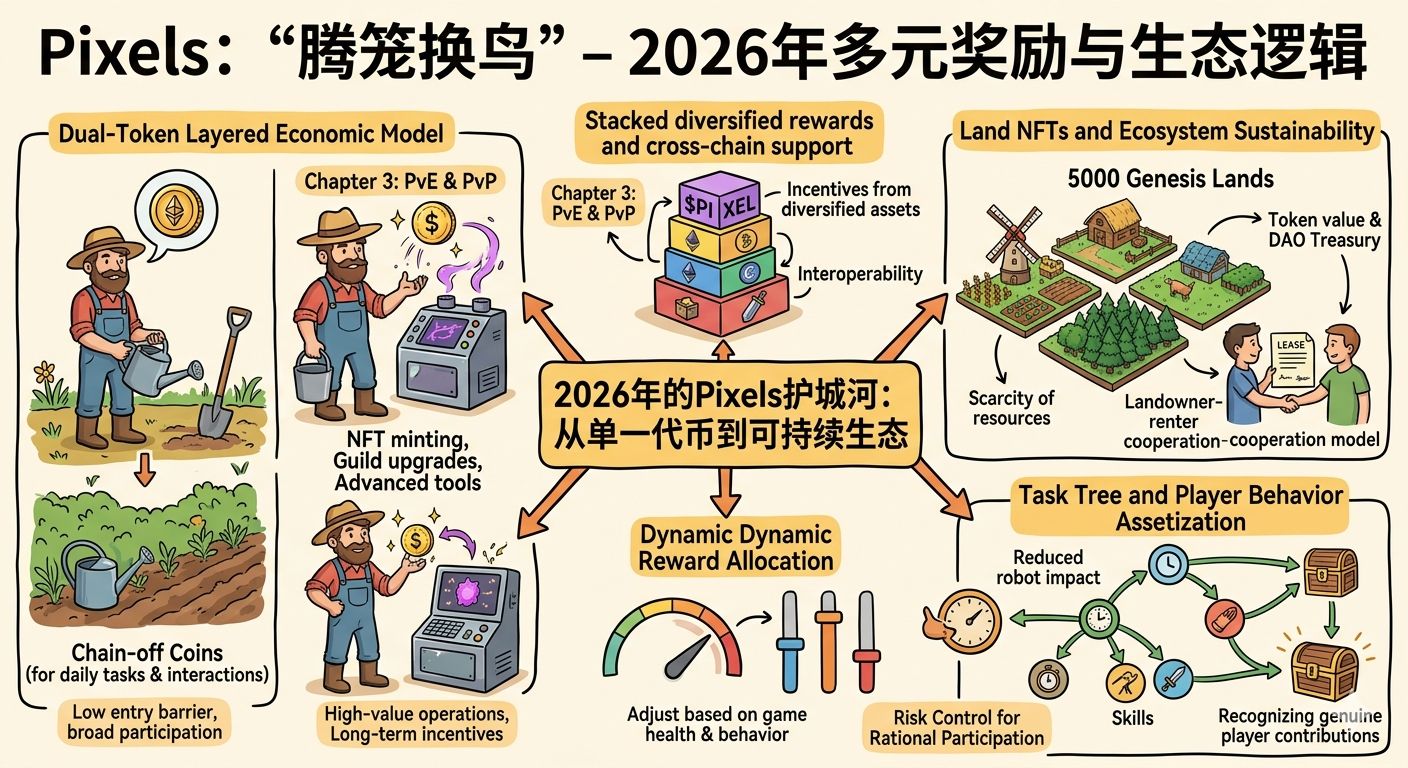
Recently, I carefully studied the underlying adjustments of Stacked. In the past, when we received tokens, we felt it was only natural to use our own currency. But now, this single-line logic seems too fragile; when the price fluctuates, players run away faster than anyone else. This time, Pixels did not stick to a single token but pushed the reward system towards a more diverse direction. What you initially receive is still $PIXEL, but this is just the starting point; later, it will gradually accommodate external assets and cross-chain incentives. On the surface, it seems like there are just a few more options, but in reality, it is dispersing the selling pressure. The time you spend in the open world of @Pixels will not yield coins that you want to dump immediately; instead, you will obtain a richer asset combination. This changes the logic of retention; you don't just grab and run, but have more reasons to stay. I think this is called 'changing the cage for birds': first, use $PIXEL to retain the most core active users, and then connect external resources through Stacked, transforming from a purely social game into a fundamental platform capable of supporting various reward logics.
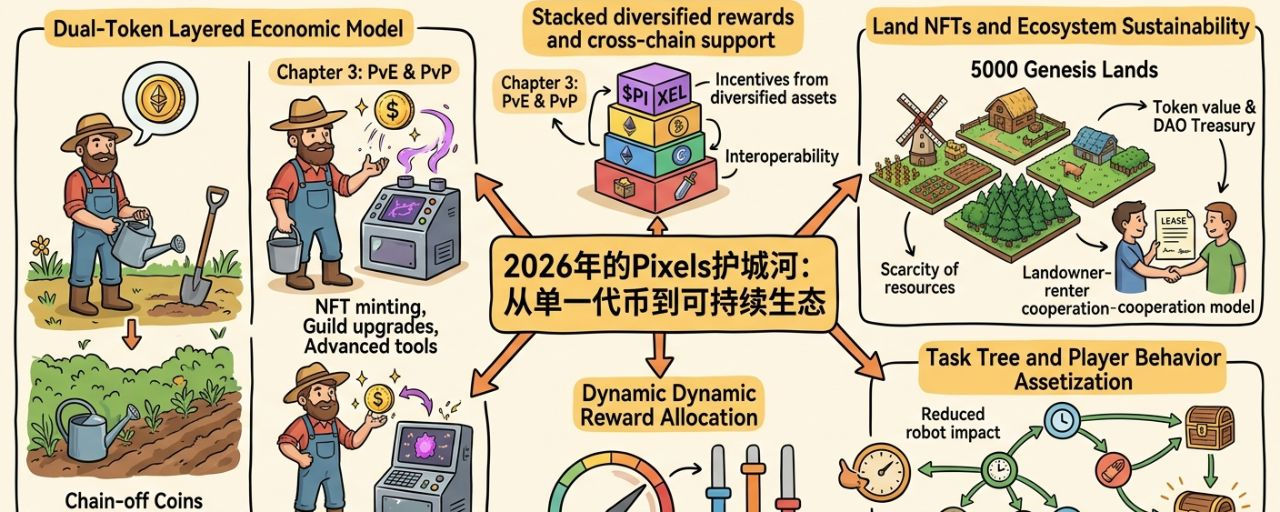
Let's talk about its dual-token hierarchy, which indeed has some thought behind it. The bottom layer uses off-chain Coins to maintain daily gameplay; the soft currency you earn from farming and interacting is highly liquid and can be spent without worry. Only truly high-value actions, such as minting rare NFTs, joining high-level guilds, or unlocking productivity items, use PIXEL. This design separates players of different levels; lower-level players exchange time for a sense of participation, while mid to high-end players exchange PIXEL for privileges, making the economic cycle relatively clear. In terms of token distribution, the white paper clearly specifies total supply and daily increase rules. The adjustment in early 2025 kept the daily inflation rate very low while converting on-chain BERRY into officially controllable off-chain Coins, mainly to prevent bots from inflating numbers. These actions indicate that the project party is actively controlling sustainability. The community DAO treasury has also accumulated quite a bit of money, and although the governance mechanism is still being improved, at least they have resources on hand.
The design of Land NFTs is quite ingenious. There are only 5000 pieces of genesis land on the entire network, and the attributes of each piece of land, such as Coop density and the number of windmills, directly affect production capacity, making land a scarce productive resource. Players without land can go to public plots or rent others' land, forming a cooperative model of 'profit-sharing farming.' Landlords hope for an active game to collect rent, while ordinary players rely on leasing to enhance returns, tying their interests together and stabilizing the ecosystem. There is also a 'task tree' system, which does not rely solely on random drops, but weights resource output based on your past behavior and contribution. There is much less interference from studios and scripts, and those who invest seriously receive higher rewards. New players may find it a bit challenging, but in the long run, it capitalizes your behavior, making the time and effort you invest visible in returns.
Standing in 2026, I feel that Pixels has moved from a relatively chaotic early stage to a transitional phase focused on sustainability. Chapter 3 has added PvE and PvP gameplay, aimed at increasing interaction consumption and fun. The key now is whether the secondary market price and real DAU can form a positive cycle. If daily activity can be stable and even rise, burning demand can balance part of the supply pressure. However, this ultimately relies on real players staying long-term. I won't blindly trust any tokens. The Pixels team has indeed put effort into dynamic reward distribution and system resilience, which serves as a pragmatic moat. I will continue to monitor on-chain data and player activity changes. As long as the system is still iterating, there is still space for this project to continue. This matter is worth attention, but ultimately, it requires rational participation and proper risk control. In the 2026 crypto market, the competition is no longer about who has the flashiest model, but who can truly create sustained interactive value. Pixels is currently moving in this direction. (This article is a platform task and does not constitute any investment advice.)