
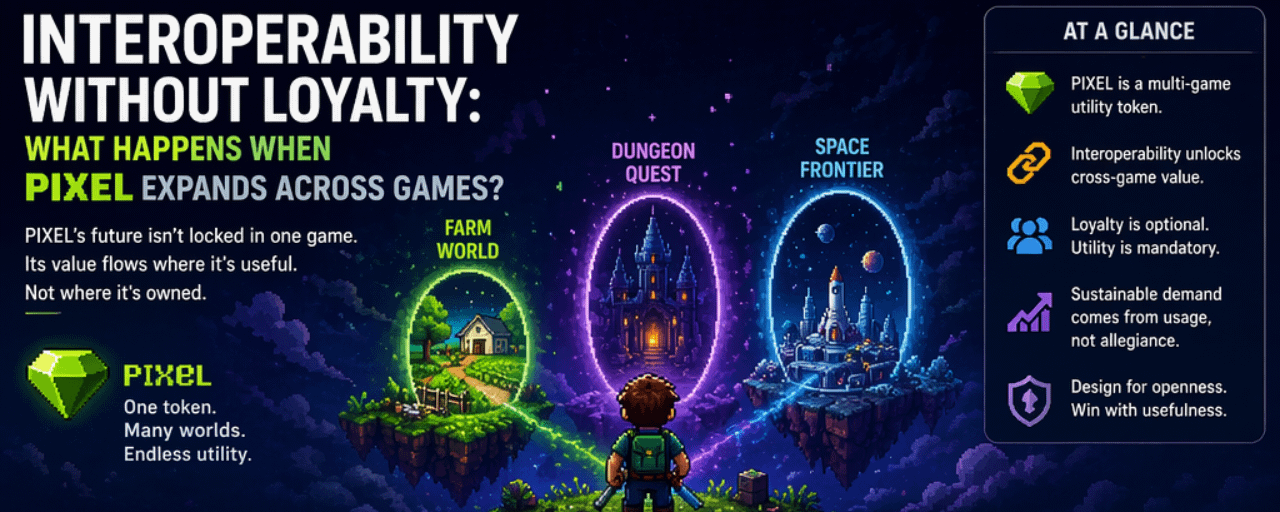
I remember the first time I looked at PIXEL and noticed how casually interoperability was mentioned. It wasn’t framed as a feature, more like an assumption. Assets moving across games, player identity persisting between environments, economies loosely connected instead of siloed. At the time, it sounded like progress. Now I’m not as sure it’s that simple.
What I’m actually watching here isn’t just expansion. It’s what happens to behavior when a system stops asking users to stay in one place.
Interoperability sounds like freedom on paper. Players aren’t locked in. Assets don’t feel trapped. Liquidity can move. But the moment you remove friction, you also remove one of the hidden forces that creates loyalty. And in token-driven systems, loyalty is often the difference between sustained demand and constant rotation.
The part that caught my attention wasn’t technical integration. It was the question underneath it. If PIXEL becomes something players can use anywhere, why would they choose to stay anywhere?
That’s not a philosophical problem. It’s an economic one.
Most game economies rely on some form of contained loop. You earn, you spend, you reinvest, and over time you build attachment. That loop creates predictable demand for the token because users repeat actions in the same environment. When interoperability enters the picture, that loop starts to stretch across multiple contexts.
In simple terms, PIXEL stops being tied to one game’s behavior and starts depending on many. That sounds like scaling, but it also introduces a different kind of instability. Instead of one retention curve, you now have several smaller ones stitched together.
And that stitching is where things get uncertain.
If players can move assets across games, they can also move their attention just as easily. That means usage becomes less about habit and more about optionality. Today they farm in one environment, tomorrow they might shift to another depending on incentives, mechanics, or even just novelty.
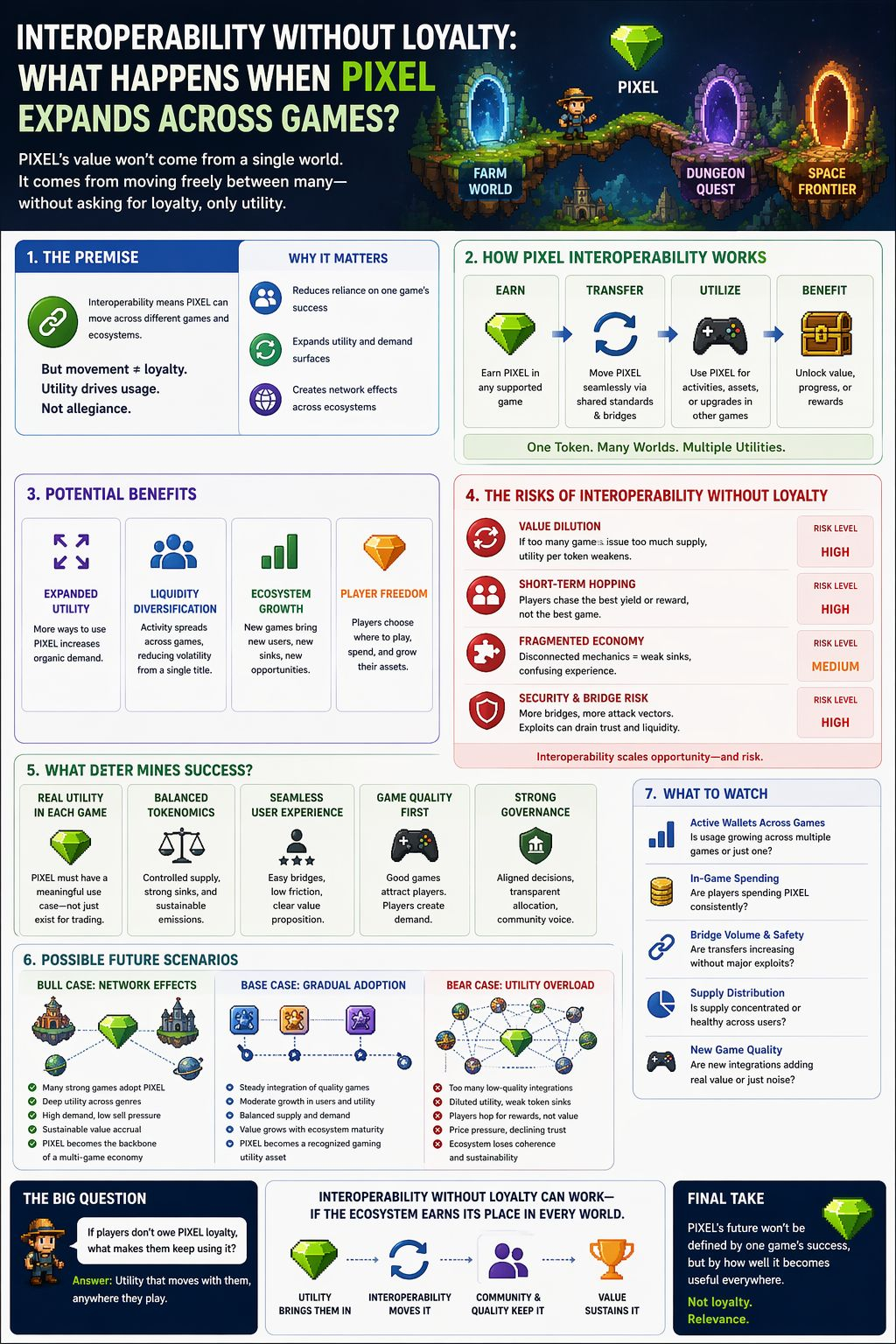
This is where the risk shows up. Optionality increases flexibility, but it can weaken consistency.
From a trader’s perspective, consistency is what creates reliable token demand. When users repeat actions daily, even small ones like planting, crafting, or trading, the token starts to circulate with purpose. That’s when you see real sinks forming. Not forced ones, but natural ones tied to behavior.
If interoperability breaks that repetition, demand doesn’t disappear. It fragments.
You might still see activity, but it becomes harder to predict where it concentrates and for how long.
That’s an inference, not a conclusion. But it changes how I read the system.
There’s also a second layer to this. Developer incentives.
Interoperability isn’t just about players moving across games. It’s about developers choosing to build within the PIXEL ecosystem. If the token becomes a shared layer across multiple experiences, then each new game adds potential demand.
But only if those games create loops strong enough to hold users.
Otherwise, they become temporary stops. And temporary stops don’t build economies. They create traffic.
We’ve seen this pattern before in crypto. Liquidity moves quickly when there’s no reason to stay. It flows toward incentives, spikes activity, then rotates out. The difference here is that PIXEL isn’t positioning itself purely as a financial layer. It’s trying to anchor behavior through gameplay.
That’s harder to fake.
When I look at Binance trading data during periods of higher activity, the temptation is to read volume as growth. But with a system like this, volume can just reflect movement between environments rather than deeper engagement within one.
If interoperability accelerates that movement, volume might increase while retention quietly weakens underneath.
That’s the kind of divergence that doesn’t show up immediately on a chart.
The design makes sense, but the usage still needs proof.
There’s a version of this where interoperability actually strengthens the network. If players carry habits with them, not just assets, then each new game becomes an extension of the same behavioral loop. In that case, PIXEL isn’t losing loyalty. It’s distributing it.
That would look like consistent wallet activity across multiple environments, not just spikes tied to new launches. It would show up as stable in-game spending even as users explore different experiences. The key signal would be repetition, not exploration.
Because exploration is easy to trigger. Repetition isn’t.
On the other hand, if players treat each game as a separate opportunity, then the system starts to resemble a network of short-term engagements rather than a unified economy. In that scenario, the token becomes more transactional than behavioral.
That shift matters.
A transactional token depends on constant inflow of attention. A behavioral token depends on existing users coming back.
Those are very different dynamics.
Interoperability tends to favor the first by default. It lowers the cost of leaving. So the system has to compensate by increasing the reason to return.
This is where subtle design decisions become more important than big features. Small frictions, identity persistence, social layers, even familiarity of mechanics. These are the things that quietly anchor users even when they technically have the freedom to leave.
Without them, interoperability becomes a highway with no destinations.
From a market perspective, I’m less interested in how many games integrate PIXEL and more interested in what happens after they do. Do users stick within one environment and deepen their activity, or do they spread thin across several with out forming strong loops anywhere?
The token might still trade actively on Binance, but that activity won’t necessarily reflect underlying growth.
If it’s the first, the pattern looks different. Activity compounds instead of resetting. Each new game doesn’t just attract users, it retains them within the broader ecosystem.
That’s when interoperability starts to look less like a risk and more like an amplifier.
The tricky part is that both scenarios can look similar in the early stages.
More games. More users. More volume.
But the behavior underneath diverges over time.
What would make me more constructive here is simple, but not easy. Not just onboarding metrics, but return rates that hold without fresh incentives.
What would make me more skeptical is if each new integration leads to a temporary spike followed by a drop in per-user activity. That would suggest that interoperability is driving exploration, not retention.
And in the long run, retention is the only thing that sustains token demand without external pressure.
There’s also a subtle point about identity. If PIXEL can tie user identity across games in a meaningful way, not just technically but behaviorally, then interoperability stops being about moving assets and starts being about carrying presence.
That’s harder to measure, but you can feel it in usage patterns. Users who behave consistently across environments. Who treat the ecosystem as one continuous space rather than a set of disconnected opportunities.
That’s when loyalty reappears, even without confinement.
Until then, I treat interoperability as a variable, not a guarantee.
The takeaway for me is straightforward. Don’t just watch how far PIXEL expands. Watch what happens to behavior as it does.
Are users returning daily, regardless of where they play?
Are token sinks forming naturally across different environments?
Is activity compounding, or just rotating?
Because in a system where loyalty is no longer enforced, it has to be earned again, quietly, through repetition.