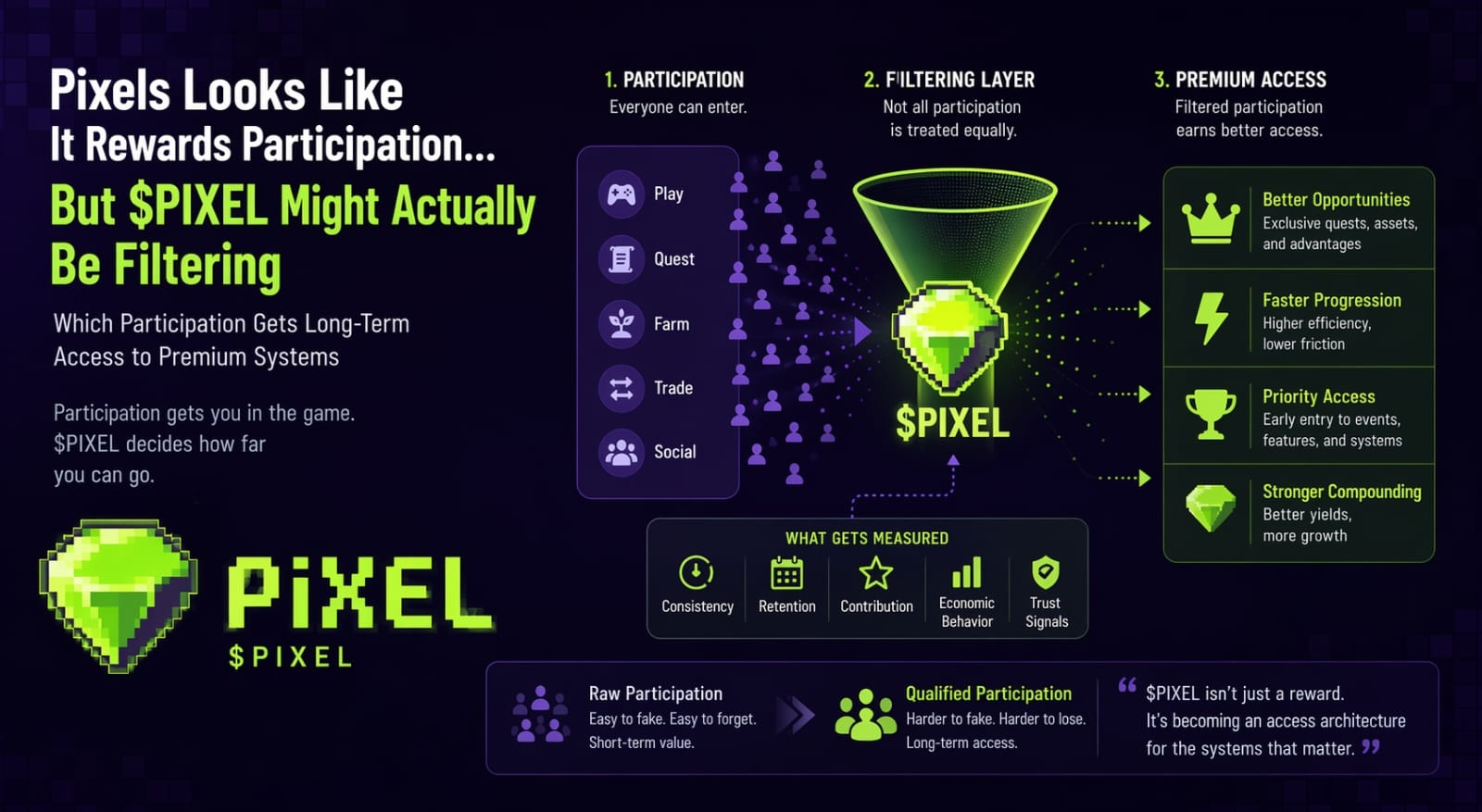
I used to think the useful signal in game economies was easy to spot. You look at wallet activity, daily users, token sinks, maybe a chart if the market is feeling generous that week. If people keep showing up and touching the system, something must be working. That was the simple version I carried for a while. But the longer I watch systems like Pixels, the less I trust raw participation as the real unit of value. A lot of people can enter a loop. That part is not hard. What matters more, I think, is what the system remembers about that participation later, and which forms of it become valid tickets into better layers of the economy.
That is where $PIXEL starts to look a little different to me. On the surface, it still reads like a reward token tied to play. You participate, you earn, you spend, you move around the game. Fair enough. But that framing may be too shallow if the broader system is slowly shifting toward premium access, better positioning, faster progression, or more durable advantages that do not open equally for everyone who merely touched the loop once. In that kind of structure, the token is not just rewarding activity. It is helping sort activity.
I keep coming back to that distinction because usage and demand are not the same thing. A lot of crypto systems blur them on purpose, or at least benefit when people confuse them. Usage tells you something is being touched. Demand tells you something is needed again under real constraints. Those are very different signals. If a player interacts because incentives are temporarily attractive, that is one thing. If a player keeps returning because prior behavior now affects future access, that starts to look more like dependency. Not dramatic dependency, maybe. Just the quieter kind, where the system stops treating every session as fresh and begins carrying forward a memory of what you have been inside it.
That memory layer is where things get interesting, and a little less innocent. When I say memory, I do not mean sentiment or community feeling. I mean structured records. Repeated actions. Patterns that can be scored, compared, reused. In crypto infrastructure, this is a familiar move. First, systems reward behavior because they need motion. Later, they become selective. They begin asking which users are consistent, which wallets are reliable, which actions are costly to fake, which histories are worth granting better access to. At that point, participation is no longer the finish line. It becomes input.
Pixels, to me, looks increasingly capable of going in that direction. Not because it says so directly, but because game economies tend to mature this way when they outgrow broad distribution. A premium system does not have to mean paywalls in the old sense. It can mean priority. It can mean better routes through the economy. It can mean certain users get smoother compounding while others keep circling the visible loop, technically active but structurally ordinary. That is a more subtle filter, and honestly more powerful than a simple fee gate.
I think people often miss how important eligibility logic becomes once an ecosystem has enough history. Eligibility logic is just the set of rules deciding who qualifies for what. Nothing fancy there. But once those rules start using past behavior instead of only current balance, the system changes shape. Now the token is interacting with reputation, retention, and proof of staying power. Proof matters here in the plain sense. Not disclosure, where you reveal everything, but proof that some condition has been met. Maybe the system does not need to know everything about a player. Maybe it only needs enough evidence to decide they belong in a better lane.
That sounds abstract, but it shows up in practical ways. Access to certain quests, assets, multipliers, or future connected titles may end up favoring players whose behavior has been legible over time. Legible is the key word. Not just active. Legible means the system can read you well enough to make decisions about you. And once that starts happening, pixel may matter less as a spending token and more as part of an access architecture. A token tied to premium systems does not always extract value through constant consumption. Sometimes it helps define who gets admitted into environments where better value can compound later.
I am careful with that idea because it can be overstated. A lot of projects look deeper than they really are when rewards are still doing most of the work. Incentives can imitate loyalty for a while. Retention can be rented. Even structured history can become noisy if the underlying actions are too easy to automate or repeat without real cost. So the test is not whether Pixels can produce a lot of participation. It is whether it can distinguish between participation that is cheap and participation that deserves downstream trust. That is harder. Much harder.
And maybe that is the real question sitting underneath pixel now. Not whether the game can keep people moving, but whether it can turn repeated movement into usable economic identity without making the whole system feel closed, brittle, or overly managed. Because once premium systems begin relying on filtered participation, the economy is no longer just rewarding players. It is deciding which players become more economically visible than others. That shift can create depth. It can also create a quiet hierarchy that only becomes obvious after the open door has been there for a while.