
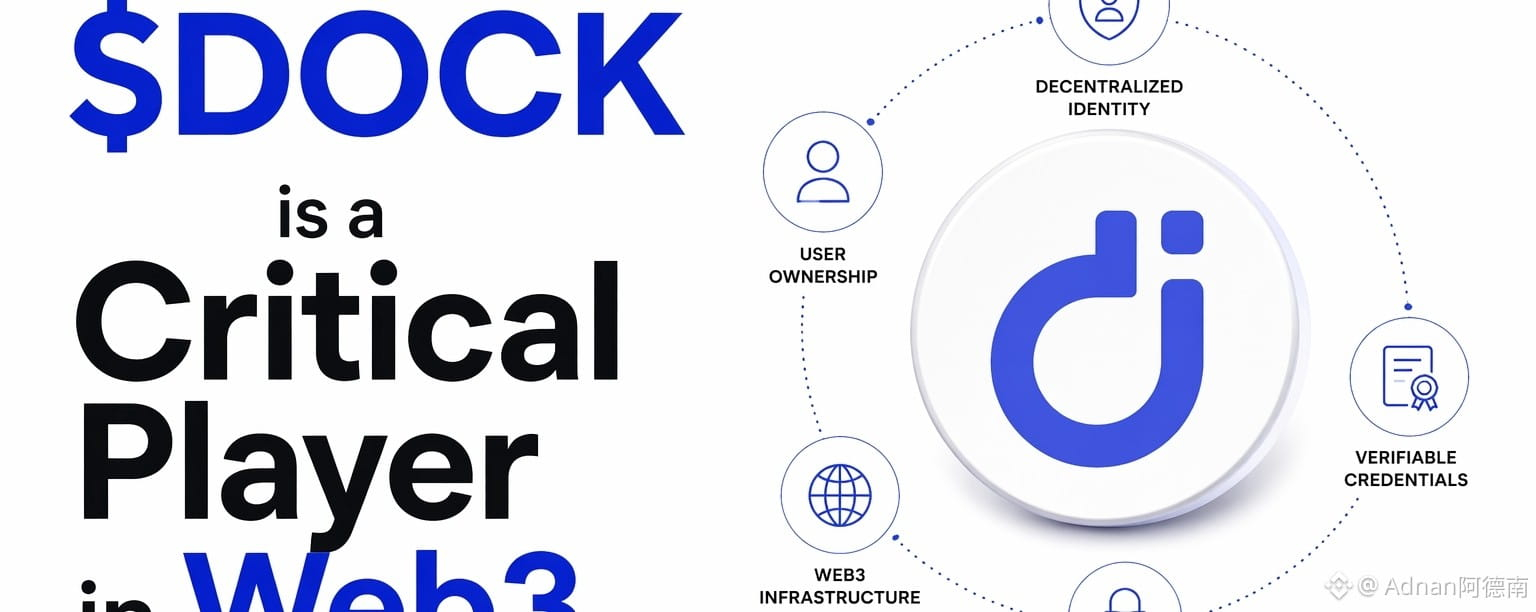

As Web3 continues to reshape the digital landscape, one of the most important challenges remains unresolved: trust and identity in a decentralized world. While blockchain has revolutionized finance and ownership, verifying real-world credentials and identities without compromising privacy is still a major hurdle.
This is where $DOCK is positioning itself as a critical infrastructure layer for the next generation of the internet.
The Missing Layer in Web3: Trust & Identity
Web3 is built on the principles of decentralization, transparency, and user ownership. However, without reliable identity systems, many applications—such as finance, education, hiring, and governance—cannot scale effectively.
Traditional Web2 systems rely on centralized authorities to verify identity and credentials, creating inefficiencies, privacy risks, and data silos. Web3 demands a new approach: self-sovereign identity, where users fully control their data.
What Is $DOCK?
$DOCK powers the Dock Network, a blockchain-based protocol focused on decentralized identity and verifiable credentials.
The platform enables organizations and developers to:
Issue digital credentials (certificates, IDs, KYC data)
Verify those credentials instantly and securely
Allow users to own and control their personal data
These credentials are cryptographically secure, tamper-proof, and instantly verifiable, making them ideal for real-world applications.
A Gateway to Web3 Adoption
Dock is often described as a gateway to Web3, and for good reason. Its infrastructure solves one of the biggest barriers to adoption: trustless verification.
Through decentralized identifiers (DIDs), users can:
Log into platforms without exposing unnecessary data
Prove qualifications or identity without intermediaries
Maintain privacy while interacting across multiple platforms
This aligns perfectly with the broader Web3 vision of giving users full control over their digital presence.
Real-World Use Cases
Unlike many theoretical blockchain projects, Dock focuses heavily on practical applications. Its technology is already relevant across multiple industries:
🎓 Education
Universities can issue digital diplomas that are instantly verifiable and fraud-proof.
💼 Employment
Professionals can carry portable, verified work credentials across platforms—eliminating the need for repeated background checks.
🏥 Healthcare
Secure sharing of medical credentials while maintaining patient privacy.
💳 Finance & KYC
Streamlined identity verification processes for exchanges and financial platforms.
By reducing fraud, lowering costs, and improving efficiency, Dock’s solutions offer tangible value to both institutions and individuals.
Technology Behind $DOCK
Dock operates on its own blockchain infrastructure designed for scalability and low-cost operations. Key features include:
Decentralized Identifiers (DIDs): Unique, blockchain-based identities
Verifiable Credentials (VCs): Secure, digital proof of information
Open-source architecture: Accessible for developers and enterprises
Substrate-based blockchain: Enabling interoperability within ecosystems like Polkadot
This foundation allows Dock to function as a protocol layer for identity in Web3, rather than just a standalone application.
Why $DOCK Matters for the Future
As Web3 evolves, identity will become as critical as payments and smart contracts. Without it, decentralized systems cannot fully replace traditional infrastructure.
$DOCK addresses this gap by:
Enabling trust without intermediaries
Giving users true ownership of their data
Powering secure, scalable identity solutions
In many ways, Dock represents a foundational piece of Web3—similar to how identity providers shaped Web2.
The Role of Exchanges
For projects like $DOCK, accessibility and liquidity are essential. Cryptocurrency exchanges help:
Provide market access for the token
Enable price discovery
Connect global users to emerging Web3 infrastructure
This integration bridges the gap between innovation and adoption, allowing users to participate in the growth of decentralized identity solutions.
Conclusion
$DOCK is not just another altcoin—it is a critical infrastructure project tackling one of Web3’s biggest challenges: identity and trust.
As the decentralized internet continues to expand, solutions that enable secure, user-controlled data will play a defining role. Dock’s focus on verifiable credentials and decentralized identity positions it as a key contributor to that future.
In a world moving toward digital ownership and privacy, $DOCK stands at the intersection of technology, trust, and real-world utility.