
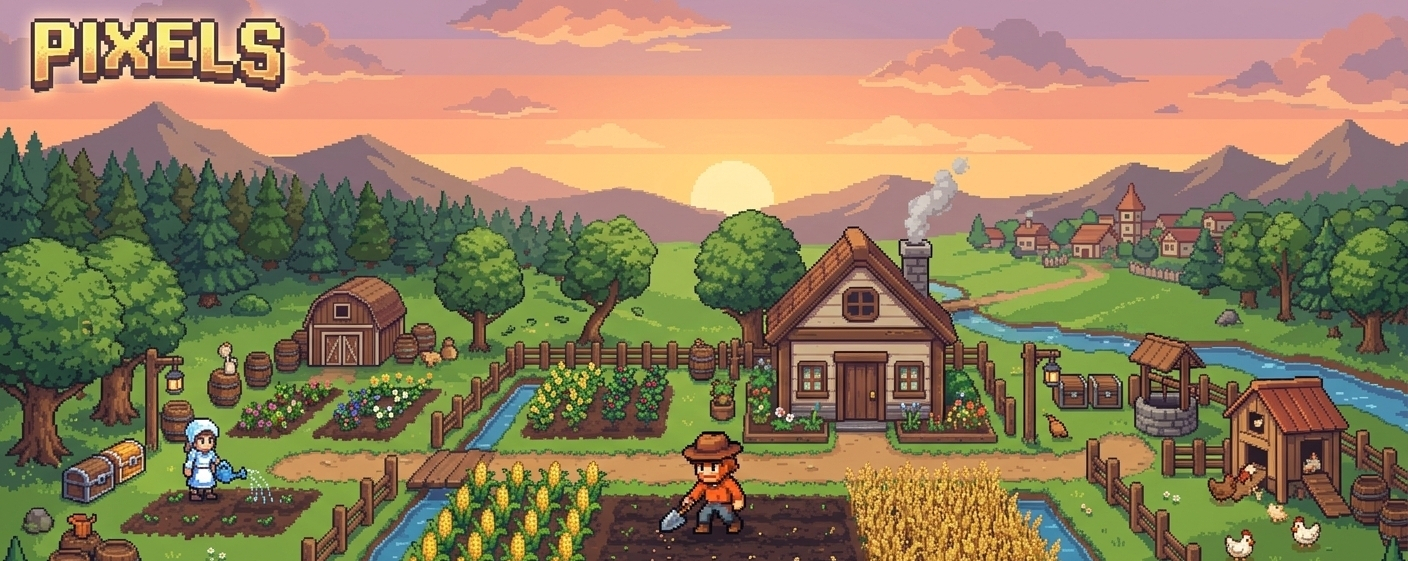
@pixel There’s a certain pattern you start to notice in Web3 games after a while. They arrive loudly, promise abundance, and then slowly fade as the excitement drains faster than the systems can sustain themselves. It’s rarely about the visuals or even the mechanics—it’s about intention. Too many of these worlds are built as economies first and experiences second. Pixels, in its own understated way, seems to be trying something softer, almost more patient.
At first glance, it doesn’t feel revolutionary. The world is gentle, familiar, even nostalgic. Farming, gathering, crafting—these are not new ideas. But that’s exactly where its difference begins to take shape. Instead of chasing novelty, Pixels leans into what people already understand about games like this. It doesn’t demand that players adapt to it; it adapts to the player’s natural rhythm. There’s something disarming about that choice. It suggests a kind of confidence, or maybe restraint, that’s been missing in a space obsessed with standing out.
Spending time in Pixels feels less like chasing progress and more like settling into a routine. You plant something, you wait, you return. You gather, you build, you slowly shape a space that starts to feel like yours. Nothing about it is urgent, and that lack of urgency is almost its defining feature. The world doesn’t push you—it lets you linger. And in that stillness, the social layer quietly begins to matter. People aren’t just competitors or liquidity providers; they’re neighbors, participants in a shared environment that grows through presence rather than pressure.
The economy sits beneath all of this like a quiet current. It’s there, undeniably important, but not always visible on the surface. That’s a delicate balance. In many projects, the token becomes the loudest voice in the room, turning every action into a calculation. Pixels seems to be trying to keep that voice lower, allowing the act of playing to remain intact. Whether that balance can hold over time is another question entirely. Economies have a way of pulling focus, especially when real value is involved.
What’s interesting is how this design shapes behavior. When a system doesn’t rush you, you’re more likely to return on your own terms. But that only works if the world continues to feel worth returning to. If the incentives ever become too strong, the experience risks collapsing into efficiency—players optimizing instead of inhabiting. It’s a fragile line, and one that Pixels will have to walk carefully. The difference between a living world and a farming loop is often just a matter of emphasis.
There’s something quietly compelling about how unambitious it feels on the surface, and yet how ambitious it might be underneath. It’s not trying to overwhelm or impress; it’s trying to endure. That’s a different kind of challenge. Building something people enjoy for a week is easy. Building something they return to without being pushed—that’s much harder.
Of course, none of this guarantees anything. The same simplicity that makes Pixels approachable could also limit its depth over time. The same economy that feels integrated today could become dominant tomorrow. And like any system tied to real incentives, it remains vulnerable to imbalance, to speculation, to shifts in player intent that no design can fully control.
Maybe the most honest way to look at Pixels is not as a breakthrough, but as a question. What happens when a Web3 game chooses to slow down instead of speed up? What happens when it tries to earn attention instead of buying it? The answers aren’t clear yet, and that uncertainty is part of the story. It’s not a finished world. It’s something in progress, quietly testing whether a different pace can actually last.