

While others farm for tokens, you are being thoroughly 'disciplined' by a set of sophisticated algorithms.
@Pixels is no longer a casual farm; it binds actions with reputation, compromises experience with computing power, and creates internal competition through zero-sum games. On the surface, it is a Web3 game, but underneath, it is a virtual factory that makes players work voluntarily, even hiding the cruel survival truth of the entire chain game industry.
Most people view Pixels as a relaxed pixel farming chain game, immersed in farming, upgrading, and token earnings, but they overlook that it has long surpassed the game itself, becoming the most sophisticated digital survival discipline experiment in the Web3 field. It wraps cold algorithmic logic in a warm community, building a virtual factory that invites players to participate voluntarily between decentralized ideals and centralized efficiency.
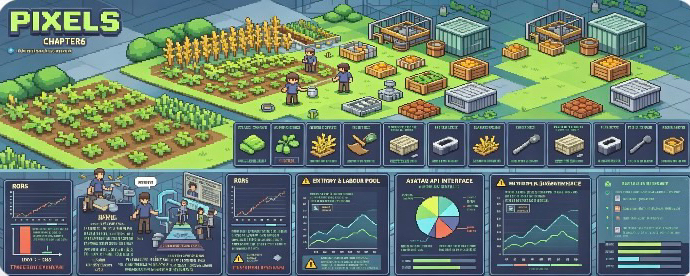
The incentive system of Pixels is a comprehensive behavior binding system. Reputation points and trust scores are not simple community ratings; they are precise digital shackles that screen players, strictly eliminating profit-seeking studios, and forcing players to follow task pipelines, exchanging physical effort and time for stable and restrained $PIXEL rewards. The project team incorporates every reward distribution into a revenue closed loop through core RORS indicators and an AI economic engine, combining real ecological consumption to build blood-producing capabilities, attempting to break the death spiral of GameFi mining and selling, which is its core competitiveness that distinguishes it from air chain games.
In terms of technical architecture, Pixels directly confronts the deadly contradiction of Web3: to support high-frequency interactions among thousands of players, it abandons the ideal of pure on-chain and adopts an authoritative off-chain engine + asynchronous settlement, using centralized servers to ensure a smooth experience. This compromise bursts the bubble of decentralization in blockchain games and exposes the industry's reality: extreme decentralization cannot support a qualified gaming experience. The Avatar API and resource stratification design further expand the game into a cross-ecological identity interface and zero-sum game field, linking high-level resources to server-wide output, where players engage in brutal competition under the guise of cooperation, and the land revenue decay mechanism completely shatters the fantasy of easy earnings, forcing everyone to continue producing in a competitive manner.
The simple UI, cumbersome backpack, and other experience flaws are not design sentiments, but rather the efficiency shackles intentionally maintained by the project team. They consume players' time anxiety with operational barriers, forcing VIPs and accelerated consumption, further consolidating the closed-loop of the token economy. Players chase numerical growth through repetitive labor, seemingly controlling virtual wealth, but in reality, they are tightly bound by the rules of code, replicating the survival anxiety of real society in a pixelated world.
$PIXEL is essentially a microcosm of the evolution of Web3 games towards platformization. It disciplines player behavior with precise algorithms, balances experience with on-chain attributes using practical architecture, and guards against collapse risks with an economic closed loop, yet it also leads players to seek illusory certainty in virtual labor. This is not just a blockchain game; it is a social experiment about humanity, capital, and code, reminding all participants: while delving deep into digital illusions, maintain the boundaries of rationality, and do not let virtual existence consume the initiative of real life.#pixel
