
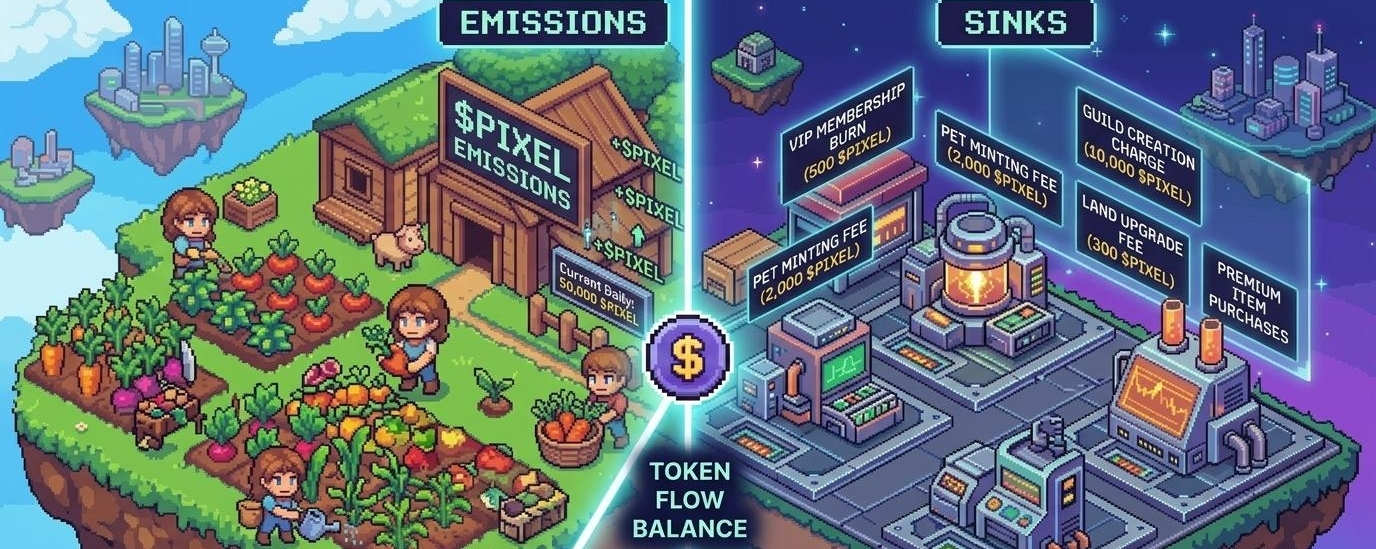
I’ve spent enough time inside Pixels to realize one uncomfortable truth: most players focus on earning, but almost nobody understands the math behind what they’re earning into. And in a system like Pixels, that difference is everything.
This isn’t just a farming game. It’s a live economic experiment one where your output is constantly being diluted unless sinks can keep up.
At first glance, Pixels feels like a pure grind-to-earn loop: you plant crops, harvest resources, craft items, complete tasks, and earn rewards. Farming is the core loop, and nearly every action consumes energy your most constrained resource. The more efficiently you use that energy, the more productive you feel. But here’s the catch: productivity doesn’t always translate into profitability.
You can be one of the most efficient farmers in the game and still lose ground economically. That’s because emissions don’t care about your efficiency.
On the supply side, PIXEL follows a structured distribution model with a fixed maximum supply and a significant portion allocated toward ecosystem rewards. This means emissions aren’t a side effect they’re part of the design. Daily rewards and activity-based incentives continuously push new tokens into circulation. As player activity increases, so does the rate of distribution.
This creates a familiar dynamic: more players lead to more farming, more farming leads to higher emissions, and higher emissions increase sell pressure. Without strong countermeasures, that pressure inevitably weighs on price stability.
That’s where sinks come in and where most players stop paying attention.
Token sinks are mechanisms that remove PIXEL from circulation. In Pixels, these include things like VIP memberships, guild creation, pet minting, and premium upgrades. On paper, the system looks balanced. But in practice, there’s a critical flaw: most sinks are optional, while emissions are constant.
This imbalance shifts the entire economy. If players aren’t actively engaging with sinks, then emissions dominate the system.
I like to simplify the entire Pixels economy into one equation: net pressure equals emissions minus sinks. When emissions are higher, inflation takes over. When they’re balanced, stability emerges. When sinks outweigh emissions which is rare you get real scarcity.
Right now, Pixels leans toward emissions being greater than sinks. You can feel it in the gameplay loop and see it reflected in market behavior: price volatility, increasing grind requirements, and growing frustration among players.
The mistake most farmers make is focusing purely on output. They optimize routes, reduce wasted energy, and maximize yield. But they ignore the bigger picture market absorption, token velocity, and how much of what they earn actually holds value over time.
This creates a dangerous mindset where players believe that grinding harder automatically leads to better results. In reality, in an inflation-heavy system, grinding harder can dilute your own earnings.
Take a simple in-game example. Each harvest consumes a chunk of energy, and when multiplied across thousands of players doing the same actions daily, it results in massive resource generation. That feeds into crafting, which feeds into rewards, which ultimately increases token distribution.
If there isn’t an equal force removing those tokens from circulation, everyone ends up competing to sell into the same liquidity pool. What feels like productivity becomes dilution.
There’s also a behavioral layer that makes this worse. Players tend to hoard rewards, avoid spending premium tokens, and optimize for extraction. This weakens sink participation even further. As sinks become underused, inflation pressure builds, prices soften, and players become even more reluctant to spend creating a loop that reinforces itself.
The players who navigate this well think differently. They don’t just focus on how much they can farm they focus on where the value flows. They time their selling, participate in sinks when it makes sense, and treat PIXEL as a tool rather than a guaranteed reward.
They also understand that Pixels is more than a game it’s an evolving economic system. It’s testing how incentives shape behavior, how players interact with tokenized rewards, and whether a balance between emissions and sinks can actually be sustained long term.
From my perspective, most farmers are stuck in a simple cycle: grind, earn, sell, repeat. But the real game operates beneath that surface. It’s about understanding the relationship between what enters the system and what leaves it.
Until that balance shifts, everything else sits on unstable ground.
So now, when I farm, I don’t just think about how much I’m earning. I think about who’s on the other side of that transactionand whether the system can actually absorb what I’m producing.
