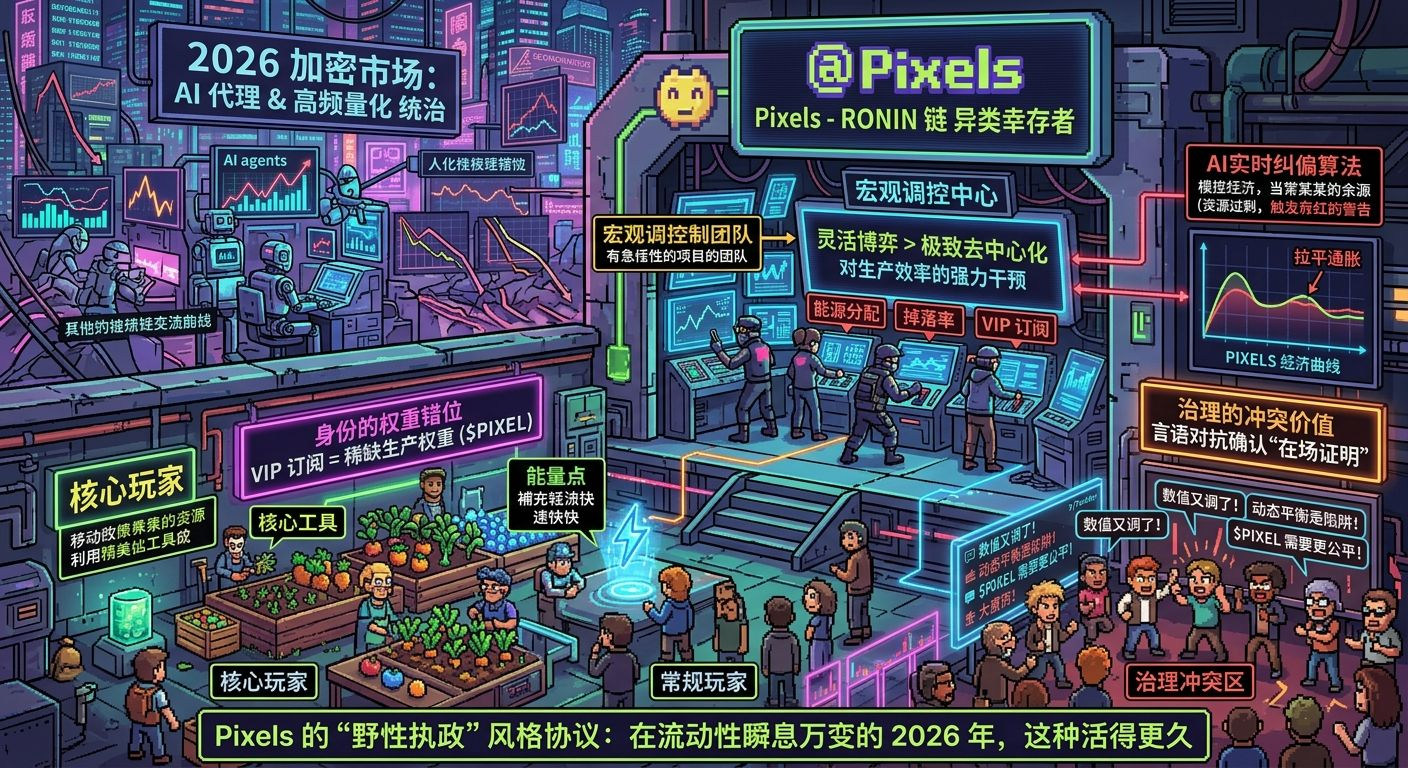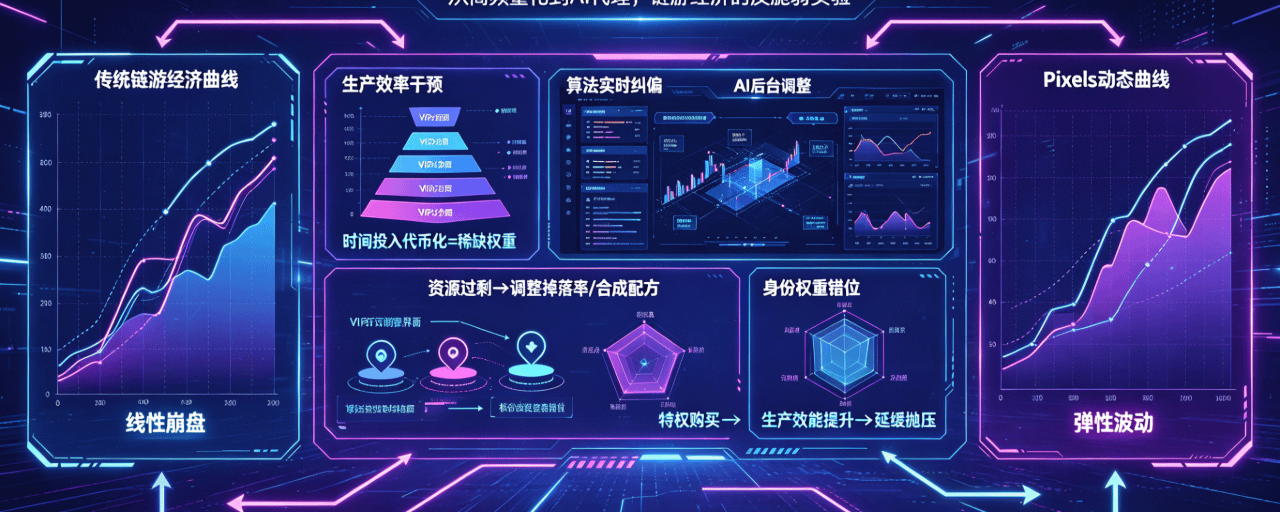

In the 2026 crypto market dominated by various high-frequency quant and AI agents, many chain games have seen their economic curves drop into a smooth straight line before the first batch of test players even exited. At such times, looking back at @Pixels Pixels on the Ronin chain, you will find that it is indeed an anomaly. Its survival until now is not based on the pursuit of extreme decentralization, but rather on an extremely flexible, even somewhat "authoritarian" dynamic gaming mechanism.
The survival core of this model lies in strong intervention in production efficiency.
Pixels does not pursue the "immutability" that is hardcoded into the underlying protocol; rather, the project team acts like an exceptionally keen macro-control center. They have established a layered energy distribution system through a VIP subscription system, essentially turning the time investment from the real world into a scarce weight on-chain through tokenized thresholds. In this system, the time and funds you invest do not disappear but are transformed into an exclusive production gain. This precise grasp of resource output efficiency allows the entire ecosystem to exhibit strong systemic elasticity when facing external liquidity shocks.
I have noticed that many people who advocate for native Web3 logic are quite resistant to this kind of "slapdash coding" behavior. Indeed, the practice of project teams setting rules and personally adjusting values undermines the so-called "sacredness of contracts" to a certain extent. If one day the core developers make a misjudgment or target the positions of certain large holders for algorithmic weakening, the entire market's liquidity does pose a risk of instant depletion.
But here lies the interesting part: this centralized rapid iteration has instead become its firewall against systemic collapse. 😂
In the crypto field, what we fear most is not that the rules have changed, but that the rules show no response in the face of a crisis. The Pixels team engages with players in the community daily, and when they find economic leverage imbalances, they immediately patch things up. This almost "hand-to-hand" operational style has instead fostered a very hardcore community consensus.
This is no longer a one-way, cold execution of code, but a long-term, tension-filled feedback loop of games.
Real-time algorithmic correction. When the output of a certain type of resource is excessive, the AI-driven backend will immediately adjust the drop rate or synthesis formula to forcibly flatten inflation.
Displacement of identity weight. Core players exchange privileges for higher production efficiency through purchases. Although this design is realistic, it greatly delays the token's selling pressure cycle.
The conflicting values of governance. The disputes in the community about numerical balance are essentially confirming each other's "presence proof" through constant verbal confrontation.
To put it simply, the vitality of Pixels actually comes from this never-ending game of confrontation. As long as everyone is still arguing over the optimal solutions for that bit of physical output, and as long as the project team dares to frequently adjust parameters to maintain ledger balance, this ecosystem remains in a lively "low-entropy state."
Playing this kind of project, what you're actually buying is not a ticket to a pixel game, but a right to participate in a dynamic economic system. In this year of 2026, where it is hard to distinguish truth from falsehood and liquidity changes in an instant, agreements that can constantly self-correct based on market sentiment, and even exhibit a bit of "wild governance" style, tend to last longer than those rigid automatons.
Will this highly dependent model of real-time developer intervention, the "planned economy" model, become the standard for future complex Web3 social ecosystems? 🙄 #pixel $PIXEL