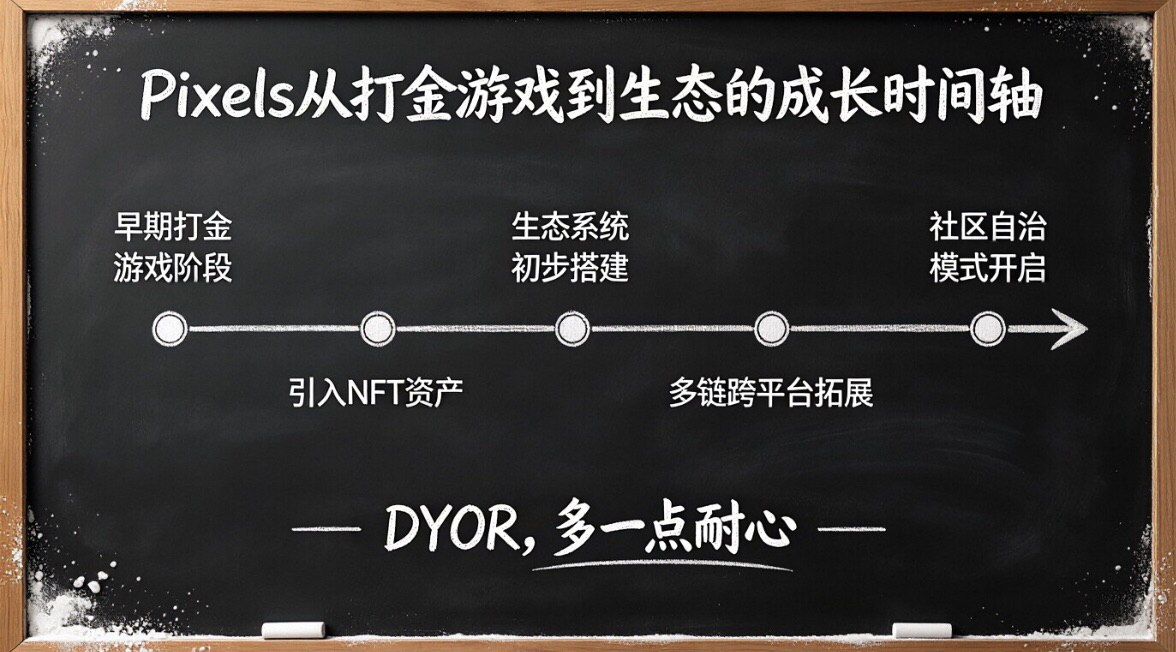
I can be considered one of the earliest players to enter Pixels, and I have a clear view of the changes in this project. When I first started playing last year, all players entering the game focused on one thing: desperately completing tasks, accumulating game resources, and quickly exchanging them for $PIXEL to sell. The main city of the game was filled with people busy running maps to earn profits, and the community discussions were all about which tasks earn money quickly and how to operate to earn more tokens. Everyone was only thinking about how much profit they could make, which was purely a play-to-earn model relying on grinding, with most people coming in to earn a quick buck and then leave.
But in the past few months, I have clearly noticed that Pixels has completely changed its direction. From the launch of the land pledge gameplay at the beginning of the year, to adjusting the reward ratio for task outputs, and then to the newly launched VIP level system, the economic logic of the project has completely changed direction. It is no longer just about making money through grinding, but is moving towards staking and ecological closure. The use of @Pixels is also increasing, and it is no longer just a token for cashing out, but rather a ticket to participate in the entire game ecosystem.
The most noticeable change is that the way to make money is completely different now. Previously, everyone calculated how much PIXEL could be earned in an hour, but now the community talks about how much currency is staked and which level yields more stable returns. The official team has directly reduced the earnings from normal gold farming, giving most of the rewards to players who stake long-term and are rooted in the ecosystem. As a result, those short-term players who came in wanting to mine and sell for quick profits can’t make any money and must leave, while those who stay to hold and stake their coins face less competition, and their earnings actually increase.
This mechanism for filtering players is actually very clever, like a sieve that filters out speculators who only want to make quick money, leaving behind players who genuinely believe in the project and are willing to accompany it for the long term. I have specifically kept an eye on the related data, and even though the overall popularity of the blockchain game market is declining, the number of wallets actively staking tokens and the amount of tokens staked per wallet are slowly increasing. It seems that the number of players has decreased, but those who remain are genuinely supporting the project with real money, making the funding even more solid.
From the perspective of market supply and demand, if more and more people are staking, the amount of PIXEL available for circulation will decrease, and naturally, the pressure to sell tokens will lessen. After that, the price of the tokens will no longer be determined solely by the amount sold daily through gold farming, but will instead follow the real demand within the ecosystem, such as upgrading items, buying land, and participating in exclusive activities. If this model can transition from purely making quick profits to one driven by supply and demand, the value logic of PIXEL will be completely rewritten.
But in my heart, there have always been a few questions I can't seem to understand and can't let go of.
First of all, staking and locking up coins only temporarily takes away the liquidity of the tokens. Whether it can be maintained in the long run depends entirely on whether new players continuously enter the market. If only old players transfer their coins from wallets to staking contracts without newcomers taking over the assets in the ecosystem, then locking up will only postpone the problem. Eventually, the staking rewards will be continually diluted, and when everyone discovers that the earnings are not keeping up, there will still be a large sell-off of tokens.
Secondly, the gameplay in the Pixels ecosystem is still not diverse enough; the land-related gameplay is very limited, and pets and decorative items can basically only be collected, with no core scenarios that allow everyone to consume tokens in large quantities. Although the team is likely to introduce gameplay such as land leasing, item synthesis, and cross-game item universality in the future, none of these have been implemented yet, and whether they can be executed successfully or if players will like them are all unknowns.
 In the end, what troubles me the most is that the Pixels team was originally focused on Web2, and their operational capabilities are unquestionable, but the centralization of the project is too high. This major adjustment to the economic model seems to be developing in a positive direction, but the entire process is led by the officials, and the sense of participation for ordinary players is getting weaker. Previously, earning money from gold farming relied entirely on one's own time and effort; now, earning returns from staking depends on the project's rules. This change for us small investors feels like a game of trust.
That being said, most of the blockchain games on the market now rely on the crazy issuance of tokens and blindly attracting new players to maintain, ultimately collapsing completely. Pixels can actively give up the gold farming model for quick profits and focus on long-term ecological construction, which is already stronger than the majority of projects. Being willing to sacrifice short-term benefits to accumulate long-term player consensus is a difficult but valuable path.
My own operational thought process is to hold a small portion of my position while continuously observing, not chasing highs or using leverage, and occasionally comparing staking data with new player growth data. If in the next few months, daily active players can stabilize and rebound, and the staking ratio remains within a reasonable range, then this transformation can be considered successful; if the data continues to show no improvement, no matter how good the plan is, it will be useless, as players will ultimately vote with their feet.
Lastly, I want to remind everyone to do their own research. The cryptocurrency market is full of uncertainties, and there are no guarantees of profit. But at this stage, Pixels is slowly transforming from just wanting to make money into an ecosystem with long-term development potential. This change deserves a bit more patience from us, and it's worth testing the waters with a small portion of our positions.#pixel #web2