


Let me first mention something that makes me feel a bit frustrated. In the past, I judged whether a blockchain game was good or not based on a very intuitive standard: how easy it was to get started, how quickly you could earn money, and whether it felt enjoyable. By this standard, to be honest, Pixels fails — the tools can break, crops can die, the recipe chains keep getting longer, the task board limits your progress, and if the facilities on the land exceed the limit, they will stop working. Every update feels like more stones are being stuffed into a system that was originally running relatively smoothly. My first reaction at that time was: these people must be out of their minds, don’t they know games should be enjoyable for users? After thinking for a long time, I realized I was using the wrong standard, and this mistake nearly led me to misjudge something very important. Real Person Research · Life Preservation First, using the wrong standard is more dangerous than having no standard because it gives you the illusion of having made a judgment.
What changed my mind was a very simple question: why do most chain games die so quickly? It's not because the rewards are too low, it's because the rewards are too easy to obtain. The smoother the system, the faster the most calculating individuals find the optimal solution. Once the optimal solution appears, everyone starts to copy it, and then no one plays the world anymore; everyone is just going through the motions. I've named this process 'the spreadsheet death ritual'—the game becomes an Excel sheet; once every cell is filled, no one needs to look at it again. The recent updates from Pixels are essentially an active resistance against this form of death. Tool durability, crops will die, facilities have limits, and production chains are elongated. Each change, when viewed individually, is quite unappealing, but they all point to the same thing: this is not a flat system from which you can extract endlessly, but a place that requires continuous care. If you take care of it, it thrives; if you neglect it, it will have problems. This feeling is completely different in magnitude from the feeling of 'logging in to claim rewards'.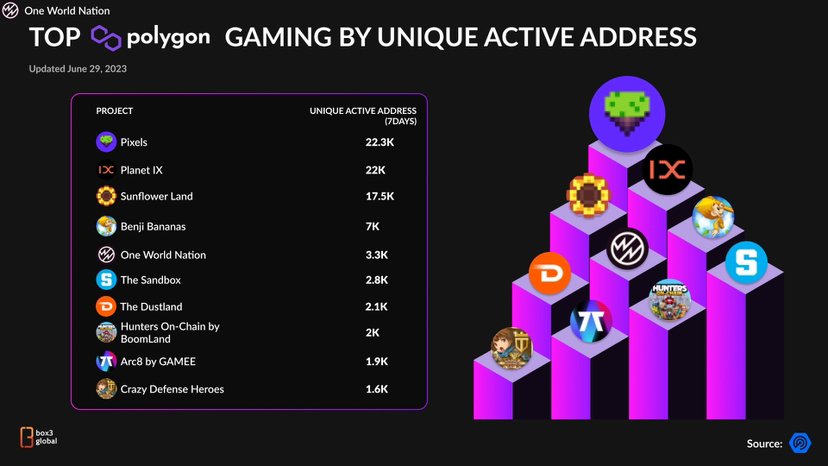
I coined a term to understand this matter, called 'friction economics'. In simple terms, it means: appropriate friction in a system is more valuable than zero friction. Zero friction means no one needs to think, no one needs to make decisions, and ultimately no one needs to truly participate—they are just executing mechanical actions waiting for numbers to come out. Having friction means that every action has a cost; you need to judge whether it is worth doing at that moment, and this judgment process itself is proof of participation. @Pixels This 'reduction of convenience' design is essentially pulling the threshold of participation from 'can you grind' back to 'do you understand this world', and the latter is the mechanism that can truly filter out users willing to stay long-term. Look at the design where land facilities exceed limits—Producer, Crafting, Petcare, and Business are counted separately, exceeding limits gives a one-week grace period, after which it begins to affect operations—I was really a bit annoyed when I first saw this rule, but later I realized that it was this annoyance that made me start to really think about 'how do I use this land', rather than 'how do I maximize the output of this land'.
If this logic holds, what does it mean for $PIXEL? It means the reason for holding $PIXEL changes from 'expecting price increases' to 'there are some things in this system that must be done with $PIXEL'. You are no longer betting on the rise and fall of a token, but on whether an economic system can continuously create real consumption demand. Stacked's support has bolstered this direction—over 200 million real rewards distributed, over $25M in real game income, and the current RORS target of 0.8 exceeding 1.0. Especially since this 0.8 figure was directly written into the white paper, which is extremely rare in this industry—most people only show you bullish charts, hiding the ugly parts deeper than anything else. A team willing to release loss numbers at least makes me willing to put it on my serious tracking list, rather than throwing it away with those projects I can see through at a glance.
$PIXEL Currently priced at $0.00744, with a 24-hour increase of +4.35%, the highest in 24 hours was $0.00774, the lowest was $0.00710, with a trading volume of 221 million PIXEL and a transaction amount of 1.6456 million USDT. MA7 is reported at 0.00755, crossing above MA25's 0.00739, showing signs of short-term stabilization, but MA99 still exerts pressure above 0.00781, and the medium-term trend has not yet been established. Trading volume has significantly decreased compared to previous periods; without volume to support a rebound, I won't consider it a major signal. Real-life research · survival priority; I am not focused on the short-term price increase, but on whether this 'friction economics' design has been validated in real data—whether player retention data has improved, and whether consumption data after the official launch of $vPIXEL has shown a healthy trend. If these two data points improve, friction economics is indeed at work; if not, no matter how nice the story sounds, it is just a story.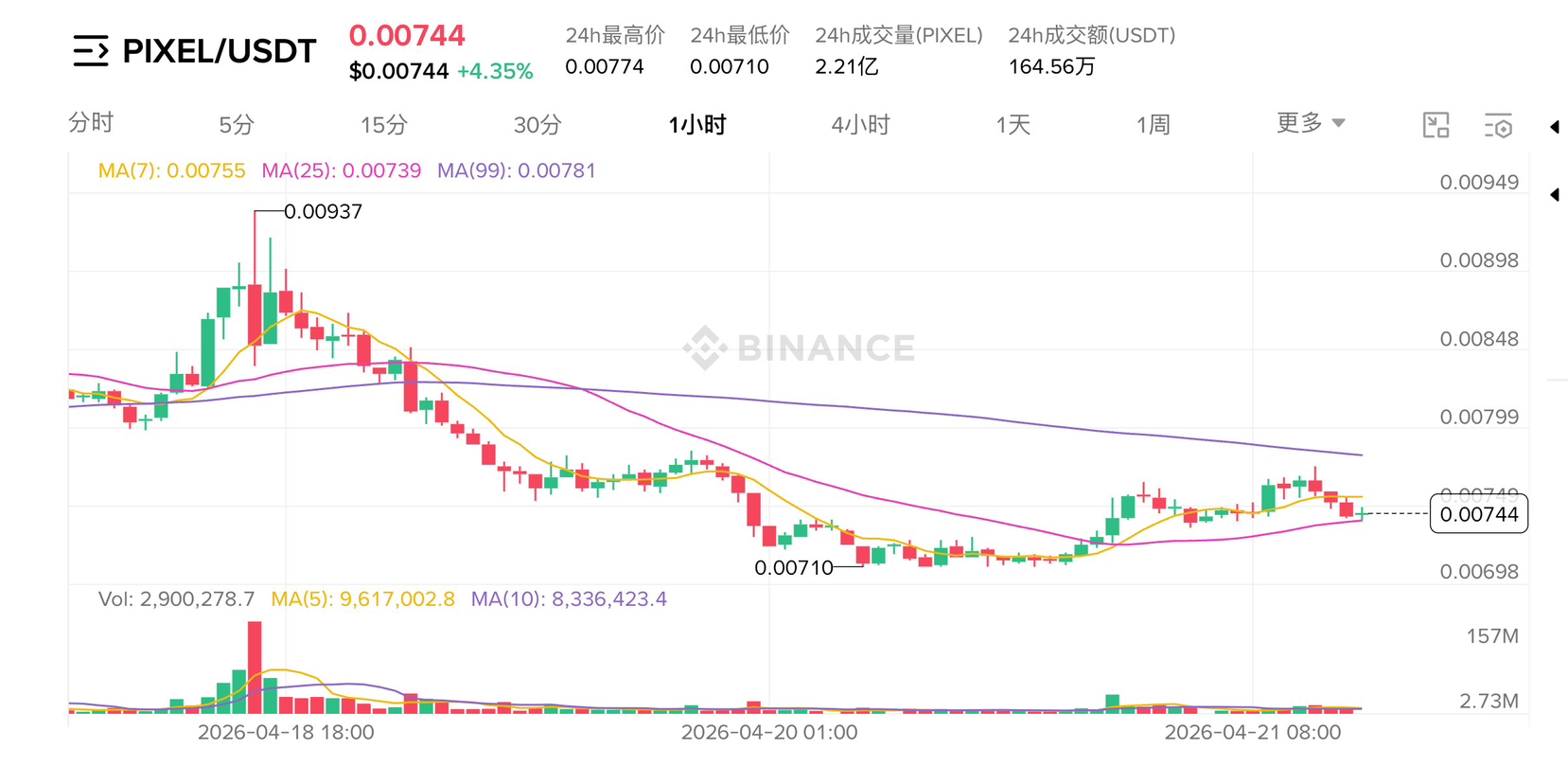
Lastly, a self-reflective discovery that leaves me somewhat speechless: after I finished writing this article, I thought about it and realized that I am also a victim—or rather, a beneficiary—of this 'friction economics' system. It is precisely because Pixels is designed to be annoying enough, requiring thought and not allowing easy calculations, that I spent so much time studying it and wrote such a lengthy piece. If it were a system that could be seen through at a glance, I would have left long ago. A game that can annoy me enough to study it seriously is, in itself, a form of retention ability. The highlight moments determine whether you will share a game, while sufficiently annoying details determine whether you will remember it three months later. Real-life research · survival priority; this is the most honest evaluation I can give this project for now.