
One of the most interesting developments in the @Pixels universe is the evolution of the Stacked ecosystem. Instead of relying purely on short-term reward loops, Pixels is designing a structure where player participation, land usage, and resource management all connect to long-term value creation. This approach helps stabilize the in-game economy and encourages strategic gameplay rather than quick farming.
The Stacked system promotes efficiency. Players who carefully manage crops, energy, and crafting chains can create sustainable output over time. This naturally increases demand for in-game resources, which feeds back into the broader ecosystem. As more users participate, liquidity flows through different layers — from farming to crafting to trading — strengthening the overall economy.
Another key factor is how the ecosystem aligns incentives. Instead of rewarding only early adopters, Stacked mechanics allow consistent players to benefit through planning and optimization. This improves retention and creates a more balanced environment. A healthier player base ultimately supports the utility and adoption of $PIXEL, since the token becomes embedded in multiple gameplay activities.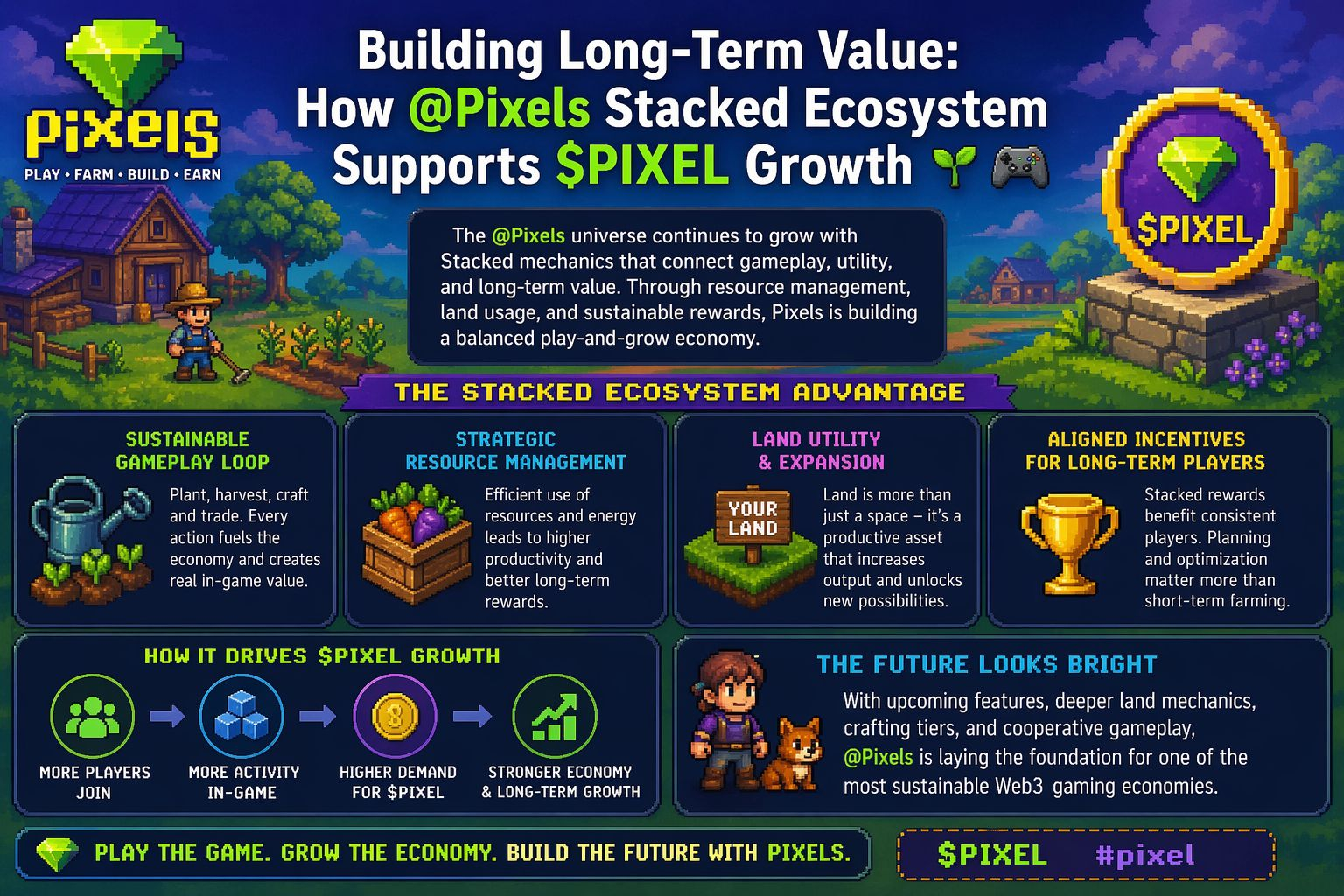
Looking ahead, further expansions in land mechanics, crafting tiers, and cooperative gameplay could deepen the Stacked economy even more. If @Pixels continues to refine these systems, the result may be one of the more sustainable Web3 gaming models. The focus on utility, player engagement, and gradual growth makes the long-term outlook for $PIXEL worth watching.