
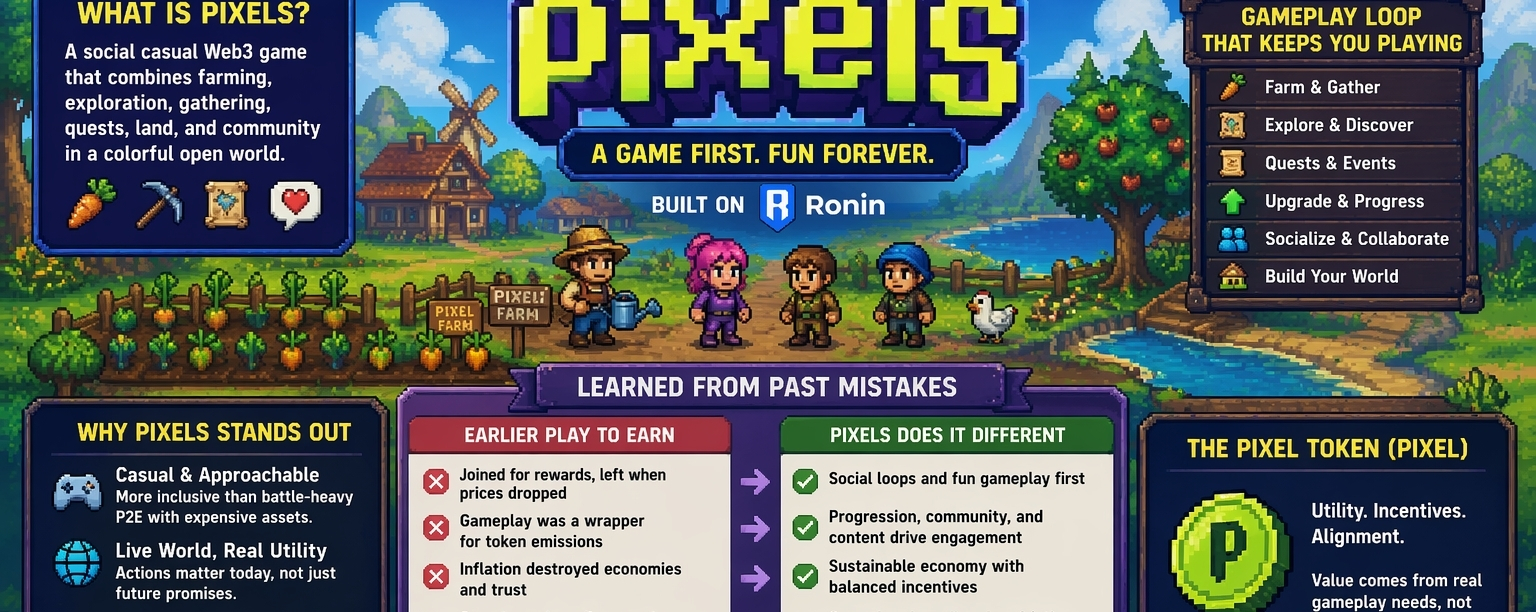
Pixel is emerging as one of the more interesting GameFi stories because it focuses on something many earlier play to earn projects forgot, which is making a game people actually want to play before asking them to earn from it.
Pixels (PIXEL) is a social casual Web3 game built on the Ronin Network, and it combines farming, exploration, gathering, progression, quests, land interaction, and community features inside a colorful open world that feels accessible even for users who have never touched crypto gaming before.
Instead of forcing players into complex wallets, expensive NFTs, or confusing token systems on day one, Pixels lowers friction with a smoother onboarding path, which matters because mass adoption in Web3 gaming depends on simplicity more than speculation.
If you have watched earlier GameFi cycles, you probably remember ecosystems where users joined mainly for rewards, invited more users for rewards, and left the moment token prices dropped, which created short life cycles and weak player retention.
Many first generation play to earn projects treated gameplay as a wrapper around token emissions, so inflation
Pixels appears to learn from those mistakes by putting social loops and repeatable gameplay first, meaning farming crops, upgrading progress, collaborating with others, exploring maps, and participating in events can still create engagement even during slower market periods.
That difference is important because sustainable ecosystems are usually built on time spent, identity, friendships, and fun rather than pure extraction of rewards.
Compared with battle focused play to earn titles that rely on expensive starter assets, Pixels is more casual and approachable, which can attract a broader audience including mobile minded users, creators, collectors, and players who prefer lower pressure experiences.
Compared with metaverse land projects that sold vision before utility, Pixels gives users a live environment where actions already matter, so the value proposition feels tied to activity instead of only future promises.
Compared with yield driven ecosystems that depended on constant new capital, Pixels benefits from a game loop where progression itself can motivate users, which is healthier than asking every participant to become a short term trader.
Ronin Network also adds a strategic advantage because it already has gaming recognition, established infrastructure, and a community familiar with digital ownership, making it a more natural home for Web3 games than chains with little gaming culture.
For you as an observer or participant, this means the key metric may not be token spikes but whether daily users return, communities stay active, creators keep building, and updates continue improving the world.
A healthy GameFi project often looks less like a casino and more like a live service game with an economy attached.
The PIXEL token can play an ecosystem role through utility, incentives, and alignment, but the long term story usually depends on whether token demand comes from real gameplay needs rather than temporary hype cycles.
That is where Pixels has a stronger narrative than many older projects, because users can understand the product instantly through farming and social play instead of needing a spreadsheet to justify participation.
Another strength is content visibility, since streamers and creators can showcase progression, farms, guild activity, and community moments in a way that is easier for new audiences to connect with.
If you are evaluating Pixels, focus on retention, active wallets, content cadence, partnership quality, token sinks, and player sentiment rather than only price charts.
Those indicators often reveal whether a Web3 game is building an economy that can last beyond one bullish quarter.
No project is risk free, and Pixels still faces competition, market cycles, user attention shifts, and the challenge of balancing rewards with sustainability, but it enters the market with lessons learned from earlier failures.
In simple terms, previous play to earn ecosystems often asked players to fund the system, while Pixels is trying to give players a world worth staying in, and that shift could be the most valuable upgrade of all.