
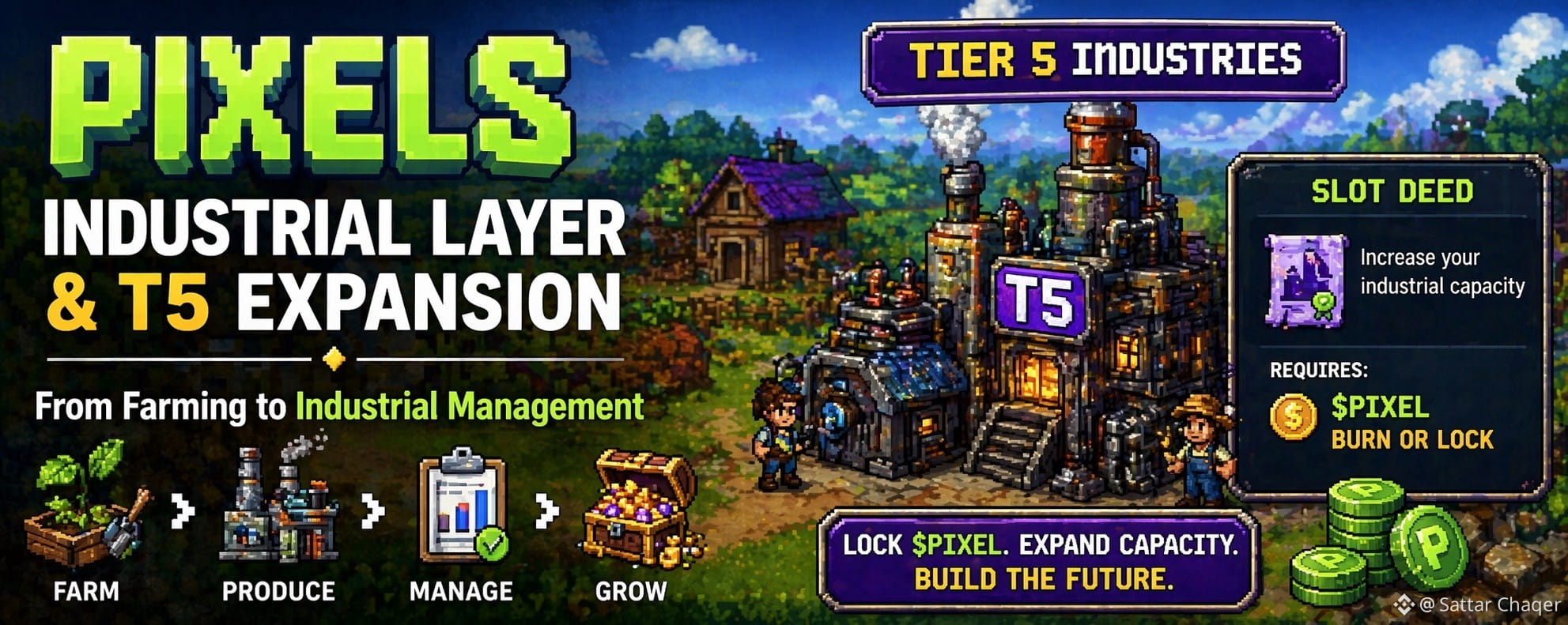


While looking at the recent updates in Pixels the introduction of Tier 5 industries and Slot Deeds feels like a bigger shift than it first appears.
On the surface it looks like just another expansion.
More upgrades more capacity more things to build.
But the structure behind it suggests something different.
Pixels is slowly moving away from simple farming loops and toward something closer to industrial management.
And that changes how players interact with the system.
The key piece here is Slot Deeds.
Instead of just expanding freely players now need to burn or lock PIXEL to increase their industrial capacity. That small change introduces a new layer of decision making.
Growth is no longer just about time and activity.
It’s about allocation.
Do you use your resources to expand production?
Do you hold liquidity?
Or do you commit to scaling your operation inside the game?
Each choice starts to carry more weight.
And over time that creates a different type of player behavior.
In earlier versions of Pixels, progression felt relatively straightforward. You farmed crafted and reinvested. The loop was accessible and easy to follow.
With T5 industries that loop becomes more complex.
Players are no longer just participating in the economy.
They’re positioning within it.
Because once industrial capacity is tied to PIXEL through Slot Deeds the system begins to connect gameplay decisions with long term commitment.
If you expand aggressively you’re effectively locking yourself deeper into the ecosystem.
If you don’t you risk falling behind players who scale faster.
That dynamic introduces something Pixels didn’t fully have before.
Competition at the infrastructure level.
Not just who plays more but who builds better.
And that’s where the shift becomes more interesting.
This isn’t just about increasing output.
It’s about introducing constraints.
By requiring players to burn or lock PIXEL the system reduces available supply while simultaneously increasing demand for expansion. It creates a feedback loop between growth and scarcity.
But it also adds pressure.
Because now every expansion decision has a cost that extends beyond gameplay.
It ties into the broader economy.
And that’s where the balance becomes important.
If the system encourages too much expansion players may overextend.
If it restricts too much growth could slow down.
So the design has to sit in a narrow range where incentives feel worth it but not overwhelming.
That’s not easy to maintain.
Especially as more players enter the higher tiers.
What makes this shift in Pixels stand out is that it moves the game closer to something that rewards planning not just participation.
Farming becomes just one part of the process.
The real focus starts to move toward managing systems allocating resources and thinking ahead.
Which changes the type of player the game attracts.
More casual loops still exist.
But at the top level the system begins to favor players who treat it more like a strategy environment than a routine.
And that leads to a bigger question.
If Pixels continues expanding in this direction does it create a stronger more sustainable economy.
or does it slowly make the system harder for new players to keep up with?