
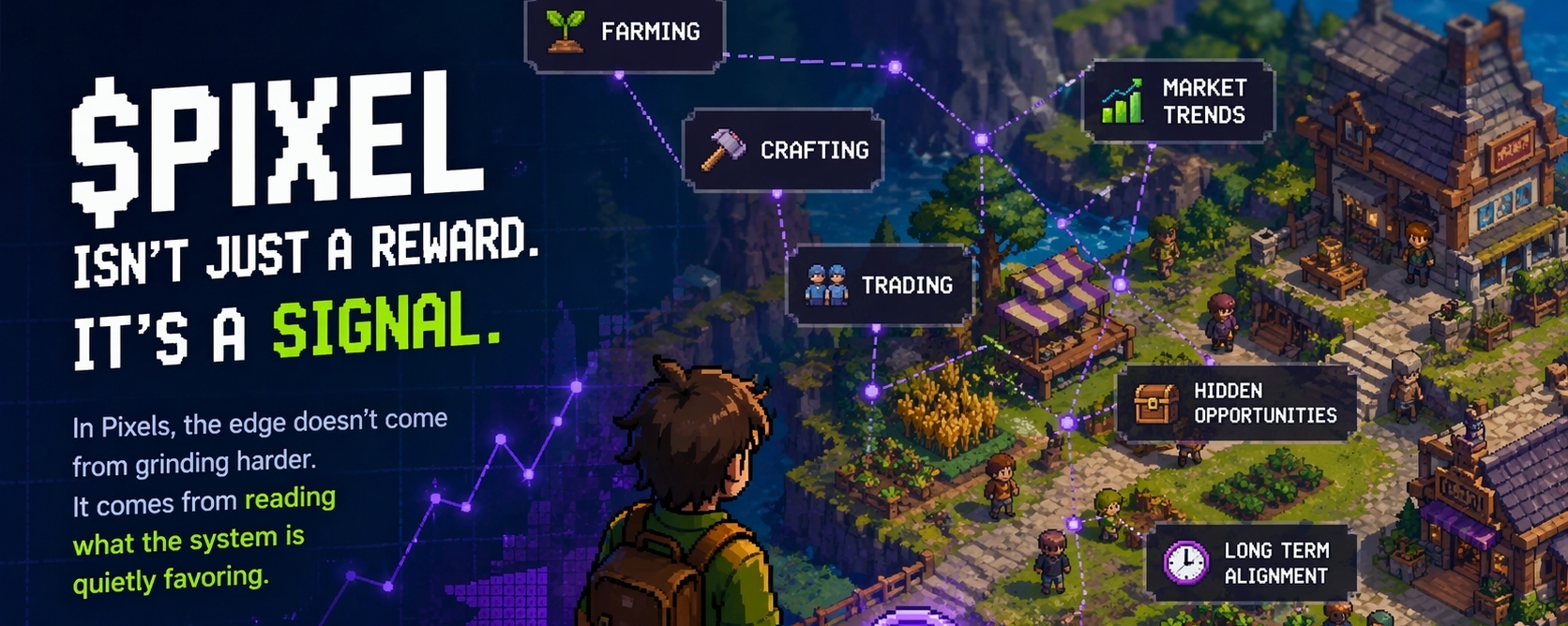
Most people enter a game expecting a simple relationship between effort and reward. Put in time, take the right actions, and progress follows. At first, Pixels seems to work that way too. You farm, craft, trade, and repeat, and it looks like growth comes from doing more. But after spending time inside the system, I’ve started to think progress in $PIXEL often has less to do with activity itself and more to do with how well you understand what the system is quietly favoring.
That changes the way the game feels. Instead of seeing optimization as simply maximizing output, you begin to notice that some of the strongest positions don’t always come from players doing the most. Sometimes they come from players recognizing patterns earlier, leaning into certain behaviors before they become obvious, or committing to opportunities before they become crowded. In that sense, the edge often seems less about grinding harder and more about interpreting sooner.
That’s where $PIXEL starts to feel different from a typical reward token. It doesn’t just represent what you earned through effort. It can feel like a reflection of whether your decisions aligned with the structure of the system before everyone else saw the same signals. Some choices that look inefficient in the short term end up compounding later, while others that appear profitable immediately never develop into anything meaningful. And often, you only understand the difference after time has passed.
That delay matters because delayed feedback changes how players think. When rewards are instant and predictable, people optimize around repetition. But when outcomes reveal themselves slowly, players start paying attention to signals instead of just loops. They begin asking not what generates the fastest return today, but what the system might value tomorrow. That introduces a much deeper strategic layer than simple resource extraction.
I think this is where many people misunderstand Pixels. On the surface, it can look like a game built around farming and economic loops. But underneath that, it often feels more like a system of positioning. Where you place attention, which loops you deepen, what you ignore, and what you recognize early may matter more than raw activity itself. That creates a very different relationship between player and economy.
In many tokenized games, dominant strategies eventually become obvious. Players converge on the same optimizations, the meta hardens, and the system becomes easy to read. But Pixels feels more adaptive than that. As more people move into the same opportunity, its advantage often changes. What looked optimal yesterday may lose relevance tomorrow. And that means obvious strategies do not always stay powerful.
That creates tension, but it also creates depth. Because in a system like that, the real advantage may come from reading shifts while they still look small. Not reacting once everyone sees the pattern, but recognizing it earlier. And that is why PIXEL increasingly feels less like something you simply earn and more like something that reflects whether you understood the system well enough to align with where it was already moving. To me, that makes progress in Pixels feel less like grinding for rewards, and more like learning to interpret signals inside a living economy.