I used to think Pixels was just a game where I did small repetitive tasks for entertainment. I entered the game to do what I liked, moving around the map, completing a few familiar missions, interacting with the environment, and then logging out. Everything happened smoothly, without feeling too complicated or requiring deep thinking.
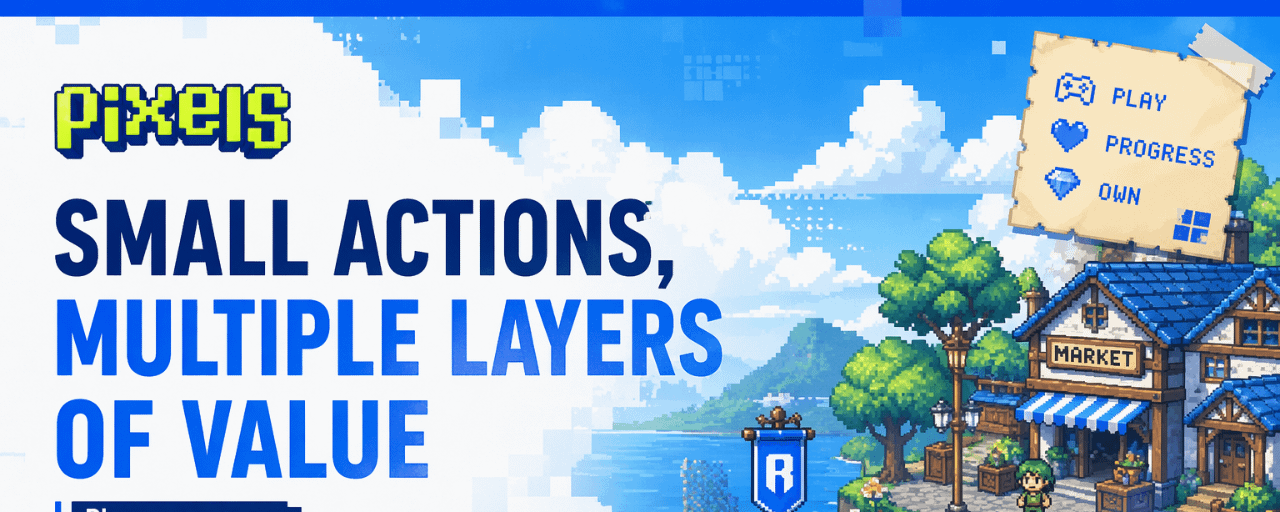
But after a period of regular play, I began to notice something different. As I understand it, every small action I take in the game doesn't just result in a single outcome. I find myself accomplishing something very simple, but it simultaneously impacts many different aspects: the character progresses, resources increase, and the underlying factors are also recognized.
I realize that I'm not just "playing for fun." I'm participating in a system where value is layered in many ways. The interesting thing is that I don't feel this while playing. I don't have to think about optimization, nor do I have to calculate how much benefit this action brings. I just act according to my natural feelings, but value accumulates automatically.
At first, I thought those repetitive tasks were just to create a sense of busyness. But after studying how the game operates and observing more closely, I was surprised to find that each small action carries more meaning than I thought. An action I take can simultaneously help me progress in experience, resources, and even on-chain elements behind it.
I also started to notice the aspect of real-world technology behind this experience. The resources I accumulate, the items I own, not only exist in the game in a conventional way but are also recorded on the blockchain infrastructure. This makes me understand that the values I create are not just numbers in the interface, but real data being stored and validated.
However, what I find interesting is that this technology is almost "invisible" while playing. I don't have to constantly sign confirmations, nor do I have to deal with complex technical steps. Everything happens behind the scenes, and I only focus on the experience in front of me.
I find that this makes the time I spend in the game feel more "substantial." I'm not just wasting time; I'm building layers of value on top of each other, including layers of experience and technology behind it. Every day I come back, I only do familiar things, but when I look back at a week or a month, I see how far I've come.
I also realize that I'm not pressured to maximize benefits. Pixels doesn't make me think about financial value every time I perform an action. Instead, the game allows me to experience naturally, while value quietly accumulates behind the scenes. This makes me feel much more comfortable.
There are times when I only intend to spend a few minutes in the game, do one or two small tasks, and then exit. But then I continue to do a few more tasks because everything flows so smoothly. I experience each step without feeling like I'm "grinding." Yet when I look back, I see that I've built a solid foundation in the game.
I admit that this layering of value makes me appreciate Pixels more. It is not ostentatious, nor does it explicitly state how much benefit my actions are generating. I gradually realize this through actual experience.
In my perception, it is precisely the existence of multiple layers of value on a single action that makes me feel everything I do is meaningful. I don't need to set big goals. I just need to continue with small familiar tasks every day.
After all, I see that Pixels has done something quite subtle: turning very small actions into a foundation for multiple layers of value, where player experience and real-world technology operate in parallel without interfering with each other.