
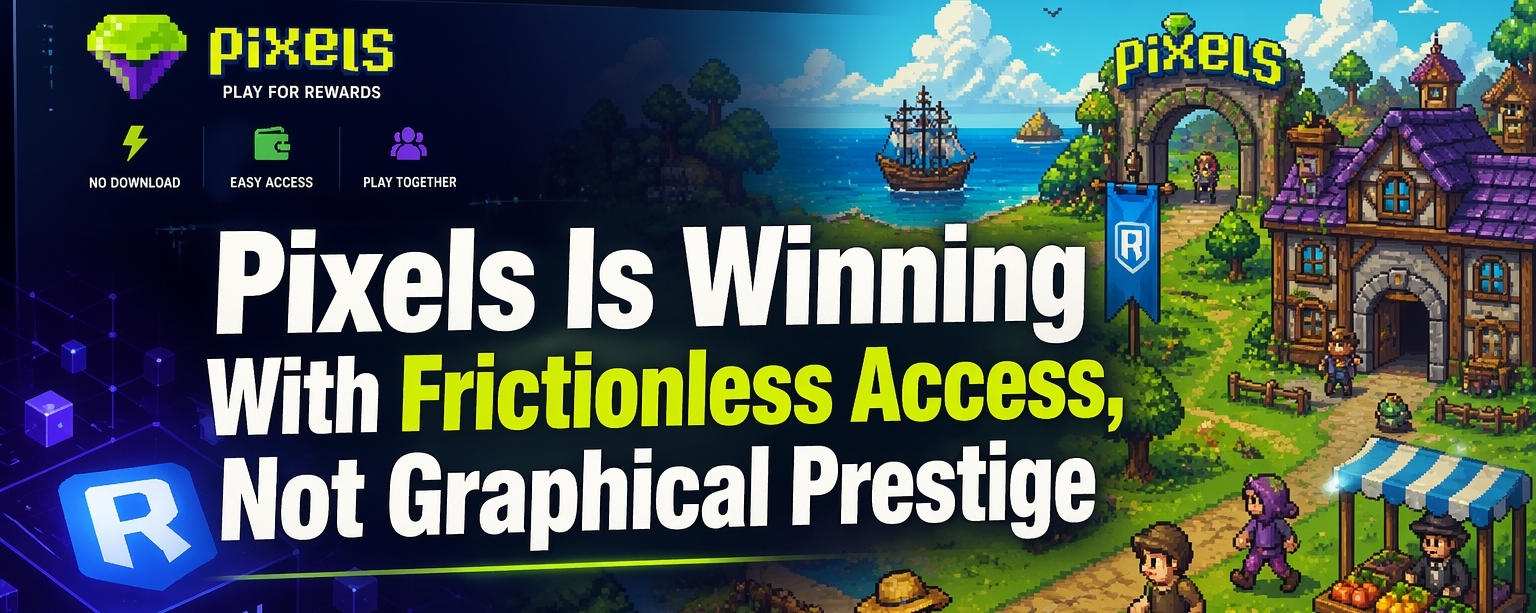
The more I watch Web3 gaming, the more I feel the industry keeps trying to win the wrong argument. It wants to prove it can look expensive. It wants to prove it can imitate the scale, polish, and visual ambition of traditional games. But when I look at Pixels, I do not see a project winning because it looks bigger. I see a project winning because it feels easier to enter, easier to understand, and easier to return to. That, to me, is the more important innovation.
What makes Pixels interesting is not that it tries to overwhelm you. It does the opposite. It meets you at a lower level of commitment. You open it, you move, you gather, you plant, you trade, you interact. The game does not behave like it needs to audition for your attention with spectacle. It behaves like it understands how people actually live online. That difference sounds small, but I think it is enormous.
Web3 gaming has spent too much time chasing legitimacy through visual ambition, as if better graphics will somehow wash away all the category’s deeper problems. I have never really believed that. A beautiful world means very little if the path into it feels annoying. People do not stay because a game looks impressive in a trailer. They stay because getting back into it feels natural. Pixels seems to understand this at a very instinctive level.
That is why the browser matters so much. To me, the browser is not just a technical choice. It is a philosophical one. It says the game would rather be available than intimidating. It would rather be part of your routine than a special event you need to prepare for. That feels much closer to how internet-native products succeed. They do not demand a ceremony. They slip into your habits.
I think that is where a lot of Web3 games still misread the player. They act like the player is standing there ready to be amazed, ready to tolerate setup friction, ready to forgive complexity because the promise of ownership is so powerful. But most people are not like that. Most people are impatient. They are distracted. They are comparing your experience against everything else they could be doing in the next thirty seconds. In that environment, accessibility is not a secondary advantage. It is the whole game.
Pixels feels like one of the clearest examples of this. Its world is light enough to enter quickly, but structured enough to make repeat behavior meaningful. That balance is harder to build than it looks. Anyone can say they want mass adoption. Fewer projects are willing to design for ordinary attention spans. Pixels does. And I think that is one reason it has managed to stay relevant while more visually ambitious projects often struggle to become daily habits.
What stands out to me even more is that Pixels does not seem obsessed with proving its seriousness through aesthetics. It feels more focused on rhythm, retention, and operational design. You can sense a product that is being tuned around return behavior. That is a very different mindset from building a game that mainly wants to impress people from a distance. Pixels, at its best, feels designed for closeness. It wants you to come back tomorrow, not just admire it today.
I also think there is something quietly honest about that approach. Web3 often talks in grand language about ownership, open economies, and digital sovereignty. But many users are not entering through ideology. They are entering through convenience. They stay because the product fits their day. In my view, Pixels understands that better than many projects that sound more ambitious on paper. It does not ask the user to care about the entire future of gaming before they plant a crop or join a loop. It just gives them a reason to begin.
That is why I do not see its lighter visual style as a weakness. I see it as restraint. It chose reach over intimidation. It chose flow over visual ego. It chose habit over spectacle. In Web3, that might end up being the smarter bet. The sector has been full of games that wanted to feel important. Pixels feels more interested in feeling usable. I trust that instinct much more.
If I had to put it simply, I would say Pixels is one of the few Web3 games that seems designed for real internet behavior rather than fantasy user behavior. Real users are busy. Real users are inconsistent. Real users abandon things quickly. A browser-native game that welcomes them back without effort has an edge that a more graphically ambitious project can easily underestimate.
So my own takeaway is this: Pixels may not be proving that graphics no longer matter. They always matter to some degree. But it is proving that in Web3 gaming, access might matter more. And personally, I think that is a far more important lesson than the industry is ready to admit. Because the future winner may not be the game that looks most like the old gaming world. It may be the one that understands the internet well enough to stop fighting how people actually use it.