
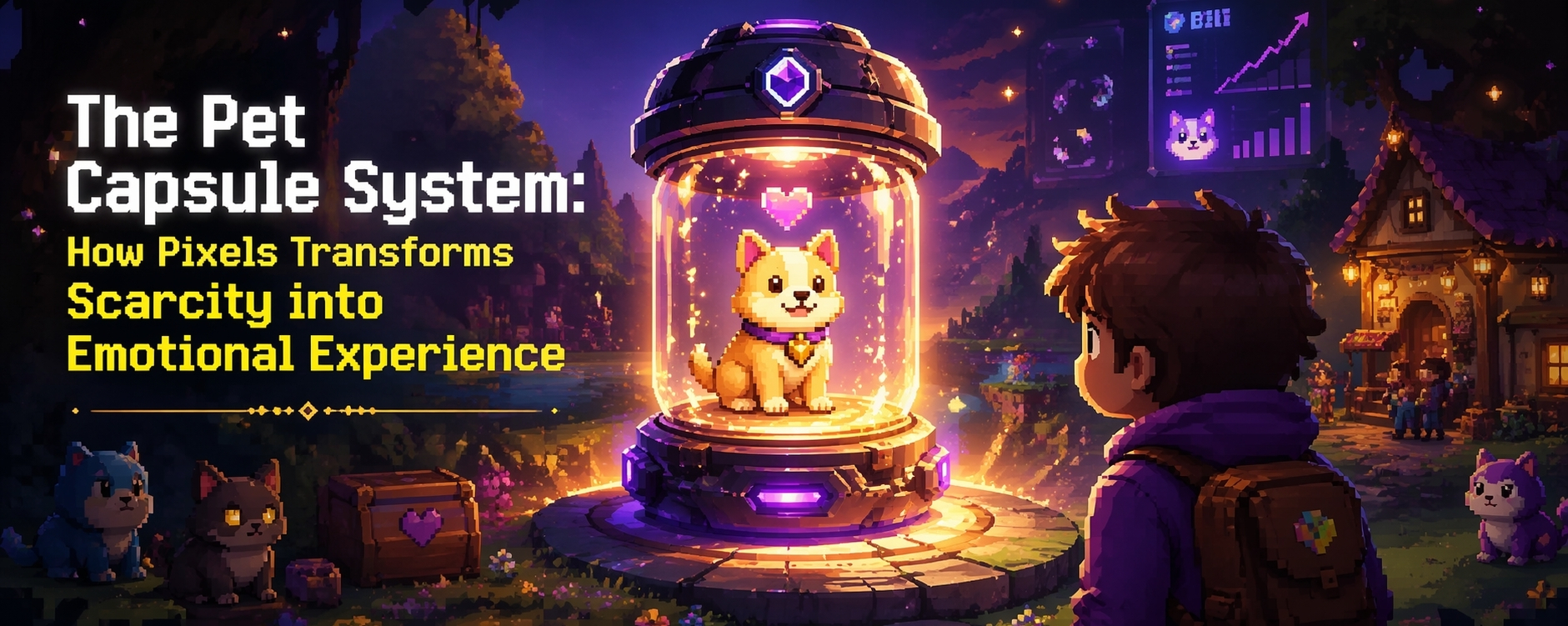

When artificial scarcity in games is discussed, the conversation usually stays focused on economics. The usual explanation is simple: when supply is limited, prices rise; when prices rise, rarity becomes more visible; and when rarity becomes visible, desire grows around it. That reading is not wrong, and it is the same lens through which most NFT scarcity, including the scarcity around Pixelsland NFTs, is usually understood. But the Pet Capsule system in Pixels feels different to me. It clearly has economic consequences, and the secondary market premiums attached to high-trait pets are real, but I do not think the main function of the scarcity is economic. What stands out more is the emotional role it plays.
What makes this system interesting is that it seems built to create feeling before calculation. It makes players want a pet before they fully step back and measure whether they truly need one. It gives the process of getting a pet a kind of weight that a normal fixed-price purchase would never have. If pets were simply sitting in a store, always available at a clear and permanent price, the decision would feel clean and practical. It would be easy, direct, and emotionally flat. The Pet Capsule system avoids that. It places uncertainty between desire and ownership, and that uncertainty changes everything.
That gap matters more than it may first appear. Once access becomes limited, timing becomes unclear, and outcomes are not entirely predictable, players begin to emotionally invest before they even own anything. The pet starts to matter before it arrives. That is what gives the system its strength. Scarcity here is not only being used to make an item rare in the market. It is being used to make the item feel important in the mind of the player. To me, that is the real design move underneath the system.
I think this becomes even clearer because pets in Pixels are not treated as simple decorations. They are not just visual additions meant to sit beside a character and signal status. They have practical use in play. They can improve range, add storage, and require care if their value is going to remain active. Their traits matter, their development matters, and the way they are maintained matters. That changes the emotional texture of ownership. A pet is not just acquired and displayed. It is raised, managed, used, and carried into the rhythm of daily play. That makes attachment feel much more natural.
This is why the scarcity works so effectively. If the capsules only delivered cosmetic variety, the excitement would probably burn hot and disappear quickly. It would feel more speculative than personal. But because the pet becomes part of how the game is actually lived, the moment of getting one feels like the beginning of something rather than the end of a transaction. The player is not just receiving an item with rarity attached to it. The player is receiving something that will continue to matter after the moment of acquisition has passed. That is a very important difference.
Another part of this, in my view, is the capsule format itself. A capsule creates a stronger emotional response than a normal purchase because it holds something back. It does not reveal everything upfront. It asks the player to commit before the full outcome is known. That turns the act of getting a pet into an experience of suspense and discovery. It is not just about buying access. It is about entering a moment where hope, expectation, and uncertainty are all active at once. Once trait differences are added into that process, each result starts to feel more personal and more memorable. Players do not just get pets; they remember how they got them, what they hoped for, and how the result compared with what they imagined.
This is also why I think the emotional side of the system should not be treated as secondary to the economic side. The market exists, of course, and it matters. Prices, floor activity, rarity premiums, and holder demand are all part of the picture. But those things feel like outcomes of something deeper rather than the deepest point themselves. Before the market assigns value, the design has already created emotional weight. It has already made the pet feel like something worth caring about. In that sense, price does not fully create significance. Often, it simply reflects significance that has already been successfully built into the player experience.
What this suggests to me is that the Pet Capsule system reveals something meaningful about what kind of game Pixels is trying to be. It does not seem interested only in making progression efficient or making digital goods tradable. It seems interested in making moments feel memorable. It seems interested in making ownership arrive with tension, anticipation, and a sense of personal importance. It wants players to remember the path to the pet, not just the pet itself. That is a more thoughtful and more layered use of scarcity than most discussions usually give it credit for.
So when I look at the Pet Capsule system, I do not see scarcity working only as an economic mechanism. I see it working as a design choice that gives emotional weight to digital ownership. By limiting access, varying outcomes, and tying pets to ongoing care and utility, Pixels turns acquisition into something that feels meaningful rather than routine. The player is not simply buying a commodity. The player is stepping into a moment that feels rare in a human sense before it ever becomes rare in a market sense. That, to me, is what makes the system more sophisticated than most surface-level readings of scarcity in games allow.