
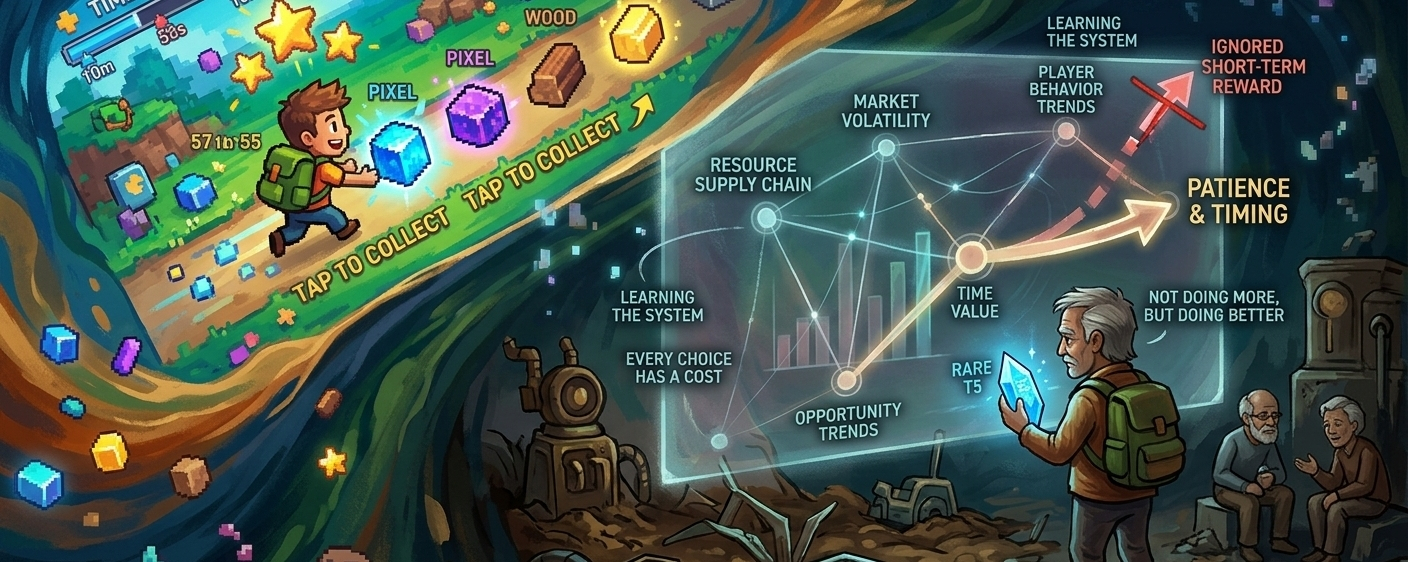

I didn’t notice the change right away.
At first, Pixels felt simple. I’d log in, do a few tasks, collect PIXEL, and get off. It was easy to enjoy because I didn’t have to think too much. Just play, progress, repeat.
But over time, I started paying attention to how people actually move inside the game.
New players usually play fast. They use what they get, take every reward they can, and keep going. That’s the normal way to play any game.
But players who have been around longer don’t always do that.
They wait more. They think more. Sometimes they don’t even take the obvious reward.
That was the first moment where Pixels started feeling different to me.
Because why would someone ignore something valuable unless they understood something deeper about the system?
The more I looked at Tier 5, the more I understood it.
It stopped feeling like a normal game loop and started feeling like a place where every decision matters. Resources are not just there to be used. They move, they disappear, they come back in other forms, and sometimes they lose value if you use them at the wrong time.
That changes the way you play.
You stop thinking only about what you can do next, and start thinking about what makes sense to do next.
That’s a big difference.
And I think that’s why Pixels doesn’t feel like “just another game” to me anymore.
It feels like a system that quietly teaches you to slow down.
The game doesn’t force you to think. It doesn’t stop you and explain everything. But the longer you stay, the more it rewards patience, timing, and self-control over rushing.
That kind of design is interesting to me because it changes where the fun comes from.
The fun is not always in doing more.
Sometimes it’s in making a better choice.
Sometimes it’s in waiting.
Sometimes it’s in realizing you avoided a mistake.
That feeling is harder to describe, but it feels more real.
It reminds me of real life in a strange way. Like when you start paying attention to your money, your time, or your energy. Things that once felt casual suddenly start to feel important because now you understand that every choice has a cost.
That’s what Pixels feels like to me now.
Not just a game I play for rewards, but a system I’m slowly learning to understand.
And maybe that’s why different players seem to experience it so differently. Some are still exploring. Some are already planning three steps ahead. Some are playing the surface, while others are trying to read what’s underneath it.
Same game, different mindset.
And honestly, that’s what keeps me thinking about it.
When a game starts rewarding patience more than speed, and understanding more than action, it stops feeling simple.
It starts feeling like something you have to learn.
