

I have sat through enough crypto game launches to know the difference between something people play and something people farm. A lot of these projects look busy for a week, maybe two, and then the charts tell the truth. The wallets stop moving. The token starts leaking. The Discord gets quiet. Pixels feels different, and that’s why it keeps coming up. It’s not because it invented play-to-earn. It’s because it seems to understand that people don’t stick around just for rewards. They stay when the game gives them a reason to come back tomorrow. Simple as that. And honestly, that’s rarer than it should be.
When Pixels moved to Ronin in 2023, the project started picking up traction, with reports putting it above 180,000 daily active users. Then in 2024, DappRadar said it was one of the biggest blockchain games around, even crossing 1 million daily active wallets at points. Those are big numbers, no doubt. But here’s the part traders pay attention to: do those numbers mean retention, or do they just mean the latest reward cycle worked? Because volume without loyalty is just noise with better packaging. And in crypto gaming, noise can look like growth right up until it isn’t.
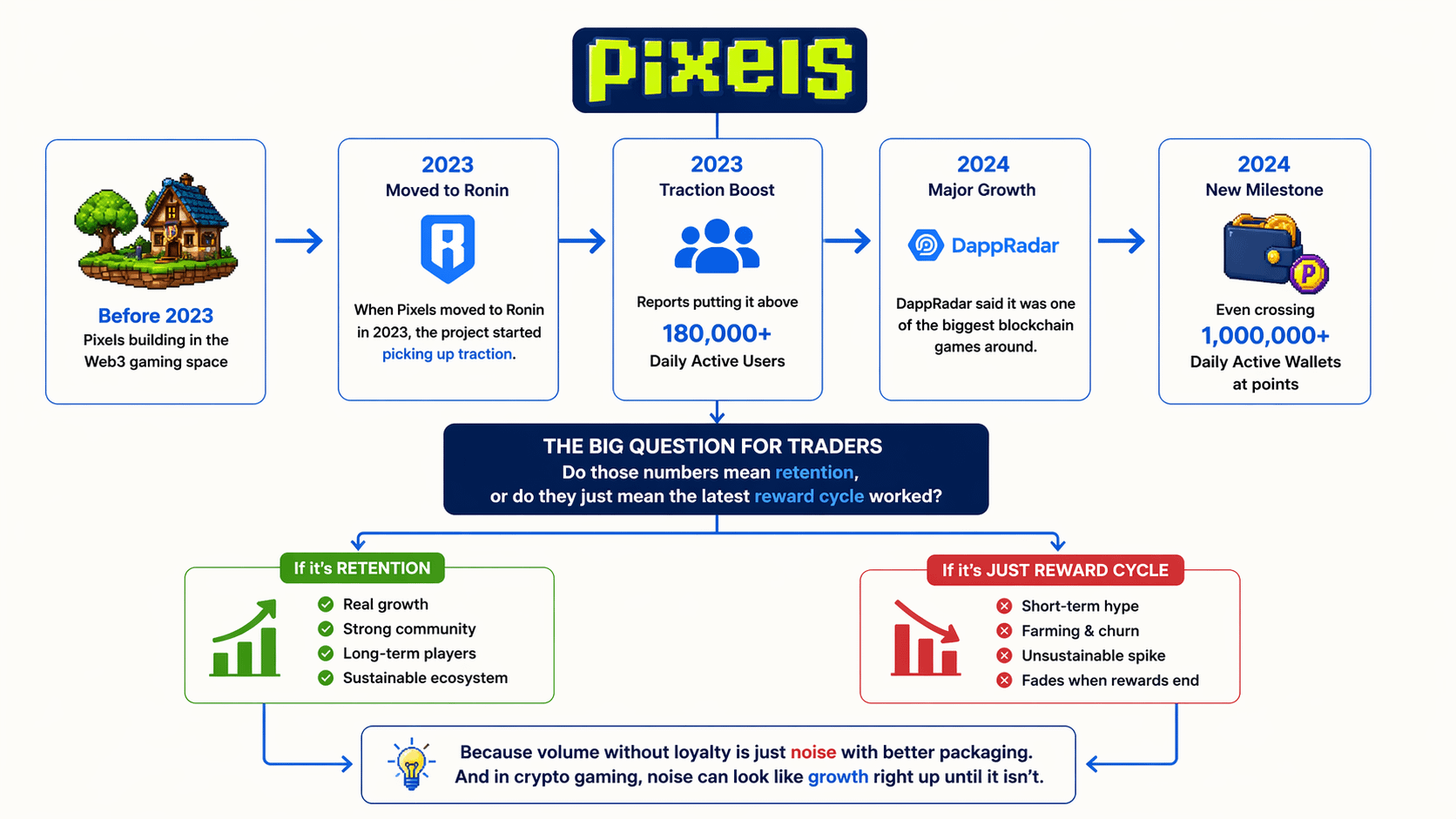
This is where the retention problem matters, and it matters a lot. In plain English, retention is whether players keep coming back after the first rush is over. If they don’t, the whole project gets shaky. Why? Because every player who leaves usually leaves behind one thing: sell pressure. They farm the token, maybe flip some in-game assets, then move on. The next wave does the same. That’s fine for a while, but long term it chews through confidence. The token starts to feel less like a part of a game economy and more like a coupon that expires the minute the music stops.
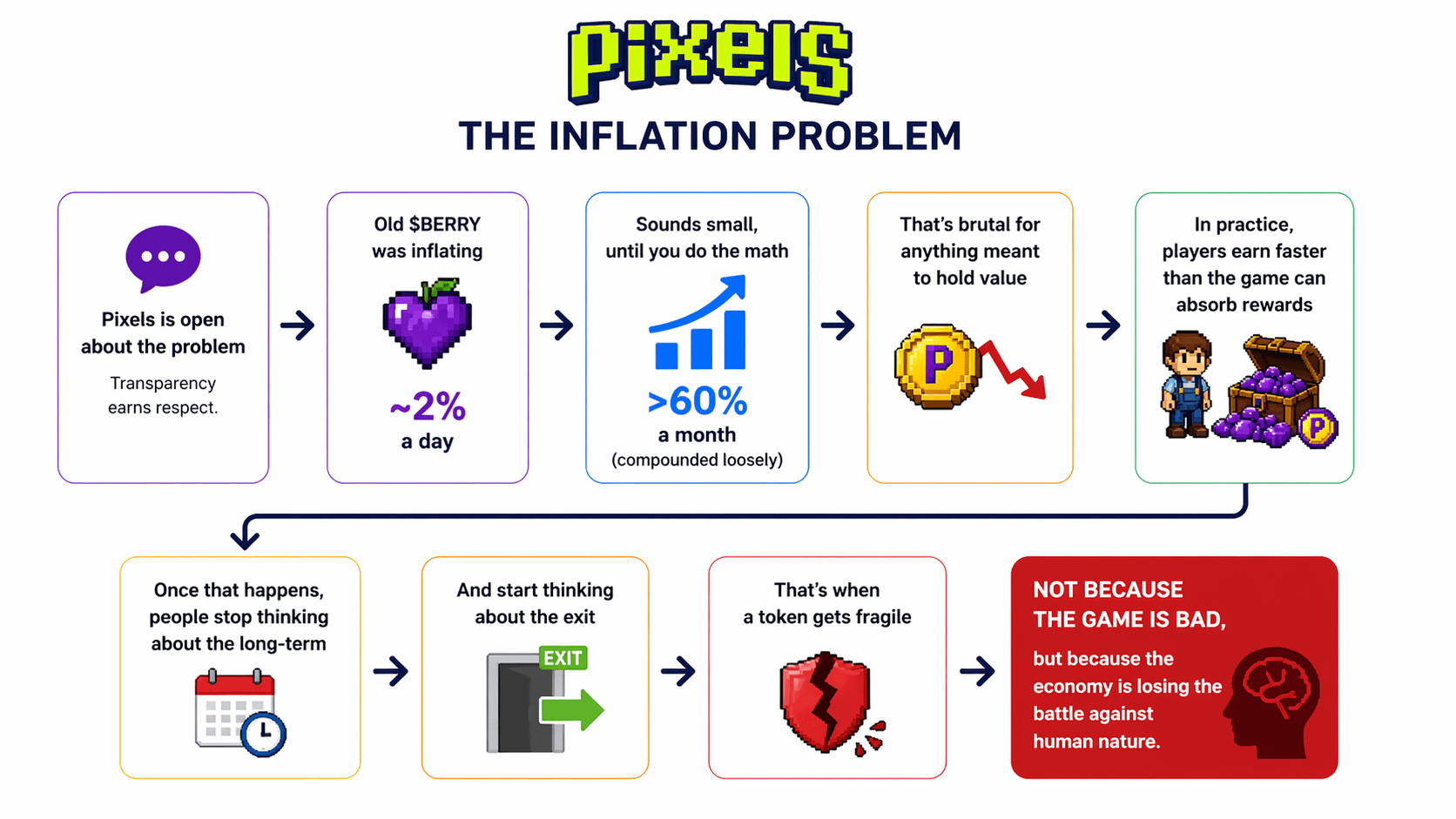
Pixels has been pretty open about this problem, which I respect. Its old $BERRY currency was reportedly inflating at around 2% a day. That sounds small until you do the math. Two percent a day is more than 60% a month if you compound it loosely, and that’s brutal for anything meant to hold value. In practice, that means players are earning faster than the game can absorb the rewards. Once that happens, people stop thinking about the long-term and start thinking about the exit. That’s when a token gets fragile. Not because the game is bad, but because the economy is losing the battle against human nature.
The team’s answer was to phase out $BERRY and lean into $PIXEL, with a conversion rate of 1,000 $BERRY to 7.6175 $PIXEL. That move tells you a lot. It says they know the old setup was too loose. Too easy to print. Too easy to sell. And that’s a weakness worth mentioning in the middle of all this: even if the game is fun, if the reward structure keeps pushing players toward quick profit, the token can still get dragged down. You can dress it up with updates and new features, but if the economy doesn’t hold, the chart will eventually show it.
What Pixels seems to be doing better than a lot of others is trying to make the loop feel normal. Daily tasks, crafting, land, progress, social stuff, little routines that give players a reason to return. That matters because real gaming is built on habit, not just hype. You don’t need to love every mechanic. You just need enough momentum to log in again. And that’s the part most play-to-earn projects never really figure out. They pay too much attention to the first day and not enough to day thirty.
Still, let’s not kid ourselves. This is a hard market. In 2024, blockchain gaming across the sector was pulling in millions of daily active wallets, so competition is ugly. Players have options. If Pixels slips on fun, or if the token economy starts feeling tight in the wrong way, people will walk. Fast. That’s the risk. Not some dramatic collapse. Just slow boredom, then quieter wallets, then weaker demand. It happens more often than people admit.
So yeah, my honest take is this: Pixels is one of the few play-to-earn projects I’d keep watching, because it seems to understand the retention problem instead of pretending it doesn’t exist. I’m not calling it a sure thing. I’m just saying it’s building in the right direction, and in this space that already puts it ahead of a lot of projects.