
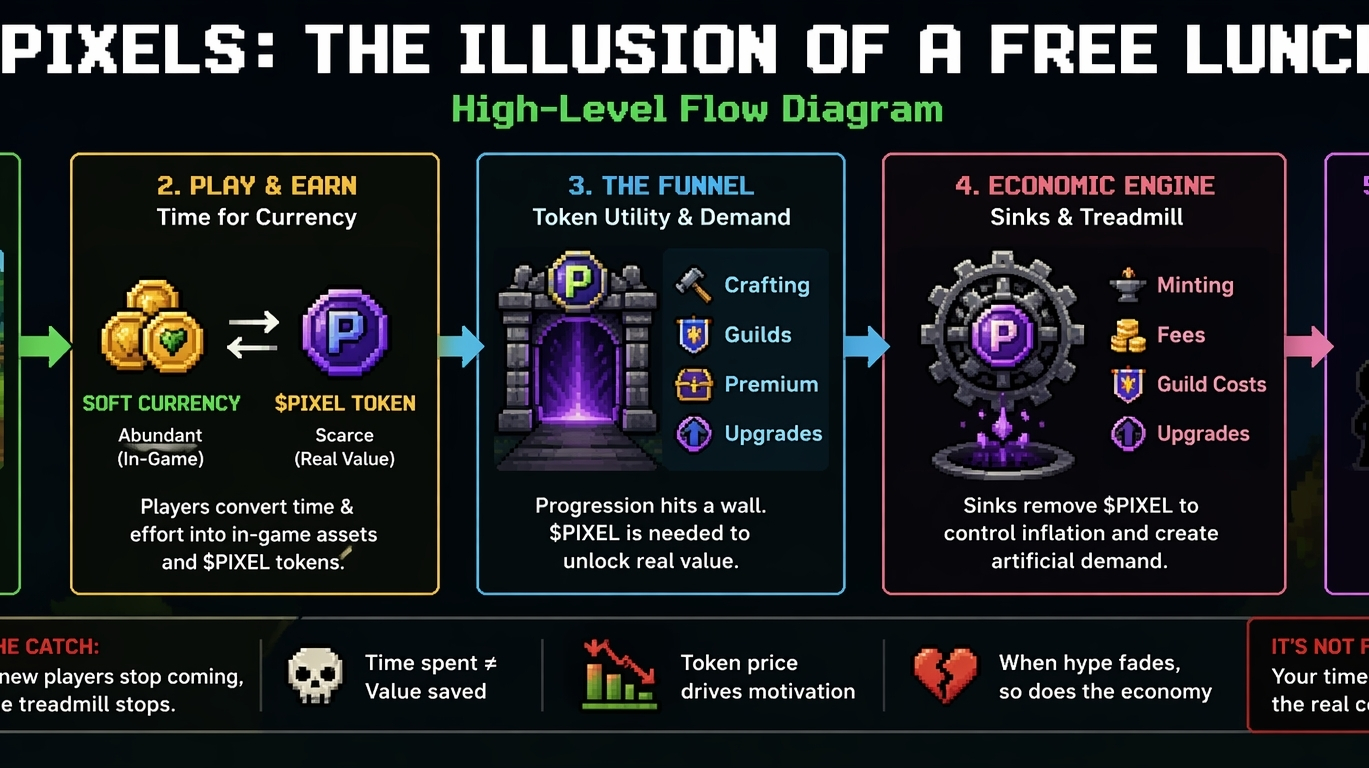
We need to talk about Pixels. It has been the darling of the Web3 gaming narrative for months, quietly accumulating users on the Ronin network with the kind of metrics that make venture capitalists nod in approval. On the surface, it presents itself as a charming, accessible farming game, a sort of Stardew Valley for the crypto-native generation. It feels free. It feels casual. But if you have been in this industry as long as I have, you know that nothing is truly free, especially not on a blockchain. The $PIXEL token, and the economic architecture it supports, is not just a reward system; it is a sophisticated mechanism for value extraction, and the real question is whether the players are the customers or merely the product.
The core promise of Web3 gaming has always been the shift from "playing to win" to "playing to earn," a distinction that sounds revolutionary until you realise it turns a pastime into a low-wage job. Pixels claims to solve the onboarding problem. It strips away the complex barriers to entry that plague most decentralised applications. You log in, you farm, you interact. It is simple, addictive, and undeniably well-executed. However, the problem it claims to solve—accessibility—is not the actual problem hindering the mass adoption of blockchain gaming. The real problem is the sustainability of economic models that rely on constant growth to pay off earlier participants. Pixels has built a beautiful interface, but it sits on top of the same precarious economic foundations that caused the collapse of the last bull run's play-to-earn giants.
Most casual observers look at Pixels and see a game. They see pixelated avatars watering crops and building guild halls. What they miss is the intricate web of incentives designed to keep the liquidity flowing upwards. The game operates on a dual-currency system, a tried and tested method to separate in-game activity from real-world value. You earn a soft currency through gameplay, which is abundant and inflationary, and a hard currency, $PIXEL, which is scarce and necessary for progression. This structure creates a bottleneck. To advance, to truly capitalise on your time investment, you must eventually interact with the token. It is a funnel, guiding players from the open fields of free-to-play into the walled garden of tokenomics.
The system functions like a casino where the chips are purchased with your time. Players generate value through their attention and labour, converting time into in-game assets. The architecture ensures that while the soft currency circulates within the game's closed loop, the real value accrues to the PIXEL token holders and the ecosystem treasury. The "free" aspect is merely the loss leader, the complimentary buffet designed to keep you on the casino floor. When a player decides to mint an item, join a guild, or access premium features, the system demands $PIXEL. This creates demand for the token, artificially propping up its price, while the in-game economy effectively subsidises this value through the sheer volume of player hours expended.
The economic layer is where the gloves come off. The PIXEL token is presented as a governance and utility token, but in reality, it acts as a toll. It is the gatekeeper to the game's meaningful economy. The model relies heavily on the "sink" mechanics—mechanisms that remove tokens from circulation to combat inflation. These sinks are necessary, but they also represent a constant drain on the player base. For the system to work, new players must enter the ecosystem at a rate that exceeds the rate at which existing players extract value. It is a demographic treadmill that requires constant feeding. When the hype dies down and the new user acquisition cost spikes, the treadmill stops, and those left holding the assets find their time was spent on depreciating digital real estate.
What makes this model interesting, and indeed dangerous, is the veneer of sustainability it paints over the underlying volatility. Unlike the blunt force of early play-to-earn models, Pixels integrates token utility deeply into the gameplay loop. You do not just earn and sell; you earn, craft, build, and burn. This creates a psychological lock-in. Players feel invested. They see their farms growing. It feels less like a speculative bubble and more like a genuine digital society. This is the brilliance of the design. It masks the economic mechanics with genuinely engaging gameplay. But the mask does not change the face underneath. The game is still, fundamentally, an on-ramp for crypto speculation.
The hard problem Pixels faces is one of identity versus economy. To succeed as a game, it must prioritise fun. To succeed as a crypto project, it must prioritise token price. These incentives are rarely aligned. When the token price dips, the incentive to play diminishes, turning the "players" into "unemployed workers." When the token price moons, the economy risks overheating, attracting bots and gold farmers who degrade the experience for genuine users. Balancing this is not a technical challenge; it is an economic impossibility for a system that relies on token appreciation as a primary metric of success.
Let's be honest about the reality here. We have seen this movie before, just with better graphics this time around. The migration to Ronin was a strategic move to lower fees and target a specific demographic of Web3 users, but it did not alter the fundamental nature of the economic trap. The marketing talks about community and ownership, but the ledger tells a story of value shifting from the many to the few. The "catch" that the marketing team glosses over is that for every winner in a PVP economy, there must be a loser. In a well-designed game, the fun is the product. In a tokenised game, the player's time and money are the product.
If the music stops, the $PIXEL token will not save your farm. It will not protect the hours you spent grinding for resources. It is a mechanism for shifting value, and right now, it is shifting it beneath the surface, away from the players tending their digital fields and toward the early adopters, liquidity providers, and the team treasury. The game is free to play, yes, but the cost of participation is your time, and in this market, time is the most expensive asset you have.