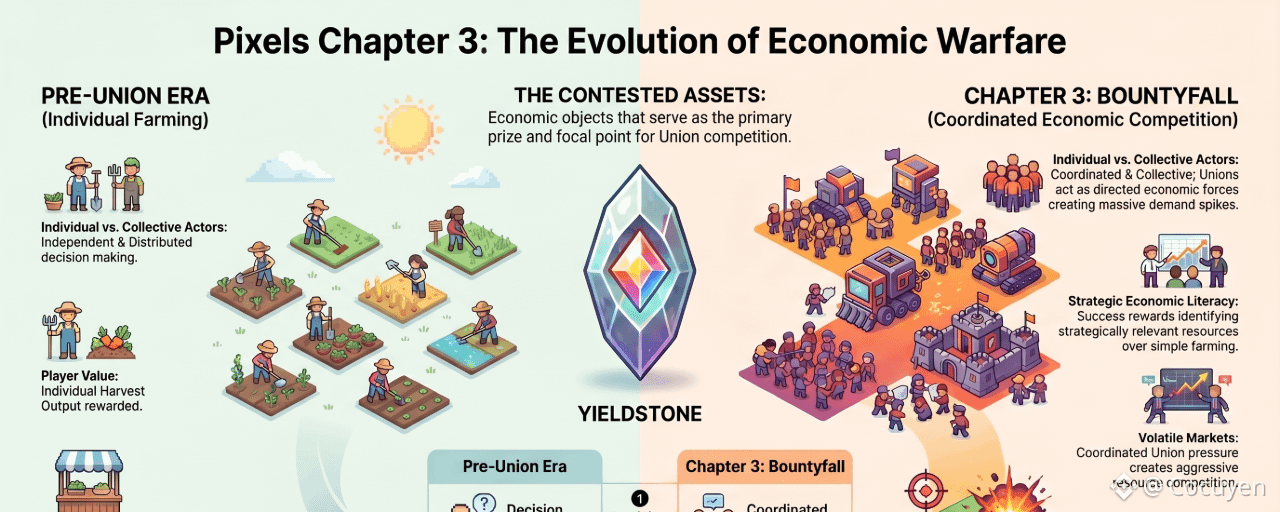
Honestly… I didn't expect to feel this particular attention when reading how Pixels built the competition part in Chapter 3.
Not skepticism. Not worry. But rather a feeling similar to when a design decision at first glance seems like a PvP feature but turns out to be one of the most interesting economic architectural moves the game has ever made.
Because there is a pattern in how Web3 games add competitive mechanisms that the sector embraces without considering the actual impact of competition on the underlying economic layer. The standard approach is to attach PvP to an existing economy. It creates a secondary race where players fight each other for rewards while the core token economy operates separately. The competitive layer and the production layer never really interact with each other.
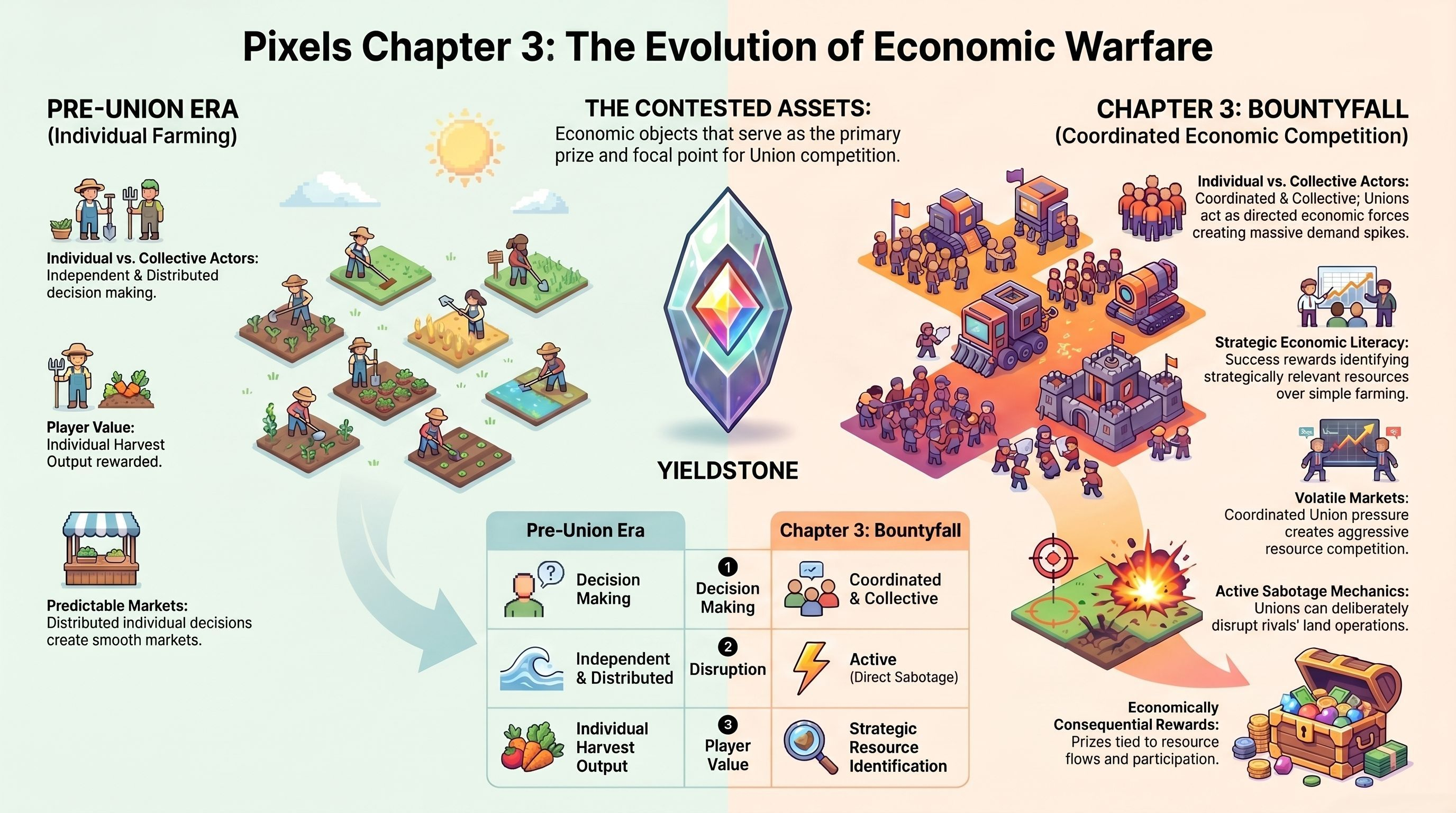
But Pixels has taken a different path. Alliances, energy stones, and player disruption are not a separate competitive mode added to the agricultural economy. They are a competitive system where the outcomes are reflected through the same production economy that landowners and manufacturers are operating.
Because the features they describe are real. Chapter 3: Bountyfall launches on October 31, 2025, and introduces team competition around Alliances, with Yieldstones as the economic object being contested and disruption as the primary mechanism of the competition. This is not a scoring system with token rewards. This is a layer of competition where the rewards are directly tied to participation and its mechanism interacts with the same resource flows that non-competing players are also dependent on.
Um… competitive design is really interesting.
But competitive design has never been the hard part when adding PvP elements to the game’s economy.
The difficulty lies in what happens to the economy when competing enterprises and producing enterprises operate in the same resource environment at the same time.
Because this is what I always come back to. Before there were Alliances, the main agents in the Pixels economy were individual players making independent decisions. The landowner decides when to harvest. The artisan decides which recipe to use. Players who do not own land decide how to allocate their time to their tasks. Those decisions are allocated to thousands of individuals not coordinating with each other, meaning that overall economic behavior is relatively smooth and predictable at a level that the development team can observe and adjust.
Unions bring collective coordinated agents into that same environment.
An Alliance identifying a type of resource related to a type of Energy Stone being contested and coordinating farming pressure towards that resource is not ten players making ten independent decisions. It is a directed economic force with competitive motivation to act faster and stronger than any individual farmer. The resource supply that the manufacturing economy relies on to stabilize prices now has to withstand demand volatility from organized groups competing for outcomes unrelated to manufacturing.
Then there's the issue of disruption. Of course.
And this is what makes the design truly compelling to analyze. Disruptive behavior as a competitive mechanism means that an Alliance can actively disrupt the production capacity of another Alliance. In a purely individual player economy, disruption is not a designed mechanism. Prices fluctuate, content changes, players adapt. But disruption is passive and dispersed. Disruptive behavior is active and targeted. A successful Alliance in disrupting the land operations of its opponents is intentionally removing production capacity from the economy, not just a side effect of optimizing their own.
The economy must simultaneously absorb both competitive pressure from demand and supply disruption due to active disruptive behavior. How these two forces interact with the traditional craft economy predates the advent of unions is a question that design raises every time a competitive event between guilds occurs.
There is also an aspect that few mention.
The farmers' unions create a new type of meaningful economic relationship that has never existed in the individual farming model. The most valuable players to a union are not necessarily the best individual farmers. They are those who understand the economy well enough to identify which types of resources are strategically relevant to the current competitive goals and adjust the union's farming capacity accordingly. Strategic economic understanding is now a competitive skill rewarded directly through the union's participation, not just through profits from individual land.
However… I would still say this.
Deciding to turn competition into a meaningful economic factor rather than just a token reward reflects a true understanding of what keeps players engaged long-term in a token-based economy. A competitive system where winning truly matters to the underlying economy will create motivations that leaderboard scores can never provide. The design of Unions is ambitious and completely on the right track.
The question is whether the participants in the competition within the Alliance think about the impact of their coordination on the broader resource economy, or if they are considering competitive goals separately from the production ecosystem in which they operate.
And in this space, unions that understand both of these aspects are always the unions with a solid economic position after the competitive event ends.
@Pixels #pixel $PIXEL $PIEVERSE $GUN