
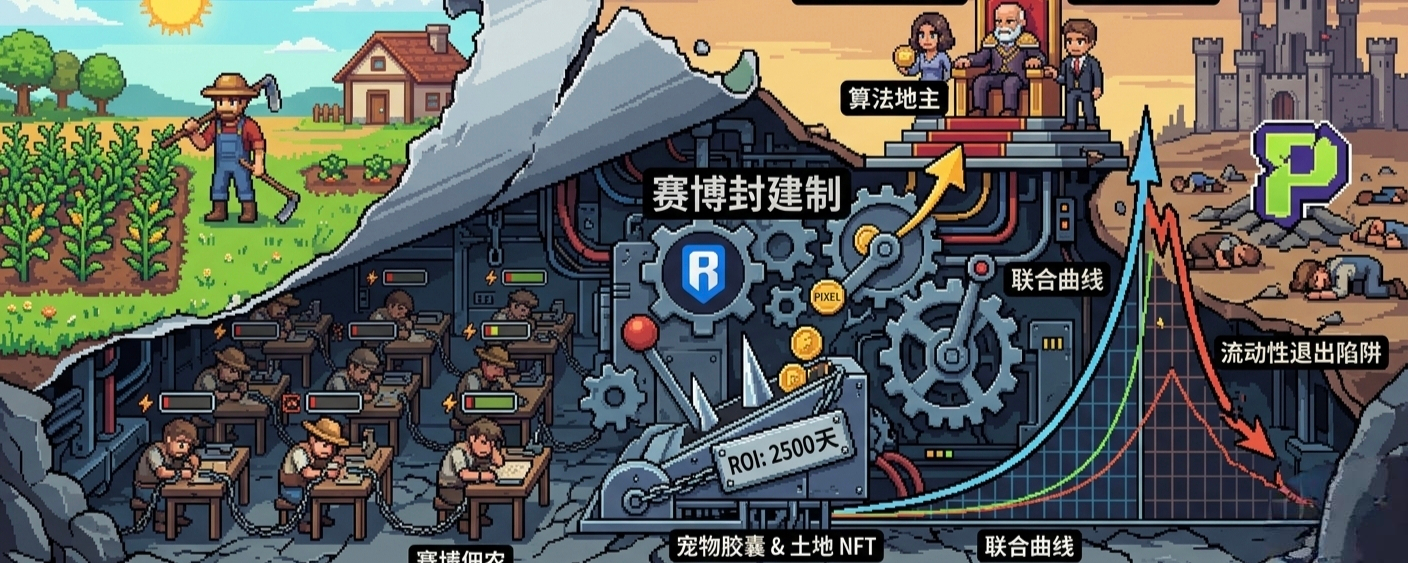

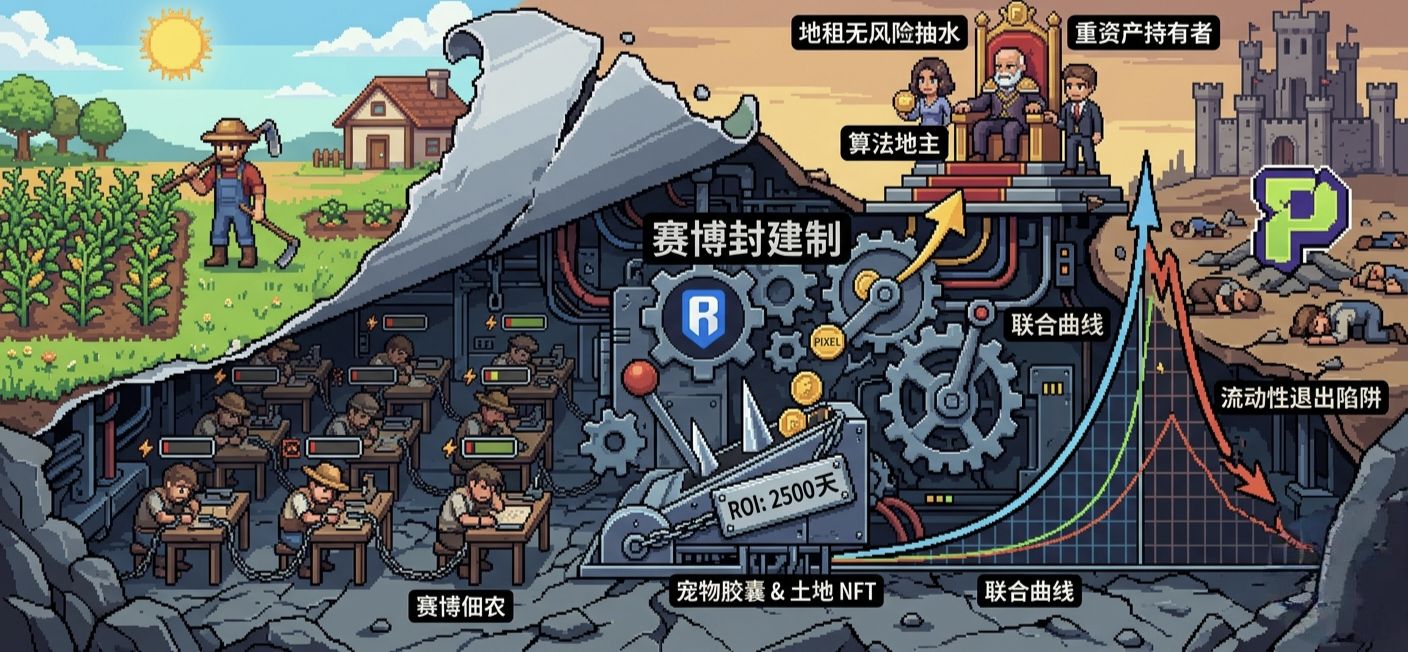
 Since @Pixels the pet system (Pets) was launched and the land tax mechanism was adjusted several times, I have actually stopped viewing it as a 'Web3 version of Stardew Valley' a long time ago. On the surface, it focuses on casual farming and resource gathering, but when you break down the pricing curve of the pet blind box and the water extraction ratio of the landlord class, this is not a farming game at all; it is essentially a feudal rent system highly controlled by 'cyber landlords' and 'heavy asset holders.'
As a 'data fanatic' accustomed to watching token emission curves and changes in holding addresses to find loopholes, I did not study how to match pet appearances to look the cutest, but instead directly pulled the minting data of pet capsules (Pet Capsule), the marginal effects of energy gains, and the tax flow on the Ronin chain over the past month, running a calculation model. After the calculation, the cold logic behind this 'account' is more sophisticated than a simple guild fund scheme.
The trap of 'productive tools' and the true return cycle of heavy assets
The circulating currency on the surface of Pixels is $PIXEL and gold coins, but the true moat at the bottom is 'core productive assets' (such as high-level pets and NFT land). The official has packaged pets as essential tools to improve mining efficiency, but from the financial statements, this is actually an extremely over-issued inferior asset.
Let's look at a set of calculation data for 'heavy investment' gold mining players:
Capital expenditure (CAPEX) threshold: Currently, forging an initial pet capsule in the game costs a rigidly anchored 500 PIXEL (approximately $150-200 at current prices). This is only the blind box cost, not including the ongoing potion consumption for feeding and upgrading.
Capital marginal returns: Players spend heavily to buy pets, with the core demand being to obtain daily additional 'energy boosts'. A mid-tier pet provides about 40-50 additional energy points per day. Based on the average income of the current task board, the conversion rate (EPR) per energy point has dropped to around 0.004 PIXEL. This means that the additional net output brought by this pet is only 0.16 to 0.2 $PIXEL per day.
Real return cycle (ROI): Without calculating the price drop risk of $PIXEL and without betting on the extremely low probability of high rarity mutations, relying solely on energy gains to mine, the static return cycle of pets has been extended to an appalling 2500 days.
From the perspective of traditional finance, this is equivalent to retail investors buying an expensive mining machine with minimal computing power. Retail investors think they are buying a productive tool that can achieve 'class transcendence,' but under a highly asymmetric pricing model, they are actually providing a huge liquidity buffer for the official to recapture tokens and reduce sell pressure.
Cyber rental system: The 'no-risk siphoning' of the landlord class
I further tracked the on-chain flow data of core resources (such as mint, silk, and other advanced materials), trying to see the true wealth distribution map in this game. The 'on-chain Gini coefficient' presented by the data is suffocating:
Systematic tax exploitation: Over 80% of high net worth task board orders must rely on specific workbenches on advanced land (Land NFT). The top 1% of high-level lords directly siphon off the labor surplus value of lower-tier players by setting rigid resource processing taxes as high as 15%-20%.
Absolute solidification of class: Among the millions of PIXEL produced daily across the network, nearly 40% of hidden value flows unidirectionally into the addresses of fewer than 500 giant landowners through complex land interactions, tolls, and processing station taxes.
In traditional Web2 MMOs, big spenders (whales) spend money for enjoyment, and ordinary players can earn money from big spenders by grinding; but in Pixels, big spenders (landlords) not only do not consume the output of lower-tier players but instead suck the blood of the lower-tier through 'land rent' without risk. As long as you don't have tens of thousands of U to buy Land NFT, your identity in this game will always be the siphoned 'cyber tenant.'
The 'pseudo-internal demand' blind spot of token sedimentation
From the perspective of economic model auditing, the most fatal blind spot of the current system lies in: the in-game sink pools heavily depend on 'blind box gaming' rather than real consumer demand.
Although the pet capsule priced at 500 PIXEL has indeed recovered a large number of tokens in the short term, this essentially exploits human 'gambling psychology.' Once these heavily invested players discover that pets cannot recoup their costs at all (even the liquidity in the secondary market is drying up), this reliance on a 'selling shovels' deflationary mechanism will come to an abrupt halt. Without new players taking over high-priced shovels, the sell pressure of $PIXEL will backlash against the entire economy like a tsunami.
Conclusion: Waiting for the turning point to break the 'computing power shackles'
My current judgment is: Don't be fooled by the bustling crowd in Pixels' social square every day; what truly determines its life cycle is the 'labor tolerance' of the lower-tier tenants and the 'pressure restraint' of the landlord class. I am currently focusing on two core indicators: first, whether the turnover rate of pets and land in the secondary market (such as Mavis Market) has experienced a cliff-like decline; second, whether a type of asset that 'does not aim to improve mining efficiency' can emerge in the game (such as purely decorative manor construction).
Likewise, I do not say this to short Pixels. It dares to bring the most naked 'land finance' and 'heavy asset renting' on-chain, which is itself a highly ambitious large-scale sociological experiment, and it shows us the complexity of the Web3 economy. But what I look forward to more is that one day, a player buys a pet just because 'it is cute while accompanying me in farming,' rather than calculating every day 'how many coins this electronic dog can help me mine tomorrow,' then we can truly say that chain games have stepped out of the quagmire of 'Ponzi computing power'.#pixel