
Most Web3 games are still asking the same question: "How do we get more players?" Pixels started asking a harder one: "How do we keep the right ones?" That shift—from acquisition to retention, from quantity to quality—is the quiet thesis behind Stacked. And it changes everything about how we should value $PIXEL.
For years, the GameFi playbook was simple. Launch a token. Attach it to a quest board. Watch the numbers spike. Hope the music doesn't stop before you've extracted enough value to move on. The model worked just long enough to fool a lot of people. But the pattern always broke in the same place. Players came for the yield. They left when the yield dried up. The game was never the point.
The team behind Pixel's lived through this firsthand. They watched bots game the system. They saw reward budgets leak to users who never intended to stay. They learned, through millions of players and hundreds of millions of reward events, that the hard part of Web3 gaming isn't putting assets on-chain. It's managing incentive alignment at scale.
Stacked is the product of those scars.
Not Another Quest Board
Let's be clear about what Stacked actually is. It's not another generic rewards app. It's a rewarded LiveOps engine with an AI game economist on top—infrastructure designed to answer a deceptively simple question: Who should get rewarded, for what, when, and with what kind of reward?
Most play-to-earn systems fail because they optimize for extraction, not engagement. They reward activity without distinguishing between a loyal player building the ecosystem and a bot farming the loophole. Stacked flips that entirely. It targets the right reward to the right user at the right moment—and then measures whether that reward actually improved retention, revenue, or LTV.
This is not a semantic difference. It's a completely different economic model.
The AI Layer: Insight to Action, No Waiting
The true differentiator inside Stacked is the intelligence layer. Studios integrating Stacked gain access to an AI game economist capable of analyzing cohorts, spotting churn patterns, and suggesting experiments worth running next.
Instead of wondering why whales are dropping between Day 3 and Day 7, a studio can ask the system directly. Instead of guessing which mechanics correlate with long-term retention, they can run targeted campaigns and measure the lift. The system generates reports, identifies meaningful cohorts, and helps teams create new reward logic tied to outcomes they actually care about.
This was built in production, not in a deck. Shaped by thousands of experiments across live game systems. Insight to action. No waiting.
Where Pixel Fits
This is where the token thesis gets interesting.
In a single-game economy, a token's fate is tied to the popularity of one title. If engagement dips, the token suffers. Stacked rewires that risk profile entirely. It positions Pixels not just as a game studio, but as B2B infrastructure for the broader Web3 gaming industry.
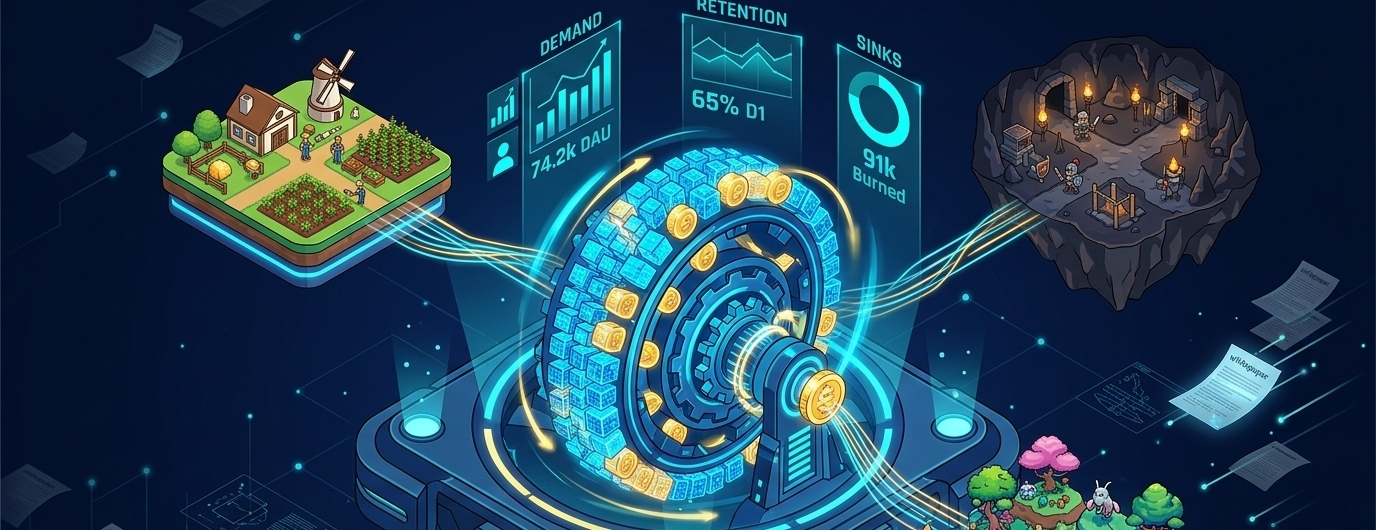
Pixel sits inside this engine as the cross-game rewards and loyalty currency. As more studios plug into Stacked—joining the existing ecosystem of Pixels, Pixel Dungeons, Sleepagotchi, and Chubkins—the demand surface for Pixel expands. More games mean more sinks, more utility, and more reasons for the token to move through the system rather than sit idle.
The team has been transparent about the evolution. Over time, Stacked will support multiple reward types, including USDC and Stacked Points. Long-term, Pixel is expected to become more staking-centric—a governance and loyalty asset that aligns long-term participants with the growth of the ecosystem itself. This isn't dilution. It's maturation.
The Moat Is Real
Here's the line that separates Stacked from the endless parade of whitepaper projects: This was built in production, not in a deck.
The fraud prevention systems, the anti-bot logic, the behavioral data at scale—these aren't theoretical features. They're battle-tested components that have already processed hundreds of millions of rewards and helped drive over $25 million in revenue inside the Pixels ecosystem. The numbers are public: 131% ROI on reward spend, 178% boost in re-engagement conversions.
Most teams can ship a quest board. Very few can build a reward system that survives real adversarial usage at scale. Stacked already has. That scar tissue is the moat.
The Flywheel
The mechanics are straightforward but powerful. More studios plugging into Stacked means more demand surface for PIXEL. More demand means more reasons to hold rather than dump. Less sell pressure creates a stronger floor. A stronger floor attracts more studios. The flywheel turns.
This is how you build a token that outlasts hype cycles. Not by forcing demand through speculation, but by distributing it across multiple ecosystems. Players who never touch the original farm may still hold PIXEL because it unlocks value in Pixel Dungeons, or Chubkins, or a future title that hasn't launched yet.
Demand isn't forced. It's distributed.
The Quiet Engine
The market is conditioned to chase spectacle. Big announcements. Loud partnerships. Flashy roadmap reveals. Stacked is none of those things. It's quiet infrastructure. It's the engine humming under the hood while players tend their crops, explore dungeons, or raise their Chubkins.
But quiet engines run longest.
Pixels is no longer just a game. It's evolving into a shared rewards layer across a growing ecosystem—a digital nation with its own economy, its own incentive structures, and its own loyalty currency. Pixel isn't searching for utility. It's busy powering it.
Most GameFi tokens follow the same arc. Hype. Launch. Inflation. Dump. Dead community. The ones that break that cycle have one thing in common: the token has a real job inside a real economy.
PIXEL has a job. And it's just getting started.