
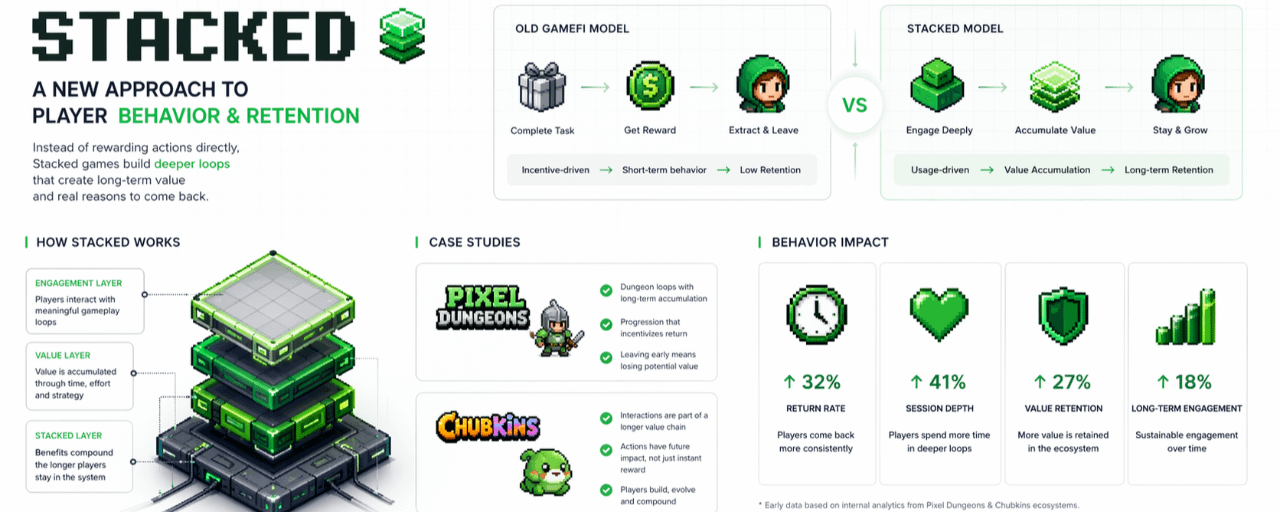
I have seen too much already, too many “new systems” being introduced as a solution for GameFi. Each cycle has a different name. Play to earn, play and earn, then social layer, then onchain economy. It sounds different, but when looking closely, it still feels the same; players come in for the rewards and then leave when the rewards are no longer enticing enough.
The persistent issue that is not new is the behavior loop of players. GameFi systems seem to still be trying to buy behavior with incentives. They pay tokens in exchange for time, offer rewards in exchange for retention, but players are very clever. They optimize, they farm, they withdraw, and they leave. Too many systems try to solve this by increasing rewards or complicating mechanisms, but the results are often the same. An economy without real demand only has cash flow coming in and then going out.
At least from my perspective, the issue does not lie in the lack of incentives but in the fact that the incentives are not tied to actual usage. Players do not need to use the system to play better; they only need to use the system to withdraw more, and that is a very small difference... but the consequences are significant.
When looking at how many games operate, I see a familiar pattern. Reward systems are designed upfront, gameplay is built around it, tokens are attached as a layer of value extraction. Players take the shortest route, not the most interesting, not the most engaging, but just the optimal route.
And then Stacked appeared, not as a new narrative but as a small change in how to frame the issue. It seems they are not asking how to reward more but how to create demand for reuse.
Pixel Dungeons and Chubkins are two quite interesting cases, not because they are too different, but because they... do not try to appear different. Both operate on the same Stacked logic, meaning instead of directly rewarding actions, they start to attach rewards to a deeper loop, a form of 'value accumulation' instead of 'instant rewards'.
It sounds simple, but looking at the behavior, there seems to be a slight shift. Players no longer just farm and withdraw immediately; they start to consider holding on, considering coming back. Not because they are forced, but because if they withdraw early, they lose part of the benefits that haven't materialized.
That's the part I always come back to, not the mechanism but the behavior.
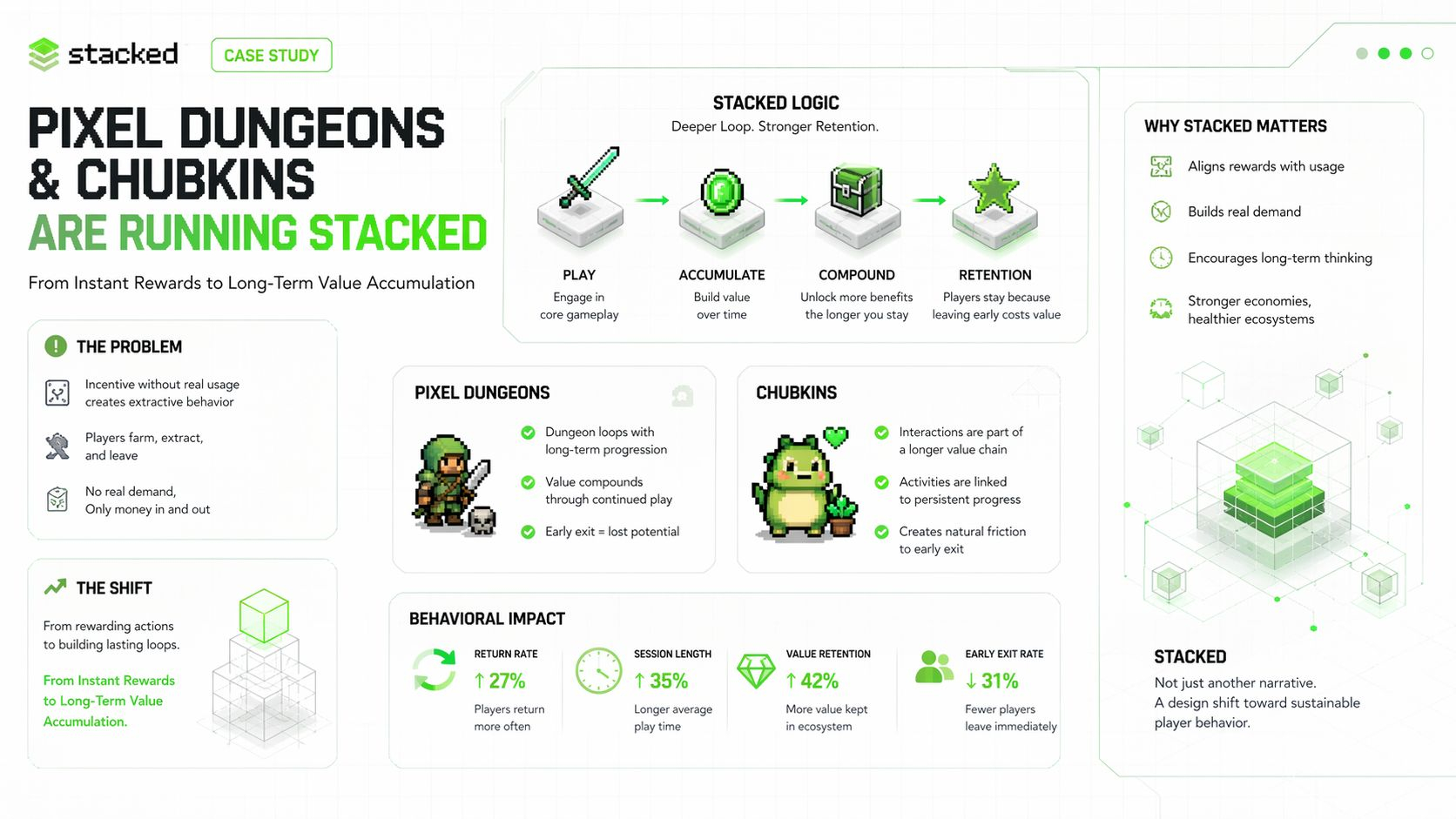
In Pixel Dungeons, the dungeon loop is not just grind; it starts to have longer-term accumulation factors. In Chubkins, interacting with the system is no longer a discrete action, but it seems anchored to a longer value chain. It's not always clear, but enough to create a bit of friction if you want to leave right away.
And that friction... sometimes it's the necessary thing.
Too many GameFi projects try to reduce friction. Faster onboarding, easier claims, quicker withdrawals, but when everything is too easy, players can also leave very easily. It seems Stacked is going a bit against that, not making it hard for players but creating reasons for them not to leave immediately.
Of course, saying that doesn't mean it will work. I've seen too many disguised lock mechanisms, too many systems trying to keep players by delaying rewards, and in the end, only create frustration instead of real engagement.
Pixel Dungeons and Chubkins are still too early at this point. The data isn't long enough, the behavior isn't clear enough, players may be experimenting or optimizing a new strategy, and it's not certain whether that is real retention.
The whitepaper doesn't say much about this, the narrative doesn't emphasize it, but usage is starting to show some small signals. Players are coming back, not all of them, but enough to raise the question of whether this is another approach or just a layer of incentives designed better.
I don't have a definite answer, and perhaps there's no need to rush.
At least from my perspective, Stacked is not a solution; it resembles an experiment, a way to adjust behavior instead of just adjusting rewards, and whether it creates a more sustainable economy... that part I'm still waiting on.
And I think that's the part worth watching the most.