
I have been thinking about growth a lot lately, and what it really means when something grows very fast.
At first, growth can look like proof that everything is working. More users, more revenue, more activity. Numbers rise, and people naturally assume the system is healthy. I used to look at those signals more directly. Now I am less sure. The more I watch markets, especially in crypto and gaming, the more I feel growth can sometimes hide pressure building underneath.
That is partly how I have been looking at what happened with Pixels.
On the surface, 2024 looked remarkable. Rapid user growth. Revenue. Attention. Momentum. Those things matter. I do not dismiss them. But I keep noticing that systems under fast expansion often reveal their weaknesses only after the excitement settles.
It reminds me of traffic on a highway.
Everything can seem smooth while cars are moving quickly. But if too many vehicles enter at once, even small disruptions start to matter. One driver brakes. Someone hesitates changing lanes. A merge happens awkwardly. And then, almost invisibly, congestion begins. What looked efficient a few minutes earlier starts slowing down.
I wonder if token economies can behave in a similar way.
When emissions are too loose, when rewards flow too broadly, when extraction becomes easier than participation, pressure may not show immediately. But it gathers. Quietly.
Token inflation, to me, feels a bit like water pressure building inside old pipes. At first, the system keeps functioning. Water still runs. Nothing appears broken. But stress accumulates in places people do not always monitor. Then leaks appear where no one expected them.
I think Pixels ran into some version of that.
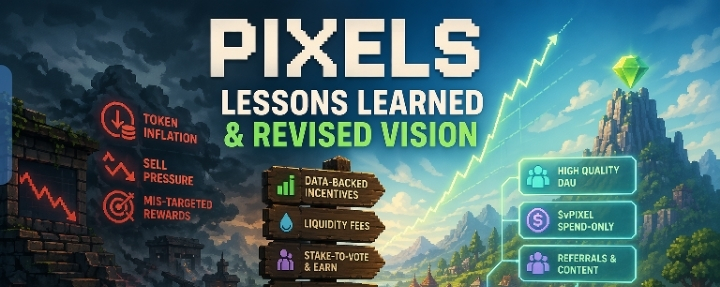
Too much token emission created strain.
Sell pressure added more.
Rewards, maybe unintentionally, sometimes encouraged behavior that fed the strain rather than relieved it.
I might be wrong, but this is what I keep coming back to: incentives do not just attract activity. They shape behavior. And behavior, over time, shapes the health of the whole system.
That feels obvious when I say it plainly. But living through it is harder.
Because in real time, activity often looks like success.
And sometimes what looks like growth is actually imbalance spreading.
What interests me most is not simply that Pixels identified these problems. Many projects identify problems after damage appears. What I find more important is the shift in thinking underneath the response.
It feels less like chasing volume now, and more like trying to understand quality.
That feels significant.
I have been thinking about this idea of targeting incentives more precisely.
Not rewarding everyone equally.
Not distributing tokens just because someone appeared.
But trying to direct rewards toward people more likely to reinvest, contribute, hold, or strengthen the network.
That is a very different philosophy.
It treats incentives less like giveaways, and more like infrastructure.
And infrastructure is something people often underestimate.
Roads do not matter much when traffic is light.
They matter when stress rises.
Maybe token design works the same way.
I also keep thinking about liquidity fees.
At first glance, heavier withdrawal fees can feel restrictive. People can react negatively. Markets often dislike friction.
But I am trying to understand whether some friction is sometimes necessary.
Every system, I think, needs some resistance.
Without resistance, pressure escapes too easily.
Without resistance, value can be extracted faster than value is rebuilt.
Again, I do not see this as simple. There are risks. Too much friction can damage trust too. People may feel trapped. Coordination can weaken if participants believe rules keep shifting.
And trust, once stressed, can be hard to repair.
That part feels very important.
Because many systems do not fail only because economics break.
They fail because confidence breaks.
And confidence is harder to measure.
You can see token prices.
You can track DAU.
But how do you measure quiet doubt spreading through a community?
How do you measure hesitation?
I am not sure we do that well.
And maybe we should.
The publishing model shift is another thing I have been trying to make sense of.
Stake-to-vote-and-earn feels, at least in theory, like moving responsibility closer to participants.
That changes the relationship.
Players stop being only users.
They become partial allocators.
Maybe even partial owners of outcomes.
I keep noticing a broader pattern in markets right now where centralized control often looks less convincing than it did a few years ago. There is more skepticism. More questioning. More demand for systems where incentives feel aligned.
Maybe this shift in Pixels reflects that larger mood too.
Maybe it is not just about fixing one game.
Maybe it is responding to something changing in how people want digital economies to work.
And that is where the revised vision starts feeling larger.
The move toward something like decentralized growth infrastructure, something closer to a network for acquisition and rewards, feels ambitious.
Possibly very ambitious.
Maybe too ambitious.
I do not know.
But I understand the logic.
If one game is vulnerable, maybe an ecosystem can distribute risk.
If one loop weakens, maybe network effects help absorb shocks.
It reminds me of crowded cities.
A single road closure can cause chaos if the whole city depends on one route.
But if there are many connected paths, disruption becomes easier to manage.
Maybe ecosystems are trying to become those alternate routes.
Still, I keep thinking the hard part is not building structures.
It is building coordination.
Coordination breaks under stress.
Teams move slower.
Signals get distorted.
Communities misunderstand intentions.
Small problems become larger simply because nobody reacts at the right time.
I have seen this happen often.
Not because people are careless.
But because pressure changes behavior.
People defend positions.
Communication narrows.
Trust gets thinner.
And systems start responding to fear rather than purpose.
That risk still exists.
Maybe it always will.
Which is why I find the focus on higher-quality users more interesting than raw user counts.
For a long time, markets seemed obsessed with scale at any cost.
More users.
More reach.
More activity.
But I keep wondering if many systems have been learning, sometimes painfully, that not all growth strengthens the system.
Some growth dilutes it.
Some growth overwhelms coordination.
Some growth introduces pressure the structure cannot absorb.
And maybe what looks like contraction in metrics can sometimes be repair.
That is a hard thing for markets to price.
Because markets often reward expansion more quickly than resilience.
But resilience may matter more.
I have also been thinking about $vPIXEL, spend-only design, and gating mechanics like VIP structures.
These feel less like isolated features to me, and more like attempts to slow leakage.
To keep value circulating longer before leaving the system.
Again, almost like trying to keep water pressure balanced.
Not sealed shut.
Just managed.
Can that work?
Possibly.
Can it create unintended distortions?
Also possibly.
I do not think anyone knows fully in advance.
And I think admitting that matters.
There are limits to what design can control.
No token model can remove market fear.
No fee structure can eliminate speculation.
No incentive system can perfectly predict human behavior.
There will still be shocks.
There will still be opportunists.
There will still be moments when trust gets tested.
That uncertainty does not disappear.
Maybe the goal is not removing uncertainty.
Maybe it is building systems that bend without breaking when uncertainty arrives.
That feels, to me, closer to what this revised vision is really wrestling with.
Not perfection.
Durability.
And I keep coming back to this thought.
Sometimes what looks like slowing down is actually the first sign a system is learning.
Sometimes pulling back is not weakness.
It is recalibration.
But whether recalibration becomes renewal… or just a pause before deeper strain returns… that may depend less on token mechanics, and more on whether human incentives, trust, and coordination can hold when the next real pressure arrives.
And I keep wondering…
When a system starts redesigning itself under stress, is that the beginning of resilience, or just the moment hidden weaknesses become impossible to ignore?