
There’s a pattern in Web3 gaming that’s hard to ignore: big promises… weak execution. Every other project talks about “true ownership” and “the future of gaming,” but when you actually play, you run into the same issues: slow transactions, constant gas fees, and gameplay that feels more like a chore than fun. Pixels changes that equation. It understands something simple but critical: if the game isn’t fun, blockchain doesn’t matter—and if the economy isn’t sustainable, the token won’t last. That’s why Pixels isn’t just another game—it’s an evolving system that’s making Web3 gaming actually practical.
Pixels may look like a relaxed farming and social MMO at first. You grow crops, gather resources, craft items, trade with other players, and build and upgrade your land. Simple enough. But as you go deeper, you realize it’s not just a farming game—it’s a player-driven economy. Assets can exist as NFTs on-chain, land has real ownership, and your progress carries actual economic weight. You’re not just playing—you’re participating in a living ecosystem.
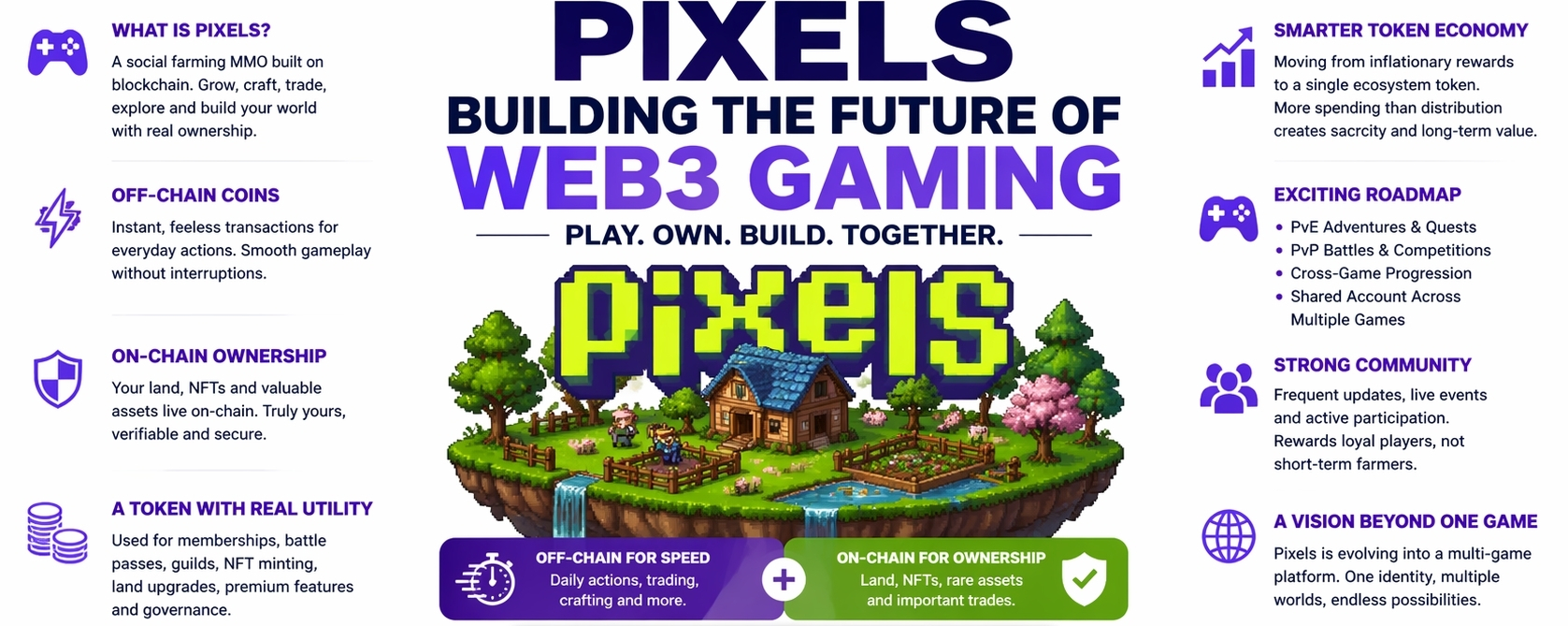
When Pixels introduced off-chain coins, many questioned it. Isn’t that against Web3? In reality, it’s a necessary evolution. If every action happens on-chain, you pay gas fees constantly, confirm every small action in your wallet, and the game becomes slow and frustrating. At that point, it stops feeling like a game and starts feeling like a financial tool. Pixels solved this by splitting its economy into two layers. Off-chain handles speed and convenience—buying seeds, small trades, crafting, and everyday gameplay—instant, free, seamless. On-chain handles ownership and value—land NFTs, rare assets, major trades, long-term holdings—secure, verifiable, truly yours. The key insight is simple: not everything needs to be on-chain, only what truly needs ownership.
The Pixels token is not designed to sit idle. It is built for real use. Players use it to unlock memberships and premium features, buy battle passes, create and manage guilds, mint and upgrade NFTs, expand and develop land, and participate in governance decisions. Most tokens rely on “hold and hope,” but Pixels flips that into “use and create value.” That difference is what gives it strength.
Web3 gaming has struggled with inflation. Too many tokens are distributed and not enough are used, leading to collapse. Pixels is moving away from that model. It focuses on a single ecosystem token, controlled emissions, and strong in-game spending. When players spend tokens on upgrades, features, and progression, those tokens are absorbed back into the ecosystem. If spending becomes greater than earning, scarcity increases, demand strengthens, and value builds naturally. This is what a sustainable game economy looks like—not hype-driven, but usage-driven.
Pixels is not stopping at one game. It is expanding into a broader ecosystem. Upcoming features include PvE content with missions and deeper gameplay loops, PvP systems that introduce competition and skill-based rewards, cross-game progression where your identity and achievements carry across multiple titles, and a shared account system that connects everything into one seamless experience. The vision is clear: one identity, multiple worlds, and a connected gaming universe.
The community is a major reason why Pixels stands out. The team shares frequent updates, communicates openly, and involves players in the evolution of the game. Live events keep the experience active, and reward systems prioritize loyal, long-term players rather than short-term farmers. This creates a healthier, more stable ecosystem built on participation instead of extraction.
Pixels is not perfect, but it is moving in the right direction. It is solving the real problems that have held Web3 gaming back—how to make gameplay smooth, where ownership truly matters, and how to build an economy that lasts. The introduction of off-chain coins is not a weakness; it is proof that the team understands reality and prioritizes player experience.
Pixels is easy to overlook—but hard to ignore once you understand it. Because this is not just another project. It might be the direction Web3 gaming is heading. Keep watching.