
Most people still approach @Pixels like it’s just another farming game. You log in, plant, craft, sell, repeat. On the surface, it works exactly like that. Simple loops, low pressure, easy to get into. And honestly, that’s what pulls most players in.
But that surface doesn’t last long if you actually stay.
After a few days of consistent play, something starts to feel different. Not broken, not confusing… just different. You realize that doing “more” doesn’t always mean progressing “faster.” Two players can follow similar routines, spend similar time, and still end up in completely different positions.
That’s where the real design of Pixels starts to show.
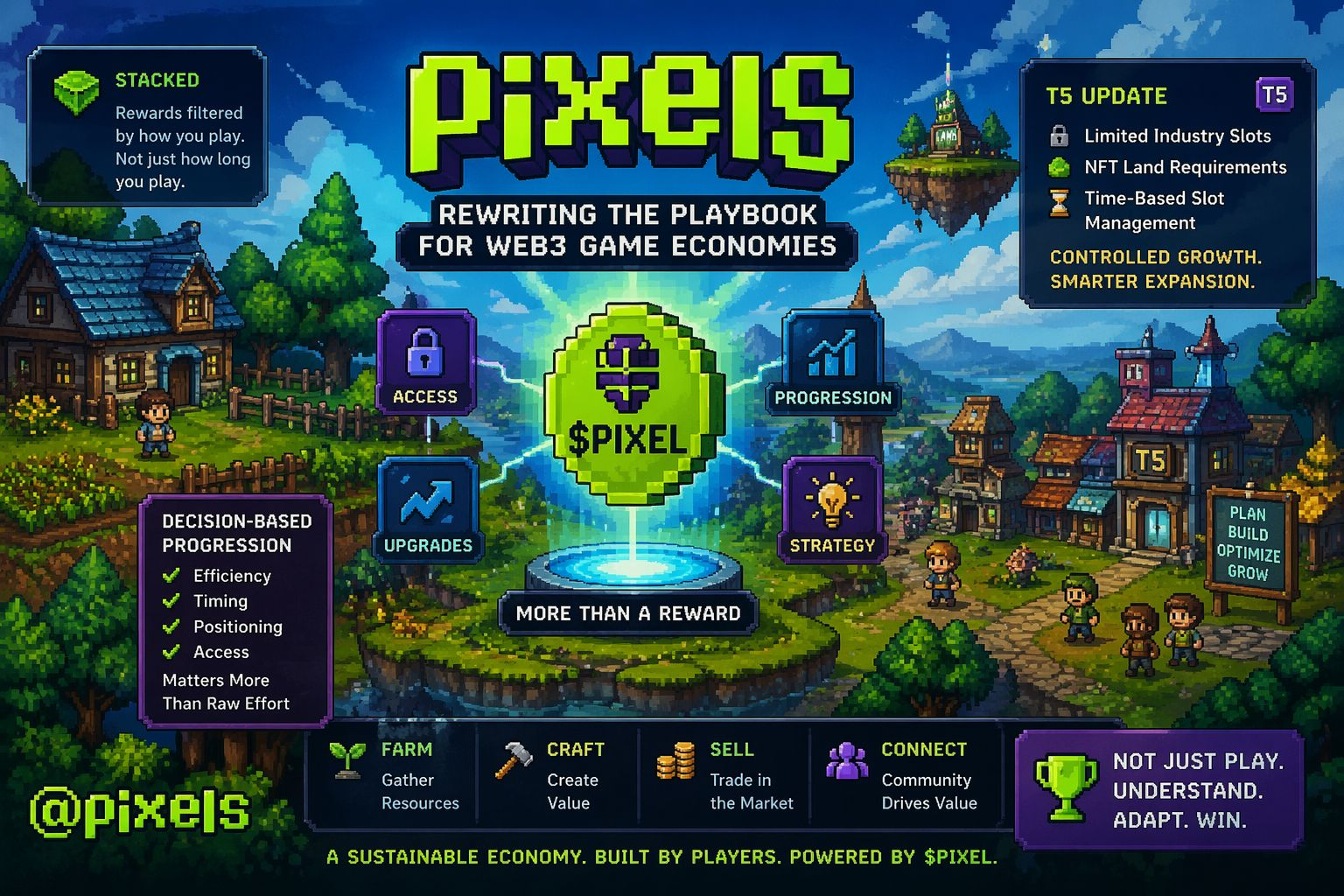
The game is quietly shifting away from time-based rewards toward decision-based progression. It’s no longer about how long you grind, but how well you understand the system. Efficiency, timing, positioning, and access start to shape outcomes more than raw effort.
And this is where the Stacked layer changes everything.
Stacked isn’t something you directly “see” every second, but you feel its impact. Rewards don’t flow the same way anymore. They feel filtered, almost selective. It’s like the system is constantly evaluating how you play, not just how much you play. That creates a gap between players who optimize and those who just repeat loops.
The T5 update made this shift impossible to ignore.
With limited industry slots, NFT land requirements, and time-based slot management, expansion is no longer infinite. You can’t just scale production endlessly like in typical Web3 economies. Every upgrade, every placement, every decision starts to carry weight. You’re forced to think about your setup, not just your output.
This introduces something most play-to-earn systems struggle with: controlled growth.
Instead of letting players extract value as fast as possible, Pixels slows things down and redirects focus toward sustainability. That naturally reduces the classic farm-and-dump behavior that breaks most token economies.
And that’s exactly where $PIXEL starts to stand out.
In many Web3 games, the native token is just a reward layer. You earn it, you sell it, and the cycle continues until the system weakens. But inside Pixels, PIXEL is gradually becoming more than that. It’s tied to access, upgrades, and progression decisions. Using it inside the system often feels more valuable than simply cashing out.
That shift matters.
Because once a token becomes part of gameplay strategy instead of just output, the entire economy starts behaving differently. Players think longer term. Decisions become more intentional. And the gap between “playing” and “understanding” gets wider.
Of course, it’s not perfect. Some systems still feel complex, and the learning curve can catch new players off guard. At times, it even feels a bit messy. But that’s also what makes it interesting. It doesn’t feel like a finished loop, it feels like something actively evolving.
And maybe that’s the real point.
Pixels isn’t trying to be the loudest Web3 game. It’s slowly building a system where behavior, economy, and progression are connected in a way most projects haven’t figured out yet.
If this direction holds, then $PIXEL won’t just be a reward token.
It will be the layer that defines how the entire game actually works.
Still early. But definitely not simple anymore.