
I’ve Seen This Before — And It Never Ends Well
Let’s not waste time pretending this is new.
GameFi has already run this experiment. It failed. Spectacularly. The names change, the interfaces improve, the language softens—but the underlying mechanics remain stubbornly familiar.
@Pixels is being hailed as a shift. It isn’t. It’s a refinement.
A better product. A smoother experience. A more sophisticated hook.
But a hook all the same.
---
The Grind Didn’t Disappear — It Was Rebranded
We’re told it no longer feels like work. That’s the selling point.
That’s also the warning sign.
When players start planning schedules, tracking outputs, watching price movements, something has already gone wrong. That isn’t casual engagement. That’s structured behavior.
Call it what it is. It’s labour without the label.
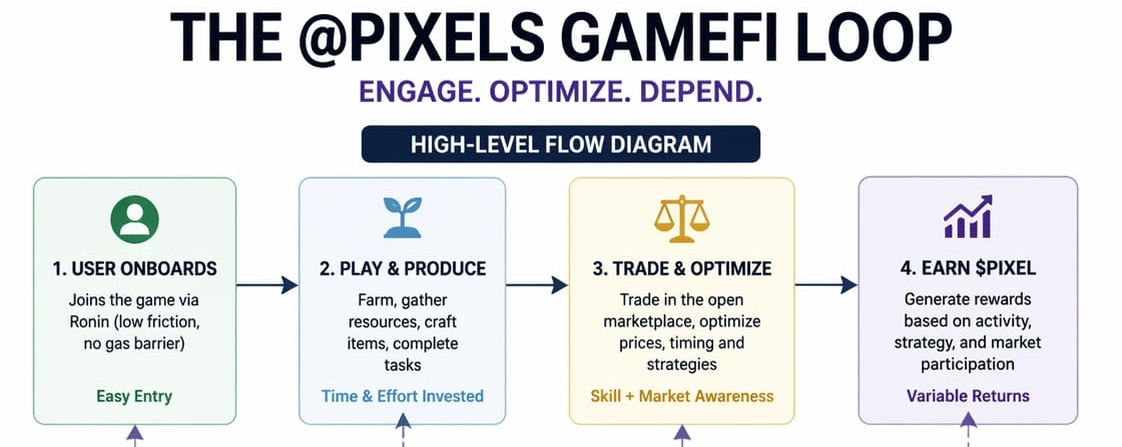
The system hasn’t removed the grind. It’s hidden it inside a feedback loop that feels rewarding enough to keep you going.
That’s not innovation. That’s design discipline applied to extraction.
---
This “Player Economy” Is Still Controlled From Above
There is a persistent fantasy that this is a real, player-driven economy.
It isn’t.
The platform controls supply. It controls scarcity. It controls rewards. It controls the rules of engagement. Players operate within a sandbox that looks open but is tightly bounded.
Yes, users can trade and optimise. But they do so inside a system that determines what is possible in the first place.
That is not a free market.
It is a managed environment designed to produce certain behaviours.
And it works.
---
Meritocracy Is the Story That Keeps People Playing
The rhetoric is predictable. Be smarter. Be faster. Earn more.
It sounds fair. It sounds earned.
It rarely is.
In closed systems like this, value doesn’t magically appear. It moves. One player’s gain is another player’s missed opportunity. Early entrants have structural advantages that no amount of “strategy” can erase.
This isn’t a meritocracy. It’s a timing game with better marketing.
And the later you arrive, the worse your odds become.
That part is never advertised.
---
Small Losses Are Being Normalised as “Learning”
There’s a quiet shift in how failure is framed.
Mistakes are lessons. Losses are part of the journey. Every bad trade is an opportunity to improve.
It sounds constructive.
It’s also conditioning.
Users are being trained to accept financial loss as routine, even necessary. The more often it happens, the less it registers. The loop continues.
This isn’t financial literacy. It’s behavioural adaptation.
And it benefits the system far more than the player.
---
Frictionless Design Removes the Only Safeguard That Matters
Low fees. Fast transactions. Seamless interaction.
All presented as progress.
In reality, friction is often the last line of defence. It slows decisions. It forces reconsideration. It creates space for doubt.
Remove it, and decisions accelerate.
Faster clicks. Faster trades. Faster commitments.
That doesn’t reduce risk. It amplifies it.
And it does so quietly.
---
“Fun First” Is Not a Break From the Past — It’s a Tactical Adjustment
After the collapse of overtly extractive models, the industry had no choice but to recalibrate.
Now the language is softer. Engagement first. Earnings later.
It sounds healthier.
It isn’t fundamentally different.
The token is still central. The incentives are still financial. The behaviour is still shaped by potential gain.
The only shift is sequencing.
Hook first. Monetise later.
It’s not a new model. It’s a more patient one.
---
At Some Point, You’re Not Playing — You’re Managing
When gameplay starts to resemble scheduling, optimisation and resource allocation, the line has already been crossed.
This is no longer leisure.
It’s participation in a system that rewards attention, time, and discipline.
The more you invest, the harder it becomes to disengage. Not because of enjoyment, but because of commitment.
That’s not accidental.
That’s the mechanism.
---
The Core Question Still Has No Answer: Who Pays?
Every GameFi model eventually confronts the same issue.
Where do the returns come from?
If they come from new players, the system depends on growth. When growth slows, the structure weakens.
If they come from external capital, the system is subsidised. Subsidies end.
If they come from internal circulation, then it’s redistribution.
There is no fourth option.
And none of these are stable over the long term.
---
The Token Is Not the Foundation — It’s the Pressure Point
$PIXEL is positioned as the backbone of the ecosystem.
In reality, it’s the vulnerability.
Tokens that serve both utility and speculation inevitably face tension. Users are encouraged to hold, to use, and eventually to sell.
And they will sell.
When enough participants choose to exit rather than reinvest, the system feels it immediately.
Liquidity tightens. Prices fall. Confidence erodes.
This pattern is not hypothetical.
It is structural.
---
The Power Dynamic Hasn’t Changed — It’s Just Less Visible
The language of ownership is persuasive.
Players build. Players trade. Players participate.
But control remains centralised.
The platform sets the parameters. The platform can change them. The platform ultimately captures the value generated within its ecosystem.
Players contribute time, attention and capital.
The platform captures the upside.
That imbalance hasn’t disappeared.
It’s simply been dressed more convincingly.
---
The Real Risk Is Not Collapse — It’s Success
The most fragile systems are often the ones that work just well enough.
They retain users. They encourage deeper engagement. They build habits.
And over time, they extract more.
Not through dramatic failure, but through sustained participation.
That’s where the real transfer of value happens.
Quietly. Gradually. Efficiently.
---
This Is Not a Revolution — It’s a More Effective Version of the Same Model
@Pixels is not rewriting the rules of GameFi.
It is executing them better.
Smoother onboarding. Stronger engagement loops. More subtle incentives.
Less hype. More retention.
But the structure remains unchanged.
A closed economy. A circulating token. A reliance on continued participation.
We have seen this before.
And when the cycle turns—as it always does—it won’t matter how polished the experience felt at the start.
It will end the same way.
Just with fewer people willing to admit they should have known better.
