


I have noticeed something lately that’s hard to ignore. The noise in Web3 gaming has dropped. Not completely, but enough that you can feel the difference. Fewerr loud promises, fewer easy-reward narratives. People are more cautious now. And in that quieter backdrop, @Pixels (PIXEL) keeps popping up in a way that doesn’t feel forced.
At first glance it doesn’t demnd attention. Farming, pixel art, a casual loop. We’ve all seen that before. I almost brushed past it. But the longer I watched, the more it felt like it wasn’t trying to win the same game others were playing. No aggressive push, no over-selling. Just a steady presnce. That kind of restraint stands out more than hype right now.
The broader shift is obvious if you’ve been around long enough. Reward-heavy systems burned themselves out. They treated users like throughput more activity meant moree success. But it never held. People farmed, sold, and left. That wasn’t a player base. It was traffic passing through.
Pixels seems built with that in mind.
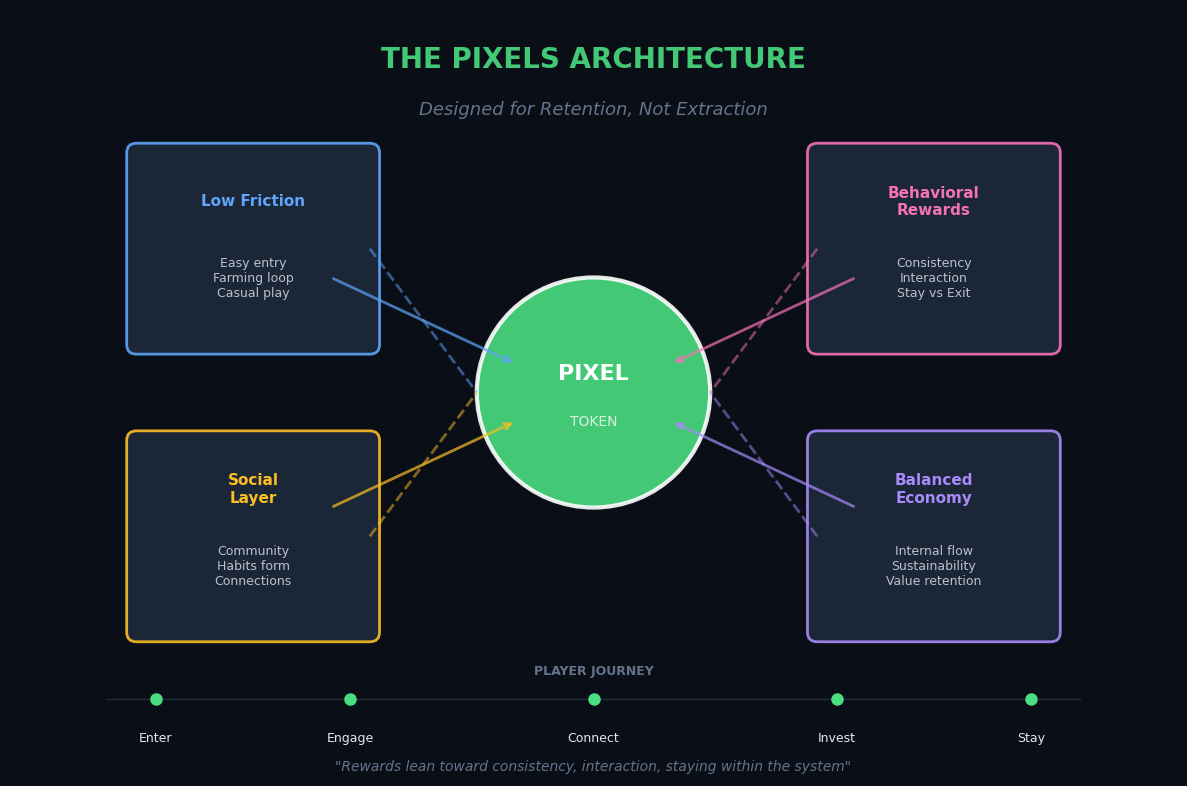
The game itself is easy to step into. You farm, explore, gather, build. Nothing complicated, and that’s probably the point. Lower the friction, let people settle in naturally. But the loop isn’t what kept my attention. It’s the structure around it. The way the system seems to respond to behavir, not just actions.
That difference changes how everything feels. Rewards don’t look evenly spread. They lean toward certain patterns consistency, interaction, staying within the system instead of exiting quickly. It doesn’t feel random. It feels designed, almost like the system is filtering for a certan type of player.
The PIXEL token sits inside that design, but not in the usual “earn and dump” role. It behaves more like a balancing mechanism. Something that nudges players to stay engaged rather than cash out immdiately. Whether that holds over time is another question, but the intent is clear enough.
The social layer ties into this more than people might think. It’s easy to dismiss it as just community features, but it rarely works that way in Web3 games. Social systems anchor players. They create habits, connections, small reasons to come back. Over time that builds a kind of stickiness that pure rewards can’t achieve.
Pixels leans into that. The environment matters as much as the rewards. Once players start feeling attached whether to progress, routines, or other players their behavior shifts. They stop acting like short-term visitors. That’s where the system starts to stabilize.
Still, there’s a tension here that I can’t shake. Systems that optimize for sustainability tend to become more controlled over time. Not immediately, but gradually. More structure, tighter incentives, less randomness. It doesn’t break the experience, but it changes the feel of it.
Pixels feels close to that edge.
Compared to earlier Web3 games, it’s clearly more aware of the problem. It’s not flooding the system with incentives and hoping retention follows. It’s shaping participation more carefully. That’s progress. But it also raises a question that doesn’t go away. How much shaping is too much before it starts to feel restrictive?
Players don’t just want efficiency. They want something that feels open, even if it’s structured underneath. Once that balance tips, the experience can feel engineered instead of natural.
There are also risks that sit just below the surface. If rewards narrow too much, new users might feel locked out of meaningful participation. If value circulation becomes too internal, pressure can build without obvious signals. And like any token-driven system, everything still depends on sustained engagement. Without that, the design doesn’t matter.
The part that sticks with me most is this. Pixels doesn’t seem focused on maximizing excitement. It’s focused on managing behavior. That’s a different objective entirely. And it might be closer to where Web3 gaming is heading than most people expect.
Less open distribution. More filtering. More emphasis on participation that supports the system rather than drains it.
I’m not framing that as good or bad. It’s just a shift. One that changes how these ecosystems feel from the inside.
Right now, I don’t see Pixels as just another game. It looks more like a controlled experiment testing whether a tighter, more deliberate design can hold up where others didn’t.
If it works, it sets a direction. If it doesn’t, it still tells us something useful. Either way, I’m watching it closely, becaus this feels less like a one-off project and more like a signal of what’s coming next.
