

During the time I researched @Pixels this, a question has been following me.
I have seen quite a few P2E incentive models, with curve designs, token releases, and staking rewards, every parameter carefully calculated. Yet every time I finish reviewing, a question pops up: why do these models all share a common blind spot? Miners come in to wash orders, the project team sees it, but chooses to tolerate it?
This is not a technical issue. They have the ability to design incentive models, but don’t they also have the ability to design a model that makes it unprofitable for miners?
I have been pondering this question for a long time without finding a solution. Until one night, I went through the historical data of Axie and finally saw the answer.
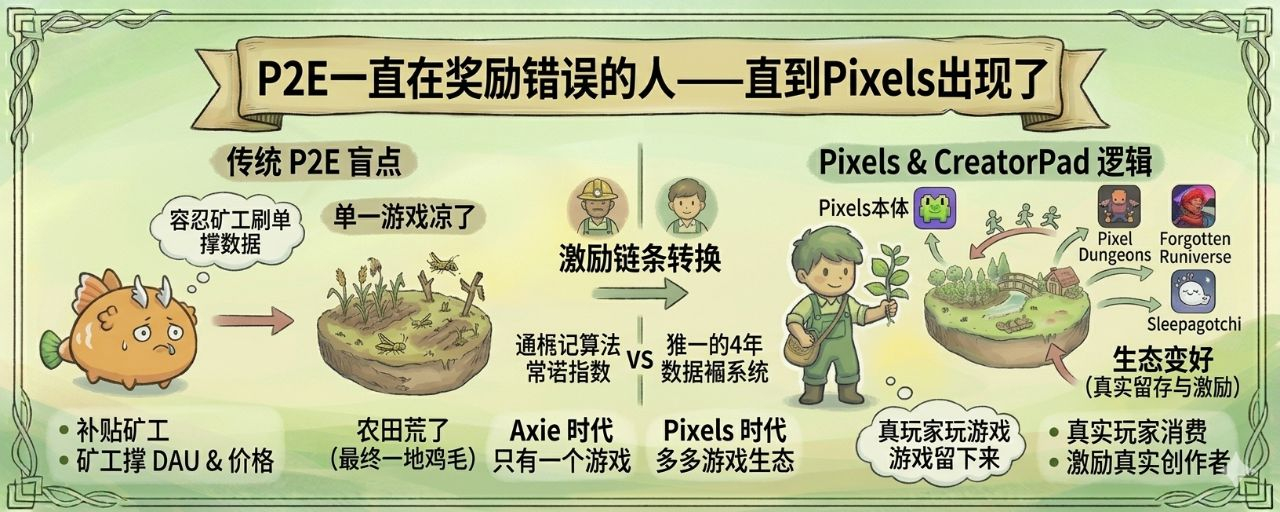
At its peak in 2021, Axie had nearly 3 million daily active users, but later third-party analysis pointed out that a significant proportion of them were from professional studios in the Philippines and Vietnam, specifically farming tasks for tokens, not playing the game. Miners come in, spend money, and farm tasks; the DAU numbers look good, and the token price is supported by someone. This logic is unhealthy, but it can indeed sustain prices for a while during a bull market.
So early P2E project parties did not "fail to see" the miner problem; they saw it but chose to tolerate it. Because there weren't enough real retained users, while miners could support the numbers.
The result of this choice is something we all saw later: game companies are forever subsidizing a user group that won't stay. Real players who remain, because their incentives are diluted by miners, receive less and less, and churn faster and faster. Miners take the money and leave a mess.
But what really made me stop and rethink this matter was not Axie's data.
It was the moment I saw Pixels write out the logic of dividing CreatorPad.
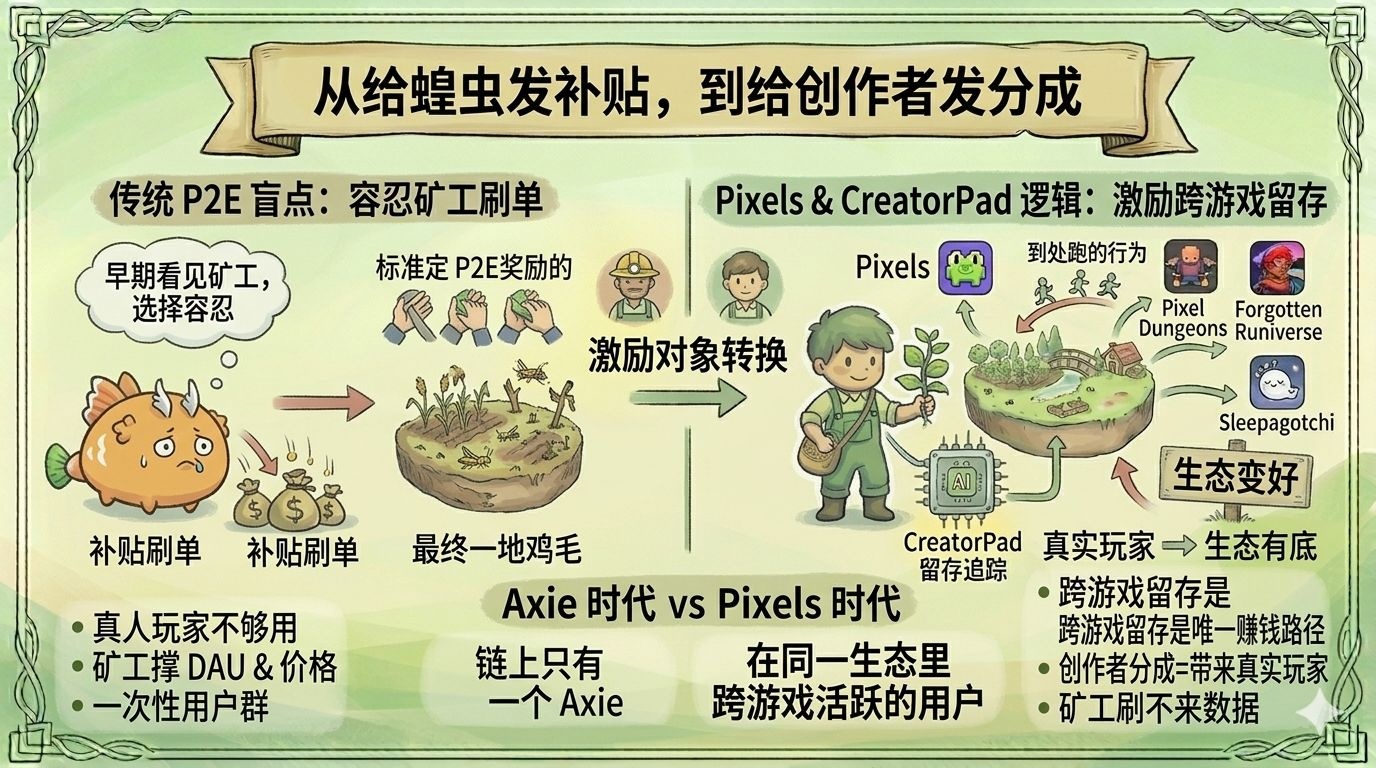
The only condition for revenue sharing in CreatorPad is: how long the users you brought in stayed in the Pixels ecosystem, how active they were in how many games, and how much they consumed. It is not based on online duration, nor on the number of tasks, but on retention.
Miners can't generate this data. Accounts brought in by miners do not consume or retain, so the creator's share is naturally close to zero. To make money here, there is only one way: to genuinely attract real players who will stay, consume, and participate in the ecosystem.
That night I watched this logic repeatedly several times. Not because it was complicated, but because I thought of a question: why didn't Axie think of this mechanism?
This is not a matter of capability. The Axie team is much larger than Pixels and has far more money. Why didn't they design such a logic?
I thought about it for a long time and felt the reason is: this logic has a prerequisite; you need to have enough "users who are active across games in the same ecosystem" for this incentive to be effective.
The Axie era did not have this prerequisite. There was only one Axie on the Ronin chain, and users had no other place to go; the concept of cross-game retention itself did not exist.
Pixels is different. The Pixels ecosystem currently has 4 games running: Pixels itself, Pixel Dungeons, Forgotten Runiverse, and Sleepagotchi. The users you bring in may first register in Pixels, then go to Dungeon to farm gear, and then participate in guild activities in Runiverse — all of these are "cross-game retention" and count as your contribution.
This is not a minor adjustment to the incentive mechanism. This has fundamentally changed the entire incentive chain: creators make money → can only attract real users → users stay and consume → the ecosystem improves → the token has a bottom line.
P2E giving rewards to miners is like giving subsidies to locusts to ensure a bountiful harvest. The numbers look good in the short term, but in the long term, the fields become barren. CreatorPad changed the incentive targets from miners to creators, and only then did the chain run completely for the first time.
The official version of Pixels Ecosystem Q4 has a plan — an open pool where any external game that reaches the RORS threshold can access the PIXEL staking reward system.
The signal I'm currently monitoring is this: after external games are integrated, can the RORS of the first batch of data maintain above 2.0? If it holds, it indicates that the CreatorPad logic not only works internally within Pixels but also works with external games. If it drops, or if there are no external games integrated, I need to reassess the revenue sharing expectations of $PIXEL .
Before that, I won't say that CreatorPad has already been successfully validated. It just has a good start.
