
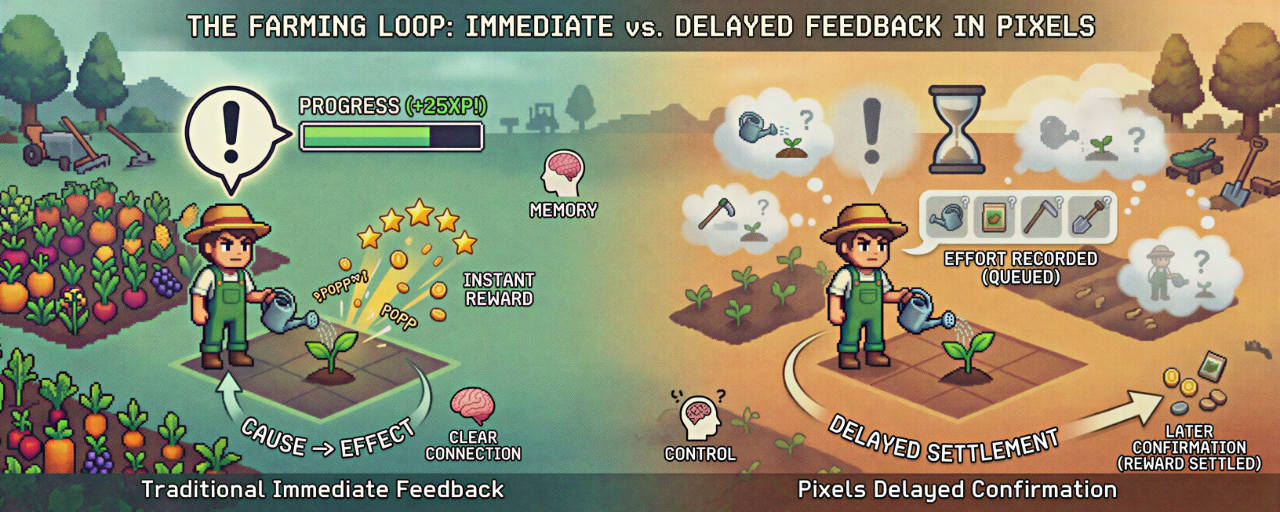
I keep noticing a pattern in Pixels. When I farm I don't get a response right away. It feels like the system isn't fully present in the moment as me. I do something then I move on. Later something. I realize the system has accepted my earlier effort.
This changes how time feels in the game. Usually I'm used to feedback in most systems. I. I see it right away. Points move numbers shift something reacts immediately.. Here it's not like that. The reaction feels. A bit detached from the action.
At first I thought it was just lag or simple batching.. After watching it for a longer time I started to feel it's more than that. It feels like the system is designed to confirm effort in a layer of time not in the same moment not in a direct way.
So farming becomes something. It stops feeling like an action with a clear outcome. It becomes like placing effort into a queue that gets evaluated later. That small shift changes how I think while playing.
I notice I don't track each action anymore. I stop expecting validation. Instead I just keep farming with an assumption that something will settle later. This creates a mindset where effort and result are separated.
There's a tension in that separation. On one side it feels calm because I'm not reacting to every update. On the side it creates doubt because I can't clearly connect what I did to what I got.
In game systems the loop is tight. Action and reward are connected immediately. That tight loop creates clarity. Also makes behavior predictable. Pixels feels looser. The loop is stretched. That stretch creates space for interpretation.
Sometimes I wonder if this design is intentional. A delayed confirmation system can shape behavior differently. It reduces gratification. It also makes players less certain about cause and effect. That uncertainty changes how attention works inside the system.
I start to focus on individual actions and more on longer patterns. Not because I want to. Because the system forces me into that rhythm. Short-term signals are weak. Long-term signals matter more.
There's also something about memory here. When confirmation comes later I often don't fully remember the moment I did the action. So the reward feels slightly disconnected from the state I had when I farmed. That disconnect is important.
It makes value feel like its forming in the background of being created at the moment of action. That can feel stable. It can feel unclear depending on how long the delay is.
I also notice a risk in this structure. If confirmation is too delayed players may start to feel that farming isn't directly linked to outcome all. When that happens trust becomes weaker. The system starts to feel like noise of logic.
If its balanced well it creates a slower thinking environment. One where players don't chase every change. Instead they settle into cycles of behavior. That's very different from crypto game loops I've seen.
Another thing I keep thinking about is control. In systems I feel more control because I can immediately test cause and effect. Here control feels softer. I act,. I don't immediately see the result. That creates a distance between intention and confirmation.
This distance is uncomfortable at first. Then it becomes normal. Then it becomes invisible. That's the part that concerns me the most. When delay becomes invisible it can change how players interpret fairness without them noticing.
Still I can't say this is bad design. It depends on what the system's trying to achieve. If the goal is engagement over time then delayed confirmation might support that. If the goal is clarity and fast trust then it works against it.
What I can say from observation is simple. Farming, in Pixels doesn't behave like feedback. It behaves like effort is recorded first and confirmed later in a moment of system logic.
Once you start seeing it like that the whole rhythm of playing changes. You stop chasing proof and you start living inside a longer and less certain loop of cause and effect.