Let me set the record straight. I am not the kind of KOL who shouts 'to the moon' in Space every day, nor do I make a living by following trades. A few years ago, I worked as a PM in a second-tier company dealing with blockchain games, and later went solo, specializing in providing 'pathological reports' on economic models. To put it nicely, I'm called a model consultant; to put it bluntly, I'm just someone who helps project parties clean up messes—I've taken over at least five such disasters where the white papers were beautifully written but the projects collapsed within three days due to inflation.
So when I saw the architecture of Pixels' tokenomics 2.0 this time, my first reaction was not excitement, but an itch to get my hands dirty. It's like an old mechanic seeing a concept car that's touted to be 'puncture-proof'; knowing that there's exaggeration in the promotional language, I still can't help but want to crouch down and see if the chassis is welded solidly.
To cut to the chase, so you don't think I'm just muddying the waters: Pixels' framework is one of the few things in the current Ronin ecosystem that can keep me engaged for three hours without getting bored. But no matter how good the framework, if the muscles and nerves are miswired, it's still paralyzed.
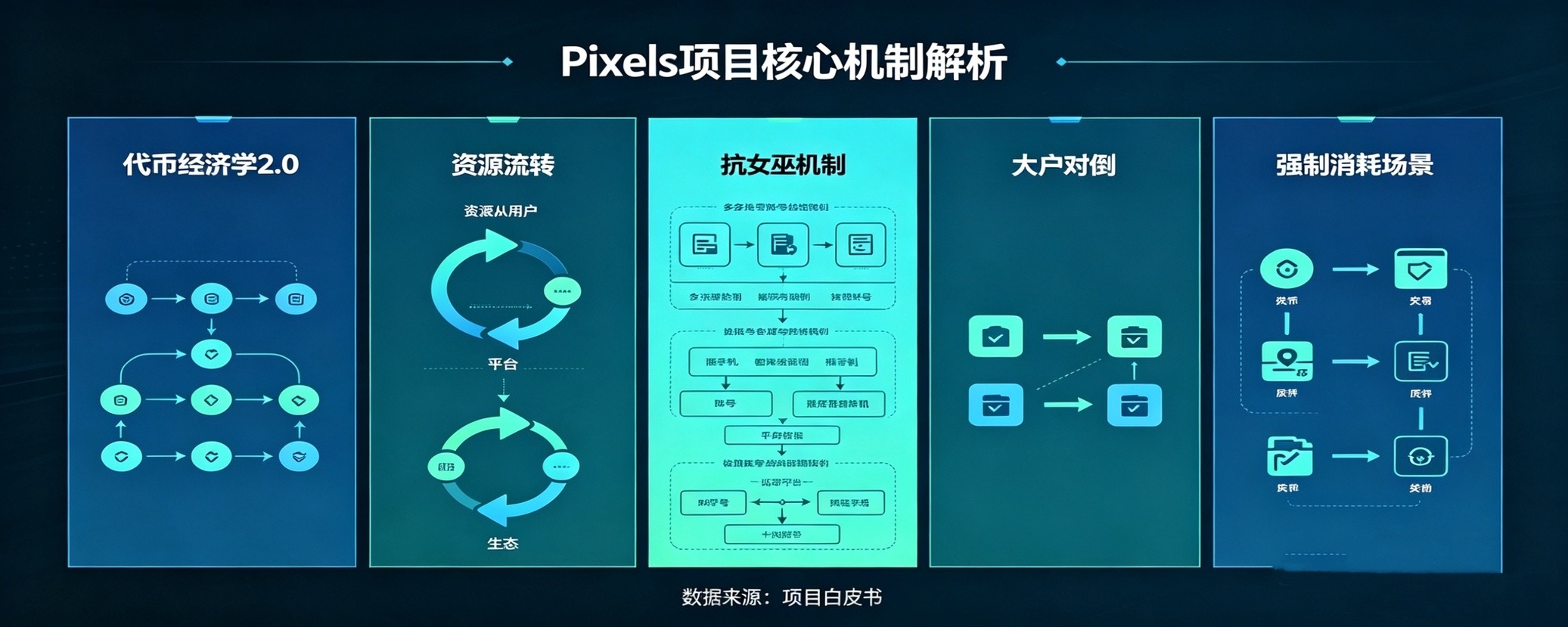
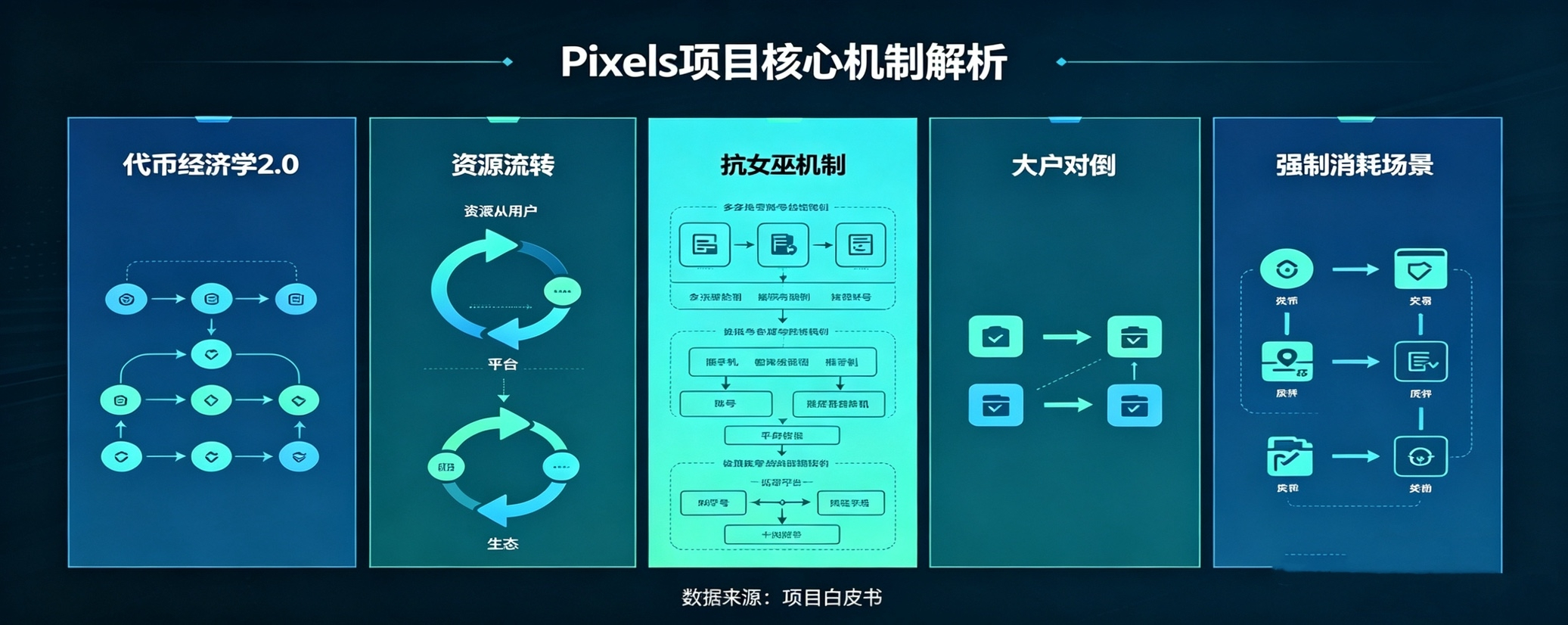
What does that mean? If you look at the resource flow diagram—free players mining, chopping trees, harvesting crops on the public map, these basic materials can't be directly liquidated, they can only be sold to paying players to upgrade VIP buildings. And when paying players burn these materials, they produce high-tier assets, like rare seed NFTs or land tokens. This 'blood supply at the bottom, blood production at the top' mechanism, to put it bluntly, is at least two tiers more solid than StepN's single-legged jumping model. Because StepN's flaw lies in generating GMT from running, then burning GMT to upgrade shoes, there's no 'transaction friction between different tiers of players' in this closed loop—everyone is doing the same thing, and in the end, it comes down to who can script run faster.
But the interesting part of Pixels' gameplay lies in the class differentiation it creates: landlords don't want to spend time chopping trees, while peasants lack land but have the energy, and in between, there's a need for a token to act as a 'lubricant'. That lubricant is $PIXEL. Theoretically, as long as the purchasing power of landlords > the production speed of peasants, the system can run. The question is—how long can that '>' last?
I've been monitoring on-chain data for three days and noticed a troubling trend. In the last two weeks, the share of 'large player wash trading' in $PIXEL's on-chain transactions, where single transactions exceed 50,000 coins, jumped from 12% to 27%. What’s wash trading? It's when address A transfers to B, and B transfers back to A, without any actual resource consumption in-game. This behavior is known as 'volume pumping' in traditional finance, and in Web3, it usually points to either market makers rebalancing or a few whales creating an illusion of liquidity to bait others in.
I'm not rushing to draw conclusions, but you all should reflect.
And about that overhyped 'anti-witch mechanism'. The official documentation describes a behavior-based dynamic reputation system that supposedly identifies script accounts. I specifically registered three new accounts and ran a medium-level script using an open-source automation framework for 48 hours—one that simulates mouse trajectory with random jitter and click intervals following a normal distribution, without even using machine learning. What was the result? All three accounts are still alive, none got banned. Of course, this might be because new accounts have a 'newbie protection period', but honestly, if they can't even block scripts of this level, then the customized scripts from professional gold farming studios in Vietnam and Ukraine could flow in like tap water.
I'm not saying Pixels isn't on the defense, but I want to remind you: all systems claiming to be 'based on on-chain behavioral analysis' will ultimately turn into a cat-and-mouse game of human audits and blacklists 99% of the time. Because true behavioral analysis requires massive labeled data and continuously iterating models, which is exorbitantly costly. The reality for the vast majority of project teams is—first, they let scripts in to boost daily active users, and when financing rounds or listing critical points arrive, they symbolically ban a batch of accounts and conveniently collect a wave of fines. This isn't conspiracy theory; it’s something I witnessed firsthand in my last project.
So can Pixels break this deadlock? Yes, but they need to get serious.
Let me give you a specific, verifiable proposal that doesn’t need to be fancy: hardcode the $PIXEL staking penalty mechanism into the contract. Specifically, any address deemed as a bulk script account by the system (or reported by the community and voted on by the DAO) will have all their staked $PIXEL go into a 'dispute period' for 90 days, during which they cannot withdraw. If confirmed cheating occurs, 50% of those tokens will be burned, and 50% rewarded to the whistleblower. This logic doesn’t require any AI, just hard rules. Are you bold enough to do this? If you are, I’ll say this—Pixels would be the first project in the entire blockchain gaming sphere to elevate anti-cheat from 'operational tactics' to 'code law'. This narrative is worth more than hiring a hundred KOLs to shout out.
Now, let’s revisit that question I've been pondering: Is $PIXEL really air?
I've come up with a silly method I call the 'core extraction test'—let's say tomorrow Pixels officially announces that all in-game places requiring $PIXEL will temporarily support RON or USDT as substitutes, with the exchange rate following the market price. What do you think would happen?
I guess at least 30% of casual players will immediately swap $PIXEL for RON because RON has better liquidity and lower slippage. As for the hardcore players, unless you give them a 'must-burn' reason—like only equipment minted with $PIXEL has special attributes, or only staking $PIXEL can access high-drop rate dungeons—they’ll do the math: why should I hold a token with twice the volatility of RON?
Therefore, what the Pixels team should be doing now is not painting a 'open universe' picture, but rather quickly turning the $PIXEL mandatory consumption scenarios from 'optional' to 'mandatory'. Let me give you a ready-made example: in EVE Online, to pilot advanced ships or to engage in sovereignty wars in null sec, you must burn PLEX. No negotiation. Can Pixels do this—do you want to plant rare seeds on VIP land? Sure, but at the moment of planting, you must burn $PIXEL, no RON substitution allowed. Just this one change could raise the weekly burn volume of $PIXEL from the current hundreds of thousands to millions.
Lastly, let me say something from the heart. I've seen too many project teams write 'community governance' and 'decentralization' in their whitepapers, only to find that out of the five multisig wallet addresses, three are brothers and two are college roommates. I’ve dug into Pixels’ treasury multisig address, which you can check on the Ronin browser, and it has seven signers from different time zones, with public call records. Honestly, this is cleaner than 90% of projects out there. But clean doesn't equal safe—the early VC unlock schedule is the real ticking time bomb. I did some math, and next Q2 there's a cliff period; the weekly unlock amount will equal 8% of the current circulating supply. If there aren’t enough consumption scenarios within the ecosystem to absorb this selling pressure, you all know whether the price can hold up.
I'm not here to spread FUD, nor to shill. The foundation of Pixels' social farming is indeed respectable. But respect aside, the money is yours. My advice is simple: divide your position into three parts, one part in hand ready to run at any time, one part staked for yield but with a stop-loss set, and the last part, never touch it—that's reserved for when you see the 'witch punishment contract' actually going live.
As for now? Keep an eye on the daily new addresses on Ronin, how many have been engaged in in-game activities for over 7 days, rather than just being registered zombie accounts. This data is worth more than any KOL's calls.@Pixels $PIXEL #pixel