
I’m waiting.Not for something specific, not even for a moment I can point at later and say that was it. Just waiting in the way you do when you’ve seen enough cycles repeat to stop expecting them to behave differently. I’m watching the edges of this space where games and finance overlap, where attention gets packaged and rebranded as participation, and I’m trying to understand what still feels real inside it.
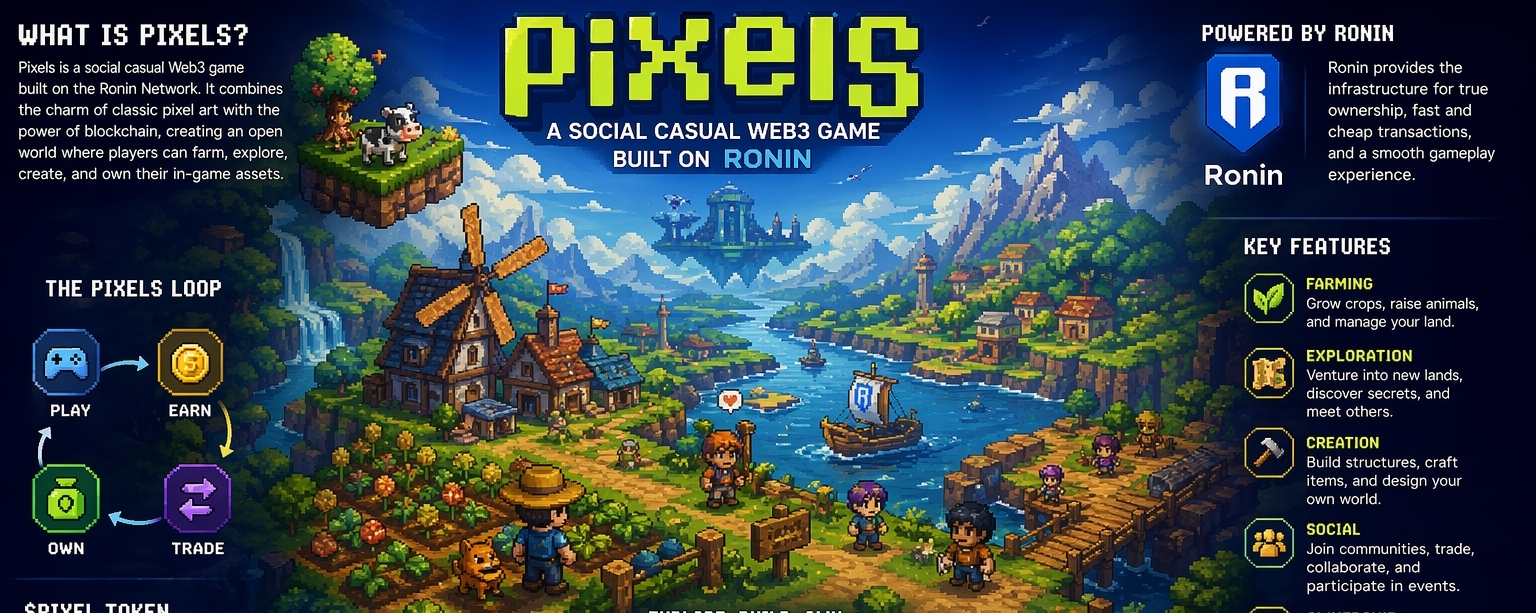
Pixels sits in that space. A farming, exploration, creation-driven world built on Ronin, wrapped in the language of Web3. On the surface it is simple. You move, you collect, you build. You repeat. The kind of loop that doesn’t need explanation because it already exists in thousands of other forms across gaming history. That’s what makes it interesting in a quiet way. It doesn’t try to reinvent what a game is at its core. It just attaches something extra underneath it and asks if that changes anything.
I keep thinking about how often that question gets asked now.
There’s a certain familiarity to it. Not just in Pixels, but in everything that looks like it. The idea that ownership can be embedded into play. That time spent inside a digital space can carry value outside of it. It sounds clean when you say it quickly. Almost obvious. But when you slow it down, when you actually sit with what people do in games, it becomes less certain.
Most players don’t come to stay. They come to drift.
They log in because something pulls them, not because they’ve calculated return on engagement or token utility. They stay if it feels good. They leave if it doesn’t. And everything built on top of that reality has to survive that same simplicity. No amount of financial design changes the fact that boredom is stronger than incentive over time.
Pixels understands, or at least appears to understand, that it can’t survive as just a system. It has to feel like a place. A small open world where repetition becomes comfort instead of obligation. Farming, collecting, building structures that might not matter outside the moment you’re in them. That part is familiar in a way that doesn’t demand belief. It just asks for time.
But time is expensive now in ways it wasn’t before.
I’ve been noticing how every new crypto-linked game carries a quiet pressure underneath it. Not always visible, but present. The expectation that it should grow, that it should expand, that it should justify itself not just as entertainment but as something economically active. That pressure changes how people look at it before they even enter.
And players feel that. Even if they don’t say it directly.
There’s always a question in the background: is this fun, or is this just early? And “early” has become a strange kind of excuse that can carry a project for a while, until it can’t.
Pixels doesn’t feel loud in that sense. It doesn’t lean too heavily into spectacle. That might be its strength, or it might just be its delay. It depends on what happens when the novelty fades and only routine is left. Because that’s where most systems are actually tested, not in launch moments but in the quiet days after.
Ronin as a network gives it a kind of structural stability, or at least that’s the idea. A place that has already seen cycles of attention, hype, decline, and rebuilding. There’s something grounding in that history, even if it doesn’t guarantee anything about what comes next. Infrastructure rarely fails loudly. It just sits there until something either grows on top of it or doesn’t.
What I keep coming back to is whether Pixels is actually asking people to care, or just giving them space to pass time with optional meaning attached.
Because those are not the same thing.
People say they want digital ownership, but they behave in patterns that rarely prioritize it. Convenience usually wins. Familiarity wins even more. If something feels like work, even subtly, it gets dropped. If something feels like pressure, it gets avoided. And yet projects like this keep trying to merge play and economy as if the overlap will naturally resolve into long-term engagement.
Sometimes it does. Most times it doesn’t.
I don’t think Pixels is pretending to have all the answers. But I also don’t think it escapes the larger uncertainty of its category. Web3 gaming still feels like it’s searching for its stable identity, somewhere between experimentation and sustainability. And anything built inside that search inherits the instability of it.
There’s also the social layer, which is harder to predict than anything else. Games like this often depend less on mechanics and more on whether communities form around them without being pushed too hard. Whether people talk about it when they don’t have to. Whether it becomes part of routine conversation or just another thing checked occasionally before attention moves elsewhere again.
That part can’t really be designed. It either happens or it doesn’t.
And I keep thinking about how many projects have felt close before. Close enough to seem like they might stick, might become part of a longer pattern. But attention is volatile. It doesn’t reward effort evenly. Sometimes the simplest things win. Sometimes nothing wins at all, and everything just fades at different speeds.
Pixels might grow into something stable. Or it might sit in that middle space where it exists, has users, has activity, but never quite becomes essential to anyone’s day. That in-between state is more common than people admit.
I’m still watching it, but not with expectation the way people usually mean it. More like observation without conclusion. Seeing how long something can remain interesting before it has to prove it deserves to be.