
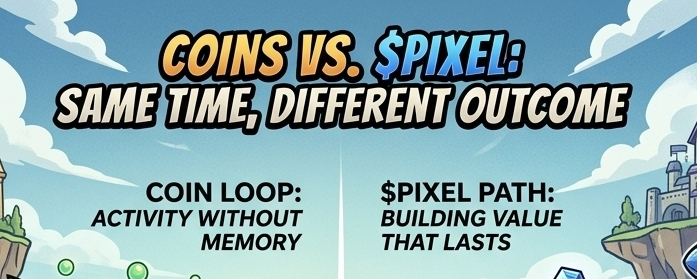
I never really questioned free-to-play games before 🎮
Most of them follow the same pattern. At the start, everything feels smooth and rewarding. Progress comes easy. But after some time, things slow down ⏳ Rewards drop, time increases, and that’s when spending money starts to feel like the only way forward 💸
It’s a system everyone already understands.
But doesn’t feel like that at first… and honestly, that’s what caught my attention 👀
You can spend hours in the game without even touching $PIXEL. You farm 🌱 earn Coins, and keep going in a comfortable loop 🔄 Nothing forces you to spend or upgrade. It feels simple and complete on its own.
But after observing it closely… something feels slightly off 🤔
The effort players put in doesn’t always match what they actually keep ⚖️
Coins are everywhere. You earn them, use them, and repeat the cycle. But they don’t really hold long-term value. They feel temporary.
It’s like activity without memory… you’re always moving 🚶♂️ but not necessarily building something that lasts.
Then there’s $PIXEL 💠
It doesn’t appear everywhere. Instead, it shows up in very specific areas—minting, upgrades, guild features 🏗️ places where your progress feels more permanent.
It’s not loud or forced. It’s just… placed differently.
That’s when it clicked for me ⚡
This isn’t about paying to progress faster.
It’s about deciding where your effort actually stays.
Two players can spend the same time in the game ⏳
One stays in the Coin loop—active, grinding, repeating 🔄 but temporary.
The other uses PIXEL occasionally—not heavily, just enough to make their progress stick 📌
At first, the difference isn’t obvious… but over time, it becomes clear.
It actually feels similar to how some systems separate activity from final results 🧠
You can do a lot, but only certain actions truly matter long-term. Pixels seems to follow that idea in a subtle way.
At first, I thought it was just another dual-currency system. But it doesn’t behave like one. There’s no pressure to use $PIXEL early on 🚫
You can ignore it for a long time… which is unusual.
Instead of forcing a gap, the game lets that gap grow slowly.
And that’s where things get tricky ⚠️
Most players don’t think this deeply while playing. They just follow what’s in front of them. If the difference between Coins and PIXEL stays unclear, many players might never move beyond the basic loop.
And if that happens…
PIXEL isks becoming disconnected from the majority of gameplay 📉
On top of that, supply keeps increasing 📊 Tokens get distributed, unlocked. If demand doesn’t grow at the same pace, pressure builds.
This has happened in other ecosystems before—even when the design itself was solid.
Still, there’s something very interesting here 🔍
If Pixels expands beyond its current gameplay, this system could become powerful. Coins stay local, handling daily activity.
But PIXEL could connect different parts of the ecosystem 🌐 acting like a bridge for long-term value.
That’s when it stops being just a game currency…
and starts looking more like infrastructure 🧩
But there’s also a concern 😅
If most players stay in the visible layer while real value builds underneath, then the system isn’t completely equal. It quietly favors certain behaviors—not through force, but through design.
I’m not sure if that’s intentional… or just how the system evolved.
What I do know is this: Pixels doesn’t force you to notice any of this 🤷♂️
You can play casually and never think about it. And maybe that’s why it works so well.
On the surface, it looks like a free economy 🌍
But underneath… it’s layered.
And in those layers, the same effort doesn’t always mean the same outcome.
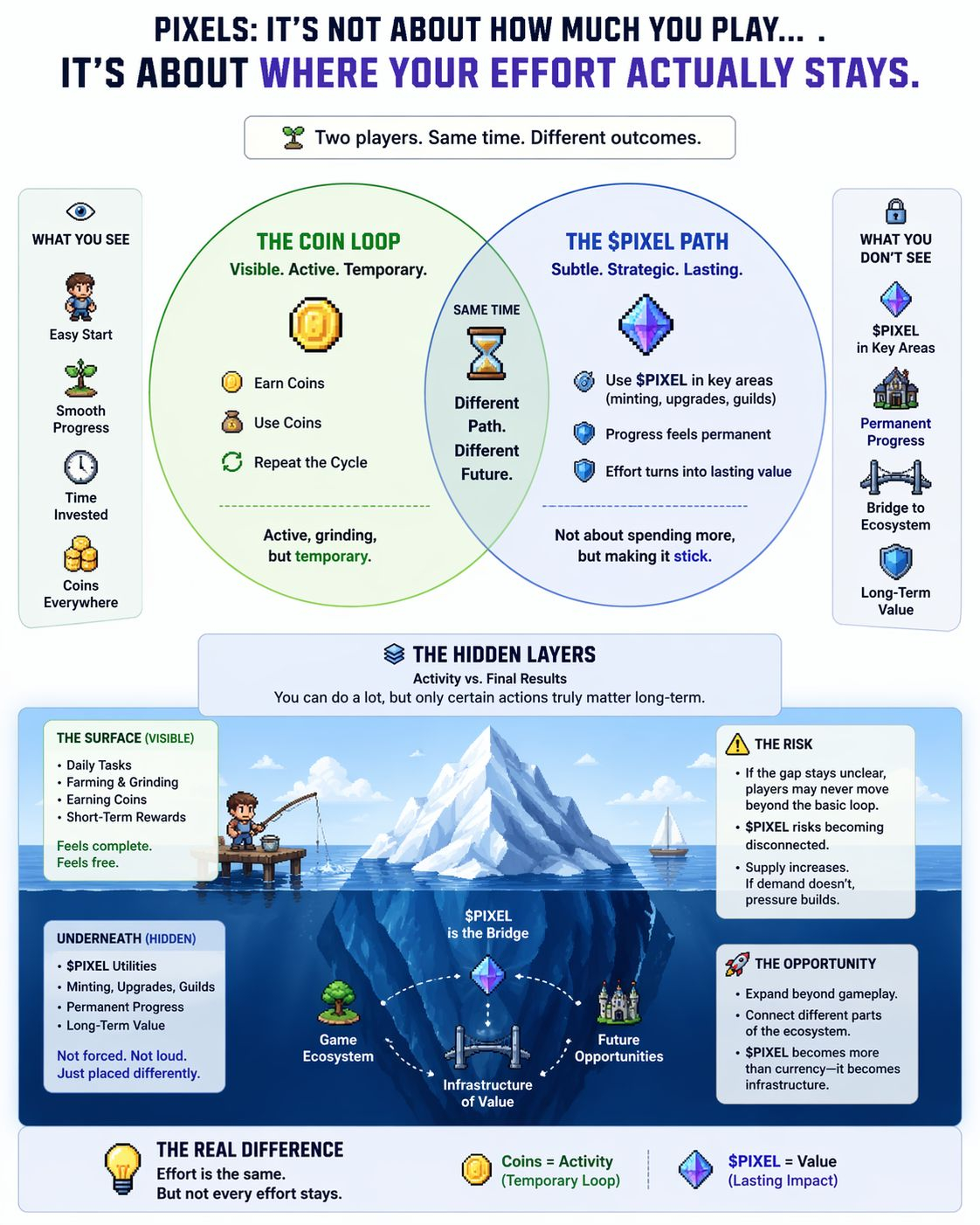
🔥 “In Pixels, it’s not about how much you play… it’s about where your effort actually stays.” 🚀$PIXEL #pixel @Pixels
