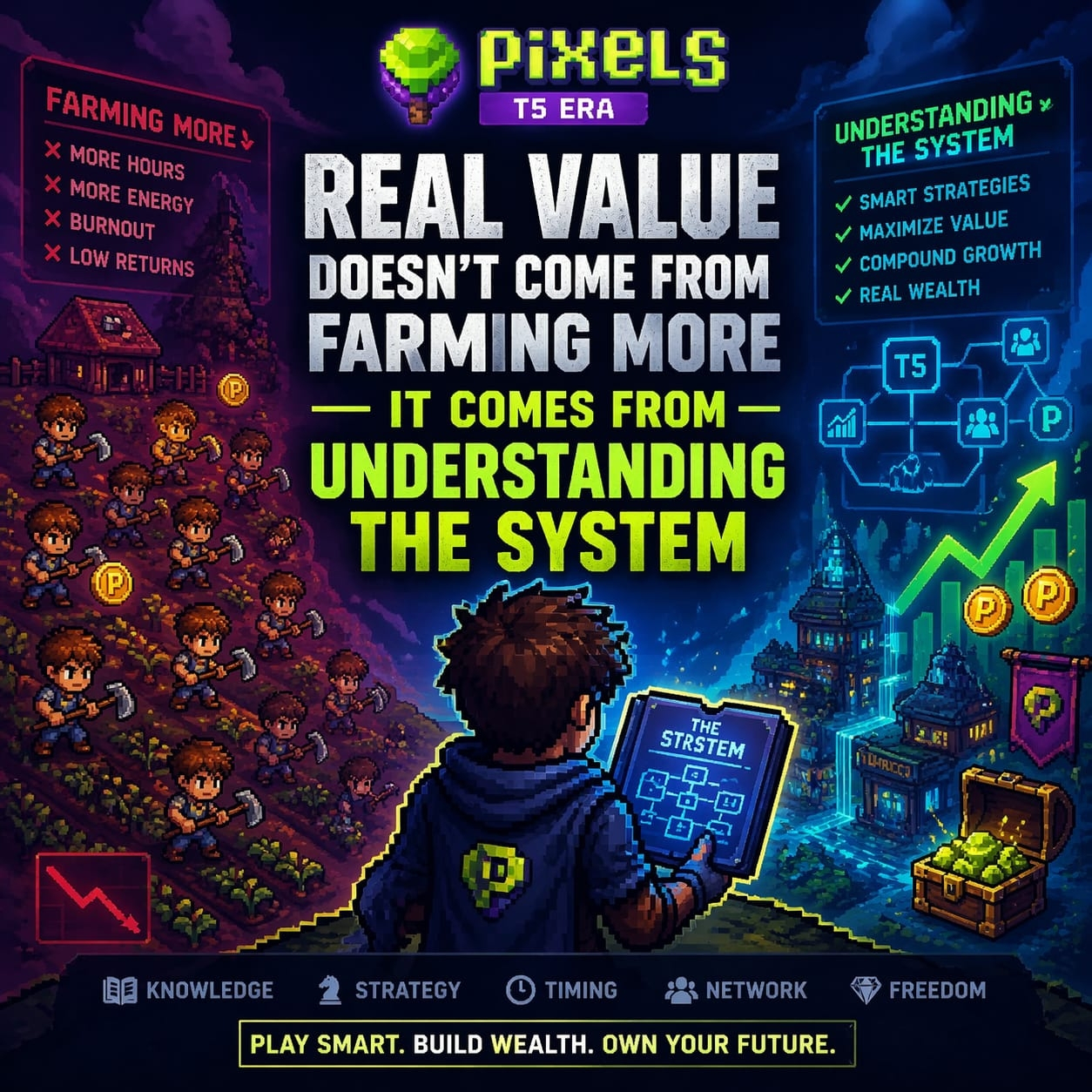
In every onchain game, the same question keeps coming back: who actually creates value?
Is it the players who grind the hardest and collect the most rewards? Is it the people who study every update, track every change, and move early? Or is it the smaller group that understands how the whole system fits together?
That question feels especially important in the T5 era of Pixels.
Pixels is no longer just a simple farming game where people log in, complete loops, and chase rewards. The ecosystem has become more layered. There is gameplay, token utility, player behavior, staking logic, and the wider structure connected to Stacked. That makes the economy more interesting, but it also makes it easier for people to misunderstand where real value comes from.
At first, many people assume the earners are the ones driving everything.
That idea makes sense on the surface. Earners are active. They spend time in the game, optimize routines, farm efficiently, and stay focused on reward opportunities. In any Web3 game, that kind of activity matters. It brings energy, volume, and attention. It keeps the economy moving.
But there is also a problem with relying only on earners.
If too many players are only there to extract value, the system starts to lose depth. The game becomes less of an economy and more of a reward machine. Once that happens, people stop thinking about participation and start thinking only about output. That kind of behavior can create activity for a while, but it rarely creates long-term strength.
Then there is the second group: the readers.
These are the people who pay attention. They read the updates carefully, follow the token design, notice where the ecosystem is moving, and understand that game economies change fast. In a more complex environment like Pixels, that kind of awareness becomes powerful. The player who understands the direction of the system often gains more than the player who just repeats the same grind every day.
Still, even that is not the full answer.
The players who create the most value are usually the ones who understand the game on a deeper level.
They are not just chasing rewards, and they are not just reading announcements. They understand behavior, timing, incentives, and structure. They know when to grind, when to hold back, when to reposition, and when a system is rewarding healthy participation versus short-term extraction. Most importantly, they understand that value in Pixels is not created by farming alone. It is created when gameplay, attention, and economic design work together.
That is what makes the T5 era interesting.
It is a test of maturity. Not just for the game, but for the players inside it. The biggest winners may not be the loudest earners or the smartest readers in isolation. They may be the players who can do both, while still understanding what makes a game economy sustainable in the first place.
In the end, real value in Pixels does not come from doing more. It comes from seeing more. The players who understand the system, not just the rewards, are usually the ones shaping the future of the ecosystem.