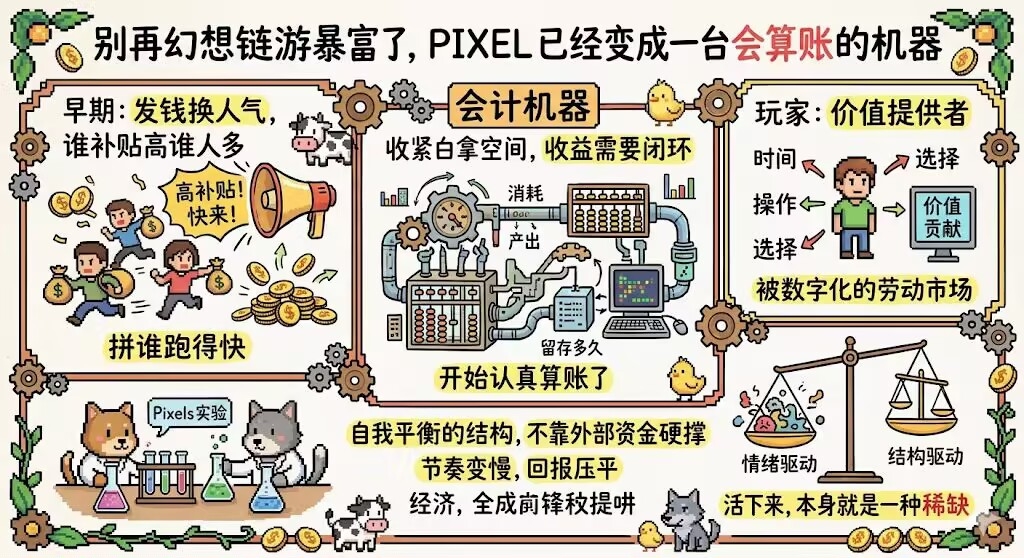
If you stay in this circle for a long time, you'll gradually realize one thing: most projects are actually telling stories. The bigger the narrative, the higher the expectations, and the faster the money comes in. But the problem is, once the story is told, or no one believes it anymore, what’s left is a mess. This is especially evident in the blockchain gaming sector; the earliest batch of projects essentially just gave out money to gain popularity. The one who subsidizes more has more people; everyone enters quite directly, taking as much as they can, and leaving once they’re done. In that phase, to put it bluntly, it wasn’t about playing games, but about who could run faster.
@Pixels In fact, I have also gone through that round. The early model of exchanging farming for returns is quite simple: the project party issues rewards, players take resources, and then the market picks up the slack. The scale was achieved, but the structure was empty; once people left, everything collapsed. But looking at $PIXEL , it is clearly no longer that way of playing. The most intuitive change is that it has started to tighten all free opportunities. You can earn returns, but the premise is that you must continue to participate, and you need to create consumption within its system; otherwise, it's difficult for the returns to close the loop. In plain terms, it has started to calculate seriously.
The rewards distributed in the past were not really concerned about whether they could be recouped, but now it’s different. Every action you take within it will be incorporated into a finer logic system, considering how much is produced, how much is consumed, and how long it is retained. These things are viewed together. It is not that it won’t let you earn, but it has to ensure that while you earn, you are also creating value for the system. This has kept many pure gold farming players out because the previous model of just taking without leaving anything behind is hard to establish in this new structure.
More interestingly, it has begun to redefine the role of players. You are no longer just someone who comes to take rewards, but more like a participant providing some kind of value. Your time, your actions, your choices will all be recorded by the system and then converted into different returns. This is somewhat like a digitized labor market; the more you do, the more you get, but the premise is that you must continue to exist and operate within the rules.
It sounds unexciting, even a bit cold, but this is precisely why it can survive. Many projects are still talking about the future, scale, and vision, but Pixels has already started doing something else; it is trying to turn the entire system into a self-balancing structure. Not relying on external funding to hold on, but instead maintaining itself through internal circulation.
This also means that there will no longer be sudden phases of getting rich. The pace will slow down, returns will be flattened, and it will be more of a long-term game. For some, this may seem boring, but from another perspective, it is rather an evolution. From the initial rough distribution of money to the current refined allocation, it is essentially a shift from emotion-driven to structure-driven.
Now I look at @Pixels , it feels more like an experiment. It is testing a very realistic thing: can an on-chain system survive without relying on constant blood transfusions? If this works, it may not be the hottest, but it will last the longest. And in this circle, being able to survive is itself a rarity.